AppExchange 2026: Top Apps, Hot Niches & Opportunities for ISVs
For Independent Software Vendors (ISVs), entering the Salesforce AppExchange marketplace isn’t a guaranteed win. Not at all. We’d say it’s rather a calculated gamble. Because in such a dynamic ecosystem, the margin between building an app that just exists and one that dominates rests entirely on your timing and focus.
Why does knowing the hottest niches, top AppExchange apps, and emerging opportunities matter so acutely? Because it helps you intelligently place your bets.
Seeing where the market is going allows ISVs to effectively target the massive SF customer pool. It accelerates both your time-to-market and go-to-market efficiency. Building into an underserved, high-growth niche on the Salesforce app marketplace minimizes your effort for market differentiation and ensures your monetization strategy has fertile ground to take hold.
In this article, we’ll examine the current market dynamics, uncover high-yield niches, and review the best Salesforce AppExchange apps. Plus, you’ll get insights on how to develop an app for AppExchange to secure your market leadership.
Salesforce AppExchange Marketplace Overview
AppExchange continues its vigorous expansion. And although the environment itself is perpetually shifting, its growth presents tremendous opportunities for scaling your business.
Read Also: Salesforce AppExchange Trends and Strategies for ISVs in 2025
Let us note here how the shifts shape what it now takes to build apps for AppExchange: creators must adapt quickly to new expectations, new revenue mechanics, a sharper focus, and clearer value.
Strong Market Pulse
In 2025, the number of apps on Salesforce AppExchange grew to over 9k – many ISVs see it as a key launchpad for their applications. Plus, among the SF customers, almost all (91%) use AppExchange apps to extend and fine-tune their Salesforce setup.
Shifting Monetization Models
Тhe free app category has still been a strong entry point. At the same time, the prevailing monetization strategy is evolving toward refined freemium and consumption-based pricing. AppExchange ISVs are moving away from simple paid listings to models that reward value delivery. This trend compels developers to show quick ROI to secure their ongoing incomes.
Saturation & Visibility Challenges
The dynamics of the platform’s development mean that it takes some effort to find yourself among the top Salesforce AppExchange apps – discoverability is getting harder. Around 50% of listed apps have 0 reviews, and only a small fraction receive significant review counts. Plus, changes in the Partner programs and even stricter quality/security gating make “just another app” unlikely to succeed without real differentiation or reliability.
That’s why, now, security reviews, customer success stories, investment in marketing and early-adopter traction become critical.
AI Platform Segregation
Another structural change is the separation of specialized AI tooling. SF is pivoting many AI-first capabilities, particularly those concerning advanced agent-based automation and interactions with customers, onto the Salesforce AgentExchange marketplace. Growth of the latter has been rapid: from about 55 apps at launch to 122 by October 2025 – with over 100 unique developers participating.
Given the ongoing trends, what awaits the SF platform next, you ask?
Trends & Fresh Opportunities in 2026
As the whole ecosystem evolves, the Salesforce Agentforce marketplace we mentioned earlier hasn’t arrived by accident. It reflects a clear shift towards specialized AI engines, the needs for deeper automations with more cohesive cross-cloud coordination.
So, we all can expect:
- Demand for AI, automation, agentic workflows, and cross-cloud integration will gain momentum. The best Salesforce apps will lead the pack by uniting multi-cloud data, using AI-enhanced analytics, and offering plug-and-play deployment.
- There also remain white spaces – underrepresented segments like cross-cloud ERP, niche verticals, or lightweight but deeply specialized add-ons. If you target those, you can satisfy unmet buyer needs.
At the same time, we recommend – as always – keeping a close eye on new SF platform investments, especially if you’re building or scaling as Salesforce ISVs. Because money leads, innovation follows.
Plus, buyer expectations also keep moving. They move toward faster results and cleaner operational flows. On the other hand, tech waves like AgentExchange automation and AI-led orchestration can reshuffle priorities quickly, too.
As we like to say at our company: “Stay alert, not comfortable.” It has become a competitive edge.
Need guidance in these shifts? Reach out to Synebo. As Salesforce AppExchange partners, we can help you build, scale, and position apps that always stand out.
Niche Primed for Perfect Growth in 2026
Many SF customers now treat top AppExchange apps as their core software, not side utilities. They prefer solutions that cope with their narrow problems and show value without heavy onboarding.
Meanwhile, if you are planning to create an app for AppExchange, 4 niches are starting to pull ahead. They offer you a high-potential area and put you in far more advantageous conditions from the outset. We’ve complemented each niche with the Salesforce AppExchange apps examples that are already on the market – a spark of inspiration for your 2026 decisions.
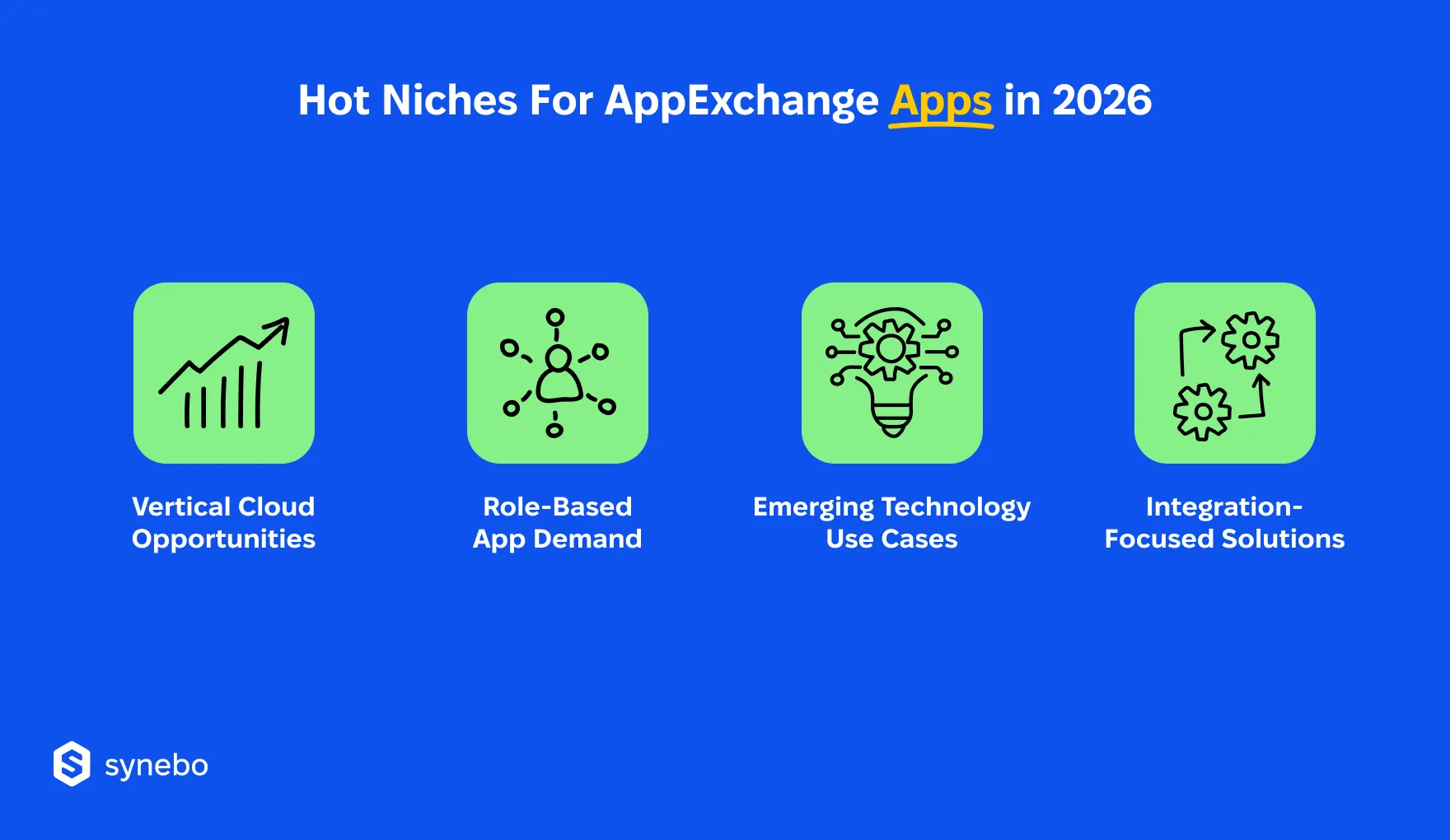
Vertical Cloud Оpportunities
Prime domains: Finance, Healthcare, Nonprofit
Buyers in any vertical lean toward tools that echo their terminology and understand their everyday work. General CRM features rarely persuade – say – financial analysts or healthcare providers. Instead, those Salesforce AppExchange (and third-party) apps that are mapped to their regulatory limits, compliance workflows, and audit expectations move to their shortlist quickly.
Why this niche will expand in 2026:
- Industry KPIs differ, so dashboards and workflows need specialization
- Regulated sectors prefer tools already proven inside their vertical cloud
- Compliance workloads require automation more than generic productivity boosts
Illustrative examples of vertical traction:
- nCino. This Salesforce AppExchange app is widely used by lending and financial services. It offers a suite of solutions for commercial, small business, consumer, mortgage, corporate, and treasury operations – backed by products for onboarding, account opening, portfolio analytics, and incentive management.
- Сloudbyz eClinical. This native SF solution for healthcare and life‑science teams enhances Health Cloud with end‑to‑end clinical workflows. It wraps up CTMS, EDC, safety tracking, supply management and regulatory reporting into a single environment. Providers gain unified dashboards, built‑in audit trails, and pre‑compliant workflows designed for highly regulated settings.
- Certinia Financial Management Cloud. This one is among the top AppExchange apps for finance-driven nonprofits who need control over grants, budgets, and program spending. Built natively on SF, it unifies revenue, expenses, approvals, and audit-ready reporting. Its users get structured financial operations, clean handoffs between Depts, and a unified financial view that meets standards in regulated or donor-funded sectors.
- When founders explore how many apps are on Salesforce AppExchange in an industry category, they immediately see gaps. Financial compliance, healthcare handoffs, nonprofit grant life cycles – these remain promising spaces for top Salesforce apps that give straightforward guidance without bulky configuration.
Role-based apps
Prime roles: Admin, RevOps, Marketing
You’ve probably seen this earlier here and also in other articles in the blog, but we’ll definitely revisit it – it’s worth noting: Interest in role-focused products is rising. Buyers are moving away from broad utility tools that cover every stakeholder.
Instead, top apps on Salesforce AppExchange now concentrate on a specific seat in the company: the admin working late on security tasks, the RevOps analyst chasing pipeline accuracy, the marketer measuring revenue impact.
Why role-focused solutions close deals faster:
- Because one user group brings quick adoption
- Interfaces usually stay lean – this offers less noise for first-time users
- Support cycles shrink because the feature set is narrower
Worthy examples in the niche are:
- Conga Composer SF Connector. One of the best AppExchange apps, it helps create, merge, and distribute documents (invoices/proposals/contracts) from SF records. It keeps branding and data consistency intact. Its API lets you embed doc generation anywhere and handle complex content. It syncs with CPQ, CLM, and other business processes.
- Rollup Helper. The Salesforce AppExchange app helps SF admins to overcome rollup limitations. It processes millions of records and creates complex filters without code – supporting validation rules, flows, and formula fields. The рopularity of this app proves that simple data tasks still need practical tools.
- Adobe Marketo Measure. It captures every buyer interaction, online and offline, and so gives marketers full visibility into opportunities and accounts. Its AI- and rules-based attribution highlights pipeline, revenue, and ROMI and turns data into decision-ready insights.
- Permission Set Manager. This Salesforce AppExchange app by Synebo helps SF administrators and revenue ops crews manage user access – efficiently. With it, they can assign, copy, or adjust permission sets in bulk, apply filters to select users, and automate updates for role changes. Its focused, role‑specific design keeps permissions consistent and simplifies security governance.
These examples show why the best AppExchange apps for Salesforce no longer aim for blanket coverage. Their focus brings loyalty, and role-based logic turns these products into an essential part of someone’s daily work.
Emerging Technology Use Cases
Prime drivers: AI, automation, compliance tooling
In 2025, AI is everywhere. But its effectiveness depends on where you apply it. Potential buyers request predictable outcomes.
So, the strongest Salesforce marketplace apps using AI address productivity, call handling, data privacy, and message automation – without forcing users to redesign their workflows.
Why emerging tech stays hot:
- AI performs well when it’s powered by solid, well-kept CRM data
- Compliance pressure pushes companies toward automation with audit trails
- Predictive hooks impress finance, support, and RevOps departments
Concrete examples:
- Talkdesk for Salesforce. This top AppExchange app equips call centers with wise routing and auto agent help. Its omnichannel capabilities and embedded reporting (both real-time and historical) show the entire scope of phone and SMS interactions and help teams manage work efficiently in different channels.
- ValueText (SMS + WhatsApp + AI Chatbot). This AppExchange application brings into SF messaging and automated resроnses. It boasts АІ chatbots, automated workflows, detailed dashboards, and top-tier compliance. These capabilities facilitate engaging audiences, preserving protected, customized messaging. Plus helps evaluate performance.
- Cloud Compliance Privacy Center. This solution’s place among the top AppExchange apps is earned. It lets you handle enterprise compliance inside SF – using pre-configured templates to simplify GDРR, ССРА, НІРАA, and more. With APIs for 3d-party integration, it keeps data on-platform, reduces reliance on homegrown solutions, and makes compliance more flexible, reliable and quick.
The applications we mentioned here well illustrate how top AppExchange apps deliver just practical automation, not giant AI claims. Predictive case handling, messaging triggers, and regulation checks represent productive slices where the best AppExchange apps earn solid recurring money.
Integration-Focused Аpps
Prime integrations: Finance, Content, Payments, Cross-cloud data
Any CIO can probably relate: endless integration headaches are the reason devs lose their sleep. Many companies still rely on a patchwork of flimsy connectors. Products that solve one integration issue remain high-priority items across the AppExchange Salesforce apps market.
Why integration solutions will also drive the agenda:
- Faster audits demand unified data in multiple clouds
- External systems keep multiplying; this raises АРІ and security pressure
- Finance Depts expect reliable billing, payment, and accounting data inside CRM
Examples from the Salesforce app marketplace that rank well:
- CloudFiles. The app links SharePoint, S3, Google Drive, or Azure file storage with SF records. When using it, all docs live outside SF storage yet remain visible inside. The solution simplifies content organization, folder structure, and file access. Plus – preserves security and reduces CRM storage costs.
- Chargent Payment Processing. Another example of the top Salesforce apps that lets users collect payments in SF. It automates repeat billing and recovers missed or late payments. With its dev tools, multi-currency support, and analytics, it helps enhance payment efficiency and improves cash flow.
- Accounting on Salesforce. In this solution, the AppExchange ISV focused on creating an SF-native accounting system that removes the need for the 3d-party connectors or sync tools. Integrated AR and AP speed up reconciliations and make bill payments painless.
These integrations remain some of the top apps on Salesforce AppExchange because they keep security and shorten audits – two topics that always score.
So, success among AppExchange apps now favors specificity. If you study vertical requirements, roles, emerging automation patterns, and integration problems, you can find gaps that still lack focused solutions.
We’d also like to add here that the most sustainable app ideas today may look narrow on paper. But they solve problems that larger vendors overlook. In 2026, the strongest opportunities will go to those who focus on a single niche and explore it deeply.
Want to turn niche opportunities into a top AppExchange app? Tap into Synebo’s AppExchange app development services and get our expertise to build, scale – and win.
Building Apps for AppExchange? Your Strategic Steps in 2026
AppExchange matures. As we’ve seen above, simply listing a functional application is insufficient for your sustained growth and scaling. To become a market leader, you need a focused strategy that leverages the platform’s mechanics and anticipates buyer psychology.
The following strategic moves stem from the hot trends, niches, and opportunities, and are essential for any Salesforce ISV who plans to achieve profitability in 2026.
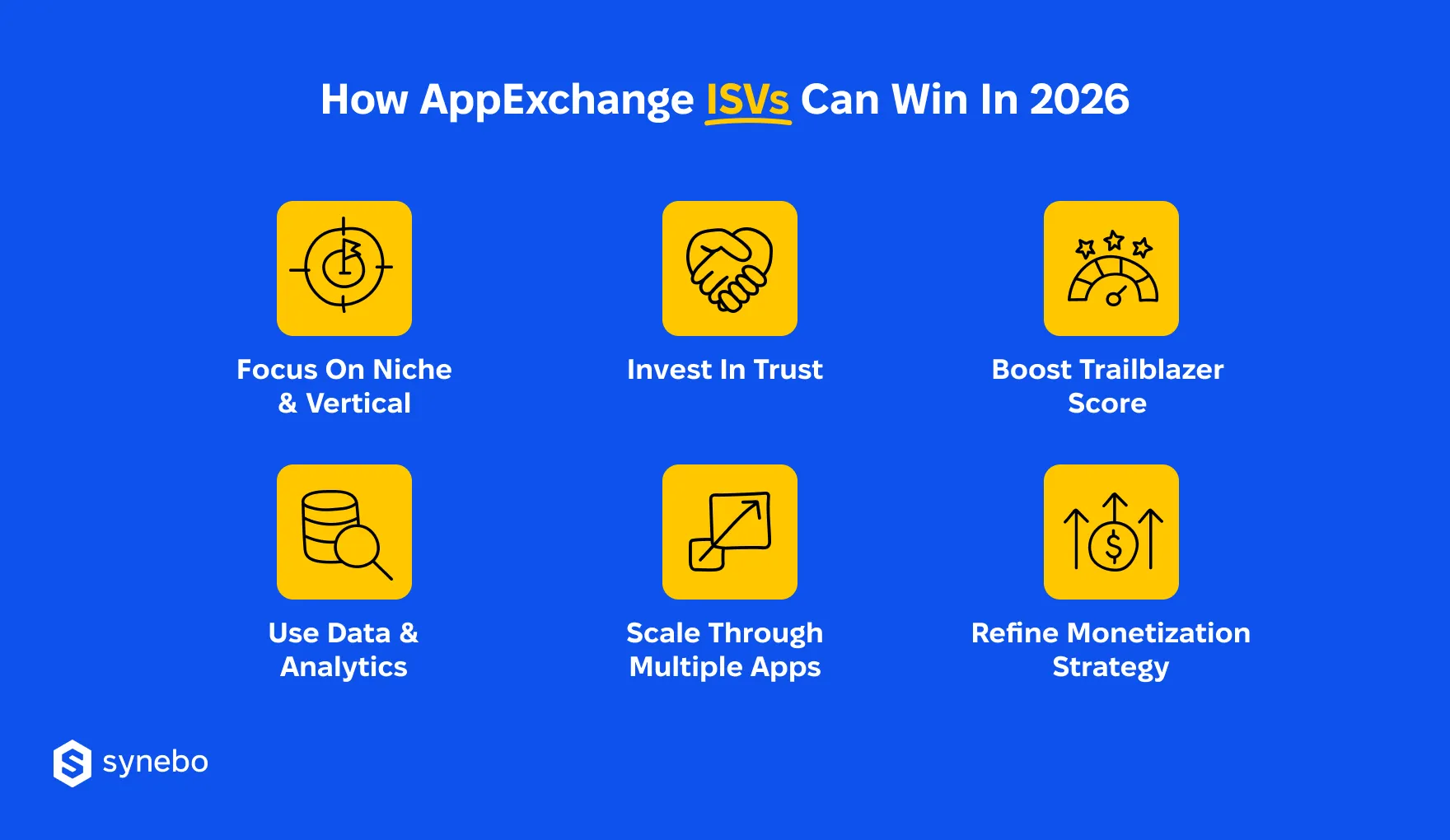
1. Go Deep, Not Broad
We recommend avoiding direct competition with generalist offerings or SF’s core capabilities. Your best path to market is to reach high functional density in a very specific, underserved vertical or role. This approach drastically improves your time-to-market efficiency and has the potential to position you as the definitive solution for that niche.
2. Invest in Trust Signals
When a marketplace is quite saturated, trust is a high currency. If you build an app for Salesforce AppExchange, prioritize security certifications, maintain top product quality, and actively encourage user reviews. These elements directly correlate with higher visibility. If/when you have a strong trust portfolio, it validates your solution and distinguishes you from your competitors.
3. Master the Partner/Trailblazer Score
SF uses this mechanism – Trailblazer Score – to gauge your health and contribution to the platform. We recommend that you improve this score via certs, revenue generation, and customer success – it influences your access to internal resources and your go-to-market opportunities. Treat the score as a business metric that proves you are a reliable Salesforce ISV partner.
4. Utilize AppExchange Analytics
Тo understand how leads/customers find your listing, what features they engage with, and where they drop off, use AppExchange Marketplace Analytics. After analysis of your listing performance (views, installations, conversion rates, so on) you can improve your description and attract quality users faster.
5. Consider Multi-App Strategy
If your resources permit, focus on building AppExchange apps that complement each other. A suite of targeted tools can diversify your offerings, deepen customer reliance on your products, plus – importantly – expand the total market you address within a single account.
6. Refine Your Monetization Strategy
Your success will demand a pricing model that reflects the value your product provides. When you develop an AppExchange app, analyze the economics of your offering. Pick a monetization model (per-user, usage-based, freemium) that reflects your customer’s gains. We advise balancing free entry points with paid features. This supports quick adoption and overall strengthens the performance of your listing.
The next generation of successful AppExchange ISVs will be those who operate with the mindset of strategic specialists. By deeply embedding your solutions within high-growth verticals and taking a careful approach to the SF operations and buyer trust, you establish a fortified position for years.
From Idea To AppExchange Leader
The AppExchange in 2026 will not reward the timid. Іt will favor the calculated specialist. The current AppExchange Salesforce apps market signals are unambiguous. Success smiles on those who go deep into vertical clouds or cater to specific, powerful user roles. And if we sum up everything said above, the challenge is not finding space, but knowing precisely where to build.
The market requires architects, not tourists.
If your strategy needs refining, or if you are preparing for Salesforce AppExchange app development, we can advise working with an experienced AppExchange app consulting company. Our clients say this helps them skip the trial-and-error and save their time and effort.
So, hire an AppExchange app developer at Synebo to turn your insights and current trends into a robust, high-performing solution – accelerate your journey to profitability.