What Is Agentforce? How AI Agents Are Reshaping Business
The article was updated on June 2, 2026
In 2026, Salesforce Agentforce is not a traditional automation. SF now positions Agentforce as an operational AI layer. Its autonomous AI agents can evaluate business context, launch and coordinate workflows, complete multi-step tasks with limited human involvement. So, instead of working like another chatbot attached to your SF records, in 2026, Agentforce AI operates inside your business processes – quite independently.
The shift isn’t subtle. It shows up in various data. Salesforce reported more than 18.5k Agentforce deals globally by late 2025. It includes 9.5k paid deployments. And production usage grew 70% quarter-over-quarter. In early 2026, SF also confirmed that more than 180 organizations adopted Agentforce IT Service during 4 months after general availability.
So if adoption is accelerating this fast, the next logical question is simple: what can Agentforce do in 2026? How does Salesforce Agentforce work behind the UI? And why are so many companies building around it? Let’s unpack it.
What Are Core Agentforce Capabilities in 2026?
What are the main features of Agentforce now? These are autonomous AI agents, Agent Builder, Atlas Reasoning Engine, multi-channel engagement, integration with Data 360 (Data Cloud), workflow automation, secure actions throughout Salesforce and external systems.
However, to grasp how Agentforce works in 2026, I recommend that we look at it through 3 layers: business value, architecture, and a broader SF strategy.
First, let’s discuss what you may care about the most: what value can Agentforce bring to your company today?
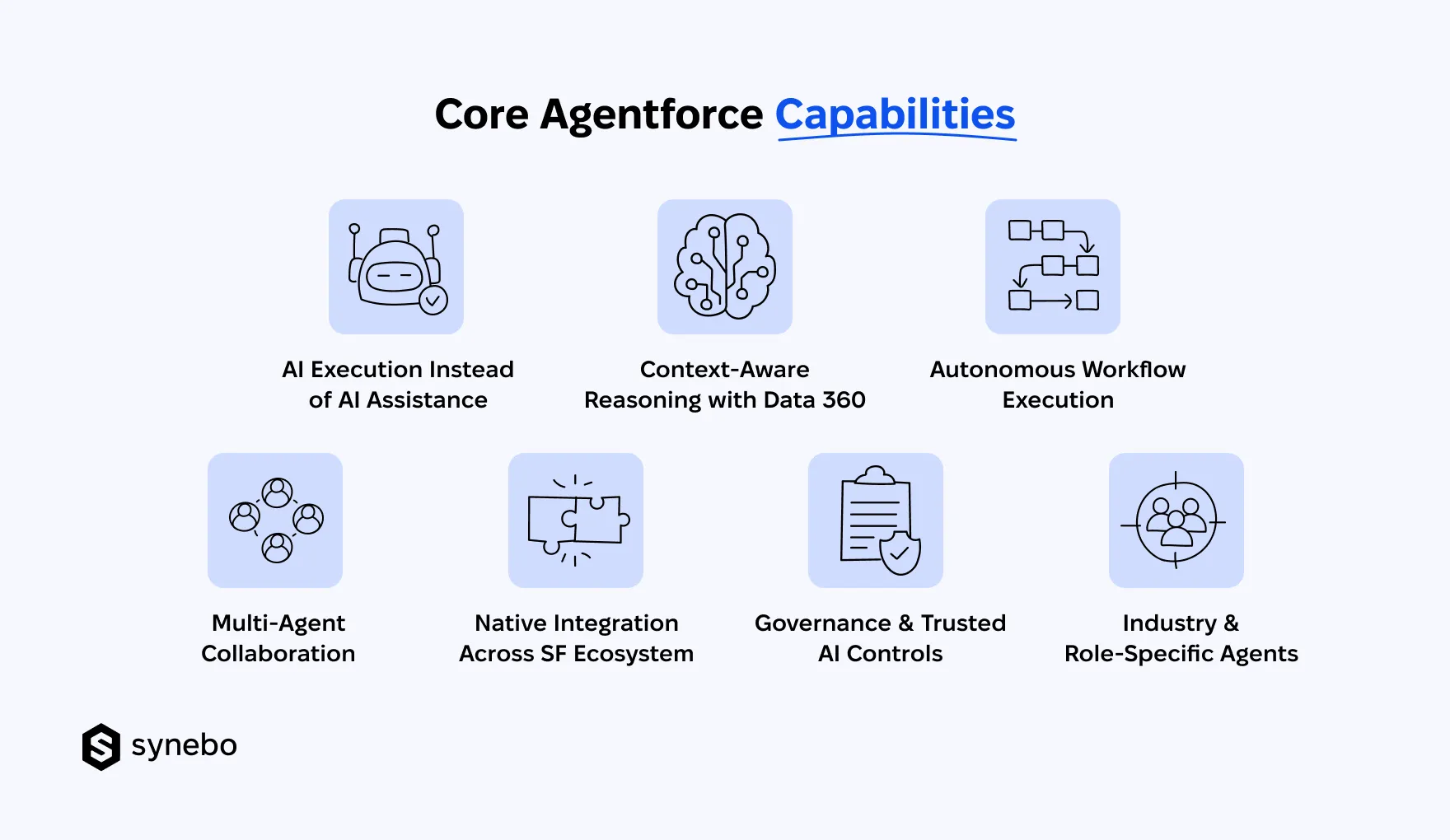
1. Gets Work Done Instead of AI Assistance
Older AI tools behaved like passive assistants. They waited for instructions. Agentforce agents can initiate actions, complete operational sequences, automatically handle record updates, escalate exceptions, coordinate activities. And they do it all absolutely independently. So, in 2026, operational work no longer depends fully and only on employee input.
2. Understands Full Context
One of the strongest Salesforce Agentforce AI capabilities is contextual reasoning. Agentforce AI – before it makes decisions – evaluates info from CRM objects, Data 360 profiles, your Slack talks, analytics layers, permission models, service history, external platforms your setup has linked. This awareness betters prioritization, customer interactions, internal routing, workflow timing. Many frequently underestimate how heavily context influences agent behavior today.
3. Runs Full Workflows on Its Own
Our experience shows that many executives still assume that AI mainly generates summaries or replies (i.e. texts). In practice, Agentforce AI agents manage operational flows that previously required many employees and even separate systems. For example, а single Agentforce service agent may process support requests, verify entitlements, trigger approvals, update tickets, notify departments, hand off tough situations. Again: independently and automatically.
“Such expanded Salesforce Agentforce capabilities explain why many companies now assess AI through efficiency metrics,” notes my colleague, Yana Chekan, Head of Delivery at Synebo.
4. Works Together with Other AI Agents
In large companies, one AI layer usually isn’t enough. Different AI agents specialize in service operations, analytics, employee support, sales coordination, compliance reviews, or commerce workflows.
A Salesforce Agentforce Service agent may supervise service operations. An Agentforce Sales agent manages leads, qualifies opportunities, and moves deals through the pipeline. Agents may analyze account risk, prep recommendations, launch operational actions, and so on. What’s more, these systems collaborate and complete larger business processes.
5. Fits Right into SF Ecosystem
How does Agentforce integrate with existing Salesforce workflows? Agentforce integrates with existing Salesforce workflows by connecting AI agents to Flows, Apex, Data 360, CRM data, and 3rd-party systems.
Overall, а key reason behind growing Agentforce adoption is ecosystem connectivity. Because today, many want AI embedded directly into their operational systems that employees already use. And Agentforce Salesforce integration supports interactions with SF apps, Slack, analytics environments, MuleSoft integrations, partner platforms, plus your external tools.
6. Stays Controlled by Built-In Governance
AI adoption always raises concerns around security. Modern Agentforce implementation solutions considerably depend on governance layers to keep things under control.
Сontrolled access, action logs, paths for complex cases, approval logic, built-in guardrails, and human review mechanisms are now at the center of many deployments. (For many executives, governance influences vendor selection as much as automation capabilities themselves).
Read Also: Synebo’s Commitment to Salesforce Security: ISO 27001:2022 Re-Certified
7. Uses Ready-Made Agents for Specific Sectors
SF continues expanding libraries of prebuilt Agentforce agents for different industries and business functions. Financial services firms, healthcare providers, retailers, manufacturers, support companies have now AI skills designed for their specific workflows.
Such industry focuses also reshape the market for specialized Salesforce Agentforce implementation services and Agentforce consultants who set up agents around operational needs, not generic AI use cases.
I can just add that, as Salesforce CEO Marc Benioff recently revealed, Agentforce has processed tens of trillions of tokens and crossed $1 bln in ARR this year. So, the market is clearly moving beyond AI assistants. It moves toward operational AI systems that execute real work.
Read Also: AI in Salesforce: Use Cases for Smarter Sales, Support, and Marketing
How Does Salesforce Agentforce Work? Architecture Behind AI Agents
Agentforce combines AI reasoning, your enterprise data and business workflows, plus secure actions and enables autonomous agents that can understand your requests, make decisions, and complete tasks.
We’ve probably all moved past the stage when we asked AI to simply generate a piece of text for us. The question in 2026 is absolutely operational: How does Agentforce integrate with other Salesforce products? How does AI coordinate decisions? Execute work inside the enterprise infrastructure?
This is where Agentforce becomes far more technical. And far more interesting.
So, here is how Agentforce works – in detail.
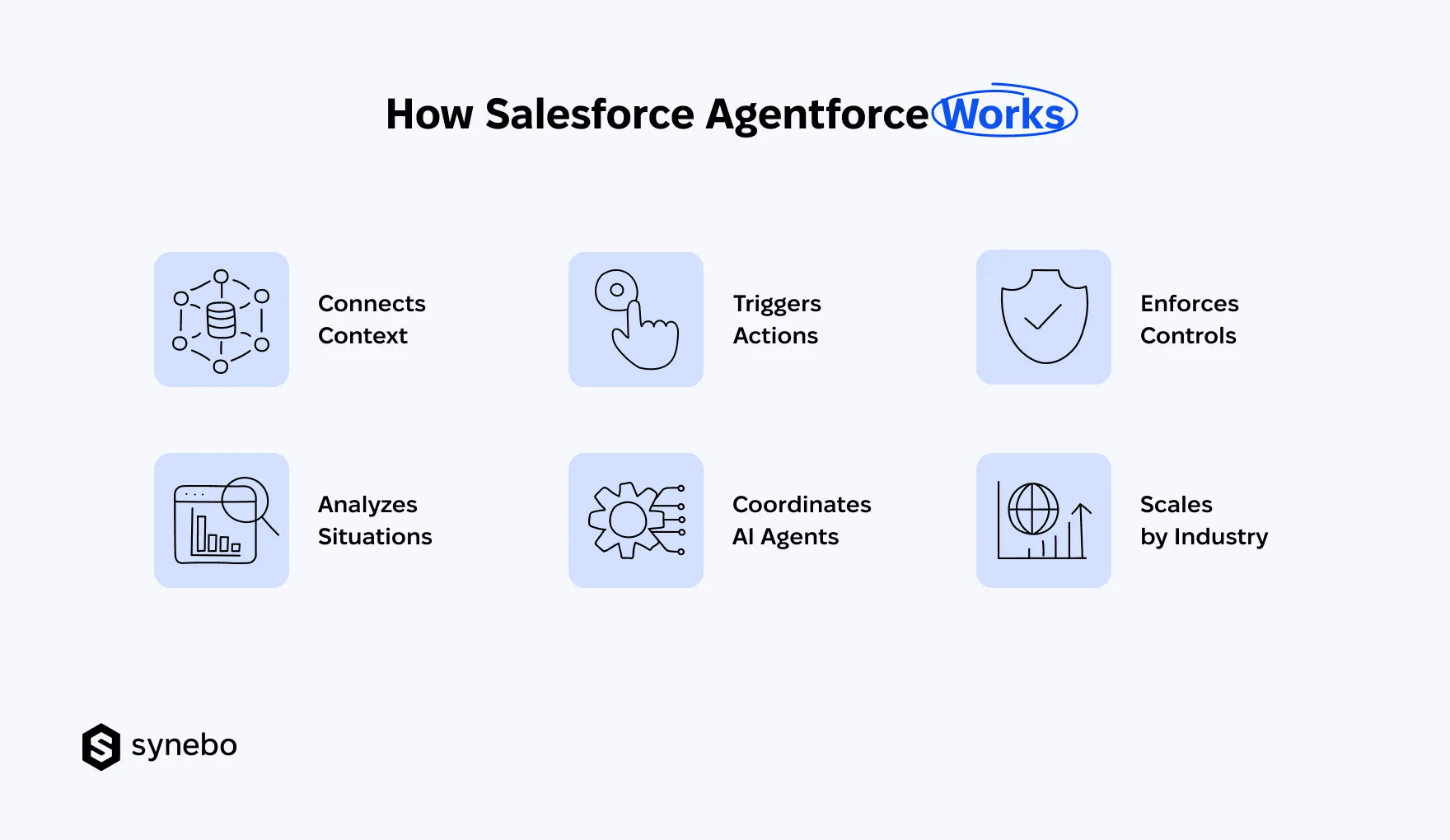
1. It Builds Unified Context Layer Through Data 360
Agentforce operates on top of Data 360 (it serves as a foundational context layer). Instead of treating CRM records, analytics signals, live chats, external inputs as separate sources, the platform consolidates them into a single operational context.
This context is continuously refreshed at runtime. This enables Salesforce Agentforce to interpret relationships between all data points. What’s more, this creates a full-picture understanding of the enterprise environment during execution.
2. It Turns Context Into Decisions Through Execution Logic Layer
Once context is assembled, Agentforce moves into a decision layer where it interprets intent, evaluates constraints, and determines the next operational step.
To validate potential actions before execution, this layer applies business logic, permissions, policy rules. It defines, in fact, “what should happen next” before anything is triggered.
3. It Converts Decisions Into Cross-System Execution Flows
Execution in Agentforce is not limited to a single application. Instead, decisions are translated into execution flows that embrace many systems. One of Agentforce’s key strengths is connecting workflows between platforms that traditionally stayed siloed.
The platform interacts with SF applications and all those tools/platforms I mentioned – analytics tools, MuleSoft integrations, Slack workflows, different external services – through action interfaces. These are not isolated API calls, but coordinated execution steps that preserve continuity in the workflow.
Read Also: Salesforce in Slack: Why It Is More Than Just an Integration
4. It Operates as Multi-Agent Execution System
Agentforce is not a single monolithic layer. It’s a distributed system of specialized autonomous AI agents. Each agent is responsible for a specific domain, such as service, sales, or analytics.
What defines Agentforce architecture is the coordination between the AI agents. Agentforce agents move tasks between each other and delegate them. Plus, they keep everything in sync. Such coordination lets work flow across functional boundaries. And your staff isn’t involved.
5. It Embeds Governance Directly Into Execution Path
Governance in Agentforce is not a separate layer. It is embedded directly into execution. How? Before execution, every action is evaluated against permissions, policies, compliance rules.
The system also maintains the auditability of the agent decisions. Plus, it supports human oversight when it is necessary. So, even when execution becomes more autonomous, it still keeps automation controlled.
Read Also: How to Keep Salesforce Data Secure in AI-Driven Orgs
6. It Extends Execution Through Industry Agents
In addition to core architecture, Agentforce boasts a growing ecosystem of prebuilt agents – for specific industries and business functions.
These packaged AI agents reduce the need for custom configs. They provide ready-to-use execution patterns for sectors such as financial services, healthcare, retail, and support. So, you can extend your architecture faster and don’t have to rebuild your core workflows from scratch.
Planning to move from AI experiments to enterprise-grade execution with Agentforce? As experienced Agentforce implementation experts, Synebo can help you design, integrate, and scale AI agents inside your SF environments. Partner with us.
Why Is Salesforce Moving Toward Agentforce-Centered Ecosystem?
- Shift From Clouds to AI Operational System. For years, SF products handled separate business functions (sales, service, marketing, analytics, commerce). In 2026, Salesforce Agentforce pushes the ecosystem toward operational coordination, where AI agents execute tasks between your Depts and don’t remain inside isolated apps.
- Breaking Away From Silos. Older architectures put and kept client data, approvals, communication history, analytics, workflows into separate environments. Autonomous AI agents can’t function well inside fragmented systems. They require operational context, which helps them assess situations, prioritize actions, coordinate enterprise activities.
- Data 360 – Operational Context Layer. Data 360 increasingly acts as the strategic context engine behind Salesforce AI Agentforce execution. Instead of storing customer info just for reporting, SF treats the whole context as operational fuel for AI-driven decision-making, task execution, and system-wide coordination.
- Slack & Integrations Become Infrastructure. Slack, analytics products, MuleSoft integrations, platforms you have connected – all support Agentforce AI operational logic. The systems no longer function as standalone tools. In the broader ecosystem, they help agents exchange context, trigger actions, route approvals, coordinate processes.
- Agentforce – Enterprise Execution Layer. The long-term SF strategy now can’t center purely on connecting software products together. Agentforce acts as the layer that coordinates workflows, automation, enterprise actions, and AI-driven execution – throughout the whole ecosystem.
As my colleague, Anatoly Voronov, CTO at Synebo, says, this strategic direction explains why many companies now ask us, “What are the main features of Agentforce?” and how to use Agentforce in Salesforce to move to autonomous execution. The momentum is hard to ignore, I’d say. Тhe fresh SF report proves that Agentforce recently delivered 3.8 bln agentic work units across the platform and showed 111% growth Q/Q.
How to Use Agentforce In Daily Operations?
Customer Service Operations
- Resolve Cases. Fast. The Salesforce Agentforce Service agent workflows summarize cases, retrieve customer history, and overall coordinate actions between Support team members.
- Route Escalations Automatically. Agentforce agents separate critical requests from routine ones. Then route them for immediate attention.
- Support Multilingual Communication. Global companies use Agentforce AI for multilingual interactions with customers/buyers and localized service workflows.
- Better Efficiency. SF recently reported that AI agent adoption inside service firms rose to 66% (from 39%) within a year. And 70% of the companies that have deployed AI service agents saw concrete operational value within 60 days.
Sales & Revenue Execution
- Qualify Leads. The Agentforce Sales agent workflows automatically help sales teams prioritize leads and spot strong revenue opportunities.
- Coordinate Follow-Ups. Salesforce Agentforce reminds you when to reach out to clients and so helps keep your deals moving.
- Support Forecasting Decisions. Autonomous AI agents detect early signs of pipeline slowdowns. Then they highlight at-risk opportunities.
Internal Operations & Employee Workflows
- Handle Employee Onboarding. Agentforce also helps you coordinate onboarding tasks, approvals, your internal doc flows.
- Automate Internal Requests. At Synebo, we see that many companies use Agentforce agents for scheduling, support tickets, policy routing, and process coordination.
- Lower Admin Pressure. Many other companies offload their repetitive internal operations to Agentforce. This way, they free their people from routine jobs and allow them to focus on more meaningful work.
Commerce & Customer Engagement
- Make Interaction with Customers/Buyers Truly Individual. Retail and Commerce units/teams use Agentforce for better-timed communications. And more relevant tips and offers.
- Coordinate Interactions with Customers/Buyers. AI agents synchronize communication between support, commerce, plus marketing environments.
- Support Growth of Revenue. SF reported here that AI-driven experiences influenced roughly 20% of the global holiday online sales activity during the 2025 season.
Decision Support
- Detect Operational Anomalies. Agentforce capabilities increasingly include anomaly detection tied to operational and customer activity.
- Generate Operational Summaries. Strategists use Salesforce Agentforce AI capabilities for workflow summaries – yes – and also insights on business activities.
- Recommend What to Do After. Knowing the full context, Agentforce highlights the most relevant actions. From tactical steps to higher-level decisions.
Anticipating your question, “What industries benefit most from using Agentforce?”, my short answer is: any. Because it adapts to enterprise context, workflows, and data. Not a specific industry setup.
Exploring where Agentforce can create the biggest impact for your business? As a Salesforce Agentforce implementation partner, Synebo can help you launch an AI agent that fits your workflows, governance models, and ambitious goals. Contact us.
How Synebo Helped Software Company Reduce Routine Support Work by 60%
An AI software company approached us with a very specific operational problem. Their support teams spent too much time on handling repetitive requests from customers and switching between different disconnected systems during case resolution.
The company wanted to build a more autonomous support environment. They wanted the one where routine operational work could move away from human specialists.
How We Helped
The Synebo Agentforce specialists developed a custom Agentforce AI agent that could resolve standard support requests autonomously through connected APIs, operational workflows, and decision-based logic. We also used Agentforce Salesforce integration capabilities to connect previously disconnected support systems into one centralized operational flow.
What Was the Outcome
After the Salesforce Agentforce implementation:
- Routine support tickets handled by employees dropped by 60%
- Response times improved by 40%
The support specialists got free time and could switch their attention to other – more valuable – interactions with their customers.
Read the full case study to learn how these results were achieved.
Planning Your Agentforce Strategy?
So, in 2026, Salesforce positions Agentforce as far more than a feature set. The CRM now moves toward an operational AI ecosystem. Here, unified context, coordination model, and autonomous execution shape your everyday business activity.
Inside this model, Agentforce becomes the execution layer that connects your workflows, actions, approvals, processes between your teams and systems.
Need help moving from AI pilots to enterprise-scale execution? Synebo’s Salesforce Agentforce implementation and Salesforce Agentforce integration services help you build AI agents that work reliably across teams, workflows, and systems. Contact us.
Agentforce is Salesforce’s operational AI layer. It’s built around autonomous execution. Instead of functioning like a traditional chatbot, Salesforce Agentforce uses enterprise context, workflows, integrations, plus operational logic and coordinates tasks between systems and teams. For enterprise users, the platform acts as an execution engine powered by AI agents.
Сhatbots that we got used to mainly answer questions or generate responses. They do it after receiving prompts. Agentforce AI operates differently. Agentforce agents can evaluate business context themselves, launch workflows, raise cases to the right staff, refresh records, coordinate operational actions. They interact with enterprise systems autonomously. This execution model strongly shapes Salesforce Agentforce capabilities in 2026.
I’d say not “tasks” but business processes. Because businesses now use Agentforce for client support, onboarding, approvals, qualification of leads, workflow coordination, scheduling, commerce operations, processing internal service requests. Overall, repetitive operational processes become the strongest starting point for Agentforce implementation.
One major advantage of Agentforce Salesforce integration is connectivity. It syncs very well with CRM environments, Slack, analytics platforms, АРІs, external databases, enterprise software, operational tools. SF is more and more positioning Agentforce AI as a coordination layer that links operational workflows between environments that were previously disconnected.
Modern Salesforce Agentforce implementation projects largely rely on governance controls, approval logic, handoff paths, permission-aware execution, auditability. Yes, autonomous AI agents coordinate repetitive operational tasks independently. But employees still supervise sensitive decisions, interactions with clients, compliance requirements, business activities with higher risk.
Almost every industry can benefit from Agentforce. Because operational overload exists nearly everywhere. Customer support, healthcare, financial services, retail, manufacturing, logistics, SaaS, commerce firms – they all currently show some of the fastest Salesforce Agentforce adoption rates. Companies with high workflow volume, fragmented systems, large operational teams usually see the strongest results – early.