Your Salesforce Has Changed. Should Your Partner Change Too?
Your current Salesforce partner is most probably doing a great job. Yet, are they equipped to support your next – bigger – plans?
Your business (and so your SF platform) may be entering a new stage. Agentforce, new integrations, more advanced development. Or a wider role for AI in your daily operations. These priorities place new demands on your Salesforce partner’s expertise, resources, and delivery capacity. The engagement that worked well for your earlier goals may now need a closer look.
This article looks at the partner decisions that can save you a costly detour: when to stick with your current team, when to call in reinforcements, and when to start fresh.
How Can You Tell Your Salesforce Partnership Still Fits?
The best test for evaluating your Salesforce implementation partner is simple: can your current partnership support the business you plan to run next, not only the one you run today?
Here are the key questions you may ask yourself:
- Has Your Salesforce Roadmap Taken New Turn? A CRM once focused on sales or service may now support Agentforce and other AI initiatives, plus have many integrations. Does your Salesforce partner have hands-on experience with these areas? Or would new projects call for skills outside the original scope?
- Can Your Team Access Expertise Ahead? Your partner may know your org and processes well. But does the team have specialists in AI? Integration architecture? Or advanced SF development? A certified Salesforce partner (or niche specialist) could complement your current team. A full switch may not be necessary.
- Are New Projects Waiting for Same Few People? Your next priorities may compete for the same developers. Are key initiatives delayed because specialists are tied up with support, upgrades, or other projects? (Even a capable Salesforce partner may have capacity limits.)
- Does Your Partnership Make Room for Bigger Plans? Routine requests may get prompt attention. Yet strategic projects remain on the backlog. Is your partner part of roadmap discussions/decisions? Or does this engagement mainly cover routine jobs (like fixes and SF releases)? Your business may now need broader consulting.
- Where Does Your SF Budget Actually Go? Review the split between maintenance and new development. If most of the budget keeps the current SF org running, what funds AI, integration, other initiatives? (This may call for a revised scope or additional capacity, not necessarily a switch to another Salesforce consulting partner.)
What These Questions Tell You
In our Salesforce projects, we see that changing business priorities do not always call for changing partners. Sometimes, the answer lies in how the work is divided.
Your partner may remain right for core support. Another Salesforce partner could take on a specialist project. Or a revised engagement could give larger initiatives room to move.
The right decision depends on the work ahead, the skills it requires, the capacity your current partnership can provide. The goal is not to change Salesforce partners for its own sake. It is a partnership model that can support your next goals and priorities in business.
Do You Need to Replace Your Salesforce Partner or Add Expertise to Your Existing Team?
Thіs distinction matters. A missing AI specialist, an overloaded dev team, and a lack of strategic guidance point to very different gaps. Each needs a different response, from bringing in niche expertise to reassessing the entire partnership.
Before making a vendor decision, look at what your current partner can deliver, what your next projects demand, where the two no longer match.
When Is Your Current Salesforce Partner Still Right Choice?
Keep the partnership if your vendor still understands your business, delivers on commitments, and has the tech resources your next projects require:
- They Deliver Consistently. Your partner meets agreed deadlines and maintains quality. They handle new requests at a reasonable pace.
- They Have Relevant Expertise. Their team understands your org, integrations, business processes. They’ve got the skills to support your next goals/priorities.
- There Is Room to Grow. Your Salesforce partner can take on new reqs, from Salesforce org scaling to AI adoption. Without a major gap in expertise or capacity.
A longer partnership can be an asset. Your vendor already knows why certain decisions were made, where the tech debt sits, which processes deserve care. There is little reason to discard that knowledge if the relationship still works.
When Does Second Salesforce Partner Make Sense?
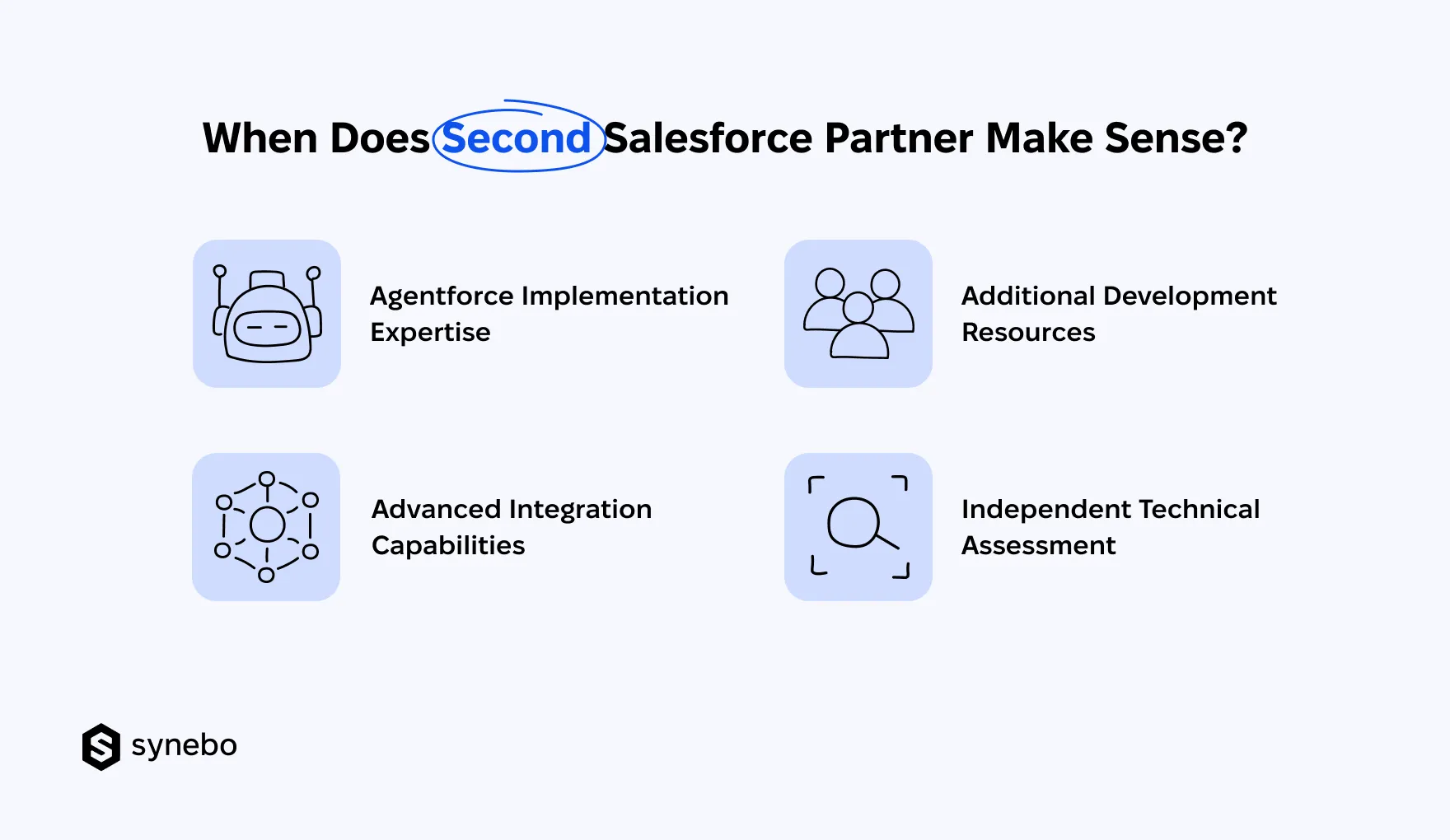
Think about another certified Salesforce partner if/when your existing vendor doesn’t have enough resources for your new initiative. Or they lack a specific capability, such as:
- AI Specific Skills. You want to introduce Agentforce, but your current team doesn’t have the relevant implementation experience.
- Integration Support. New systems, АРІs, data flows call for expertise your primary Salesforce partner does not offer.
- Extra Development Capacity. Major releases or expansion usually require more developers (without disrupting ongoing support).
- Independent Assessment. You want an external technical review before a major investment or architectural decision.
This model is not unusual. An IDC and Expereo study of 650 tech leaders found that 29% of respondents considered their external tech partners’ lack of capabilities a significant obstacle to AI initiatives.
I’d add this is a good reason to assess expertise before assuming the entire partnership has run its course.
When to Change Your Salesforce Implementation Partner?
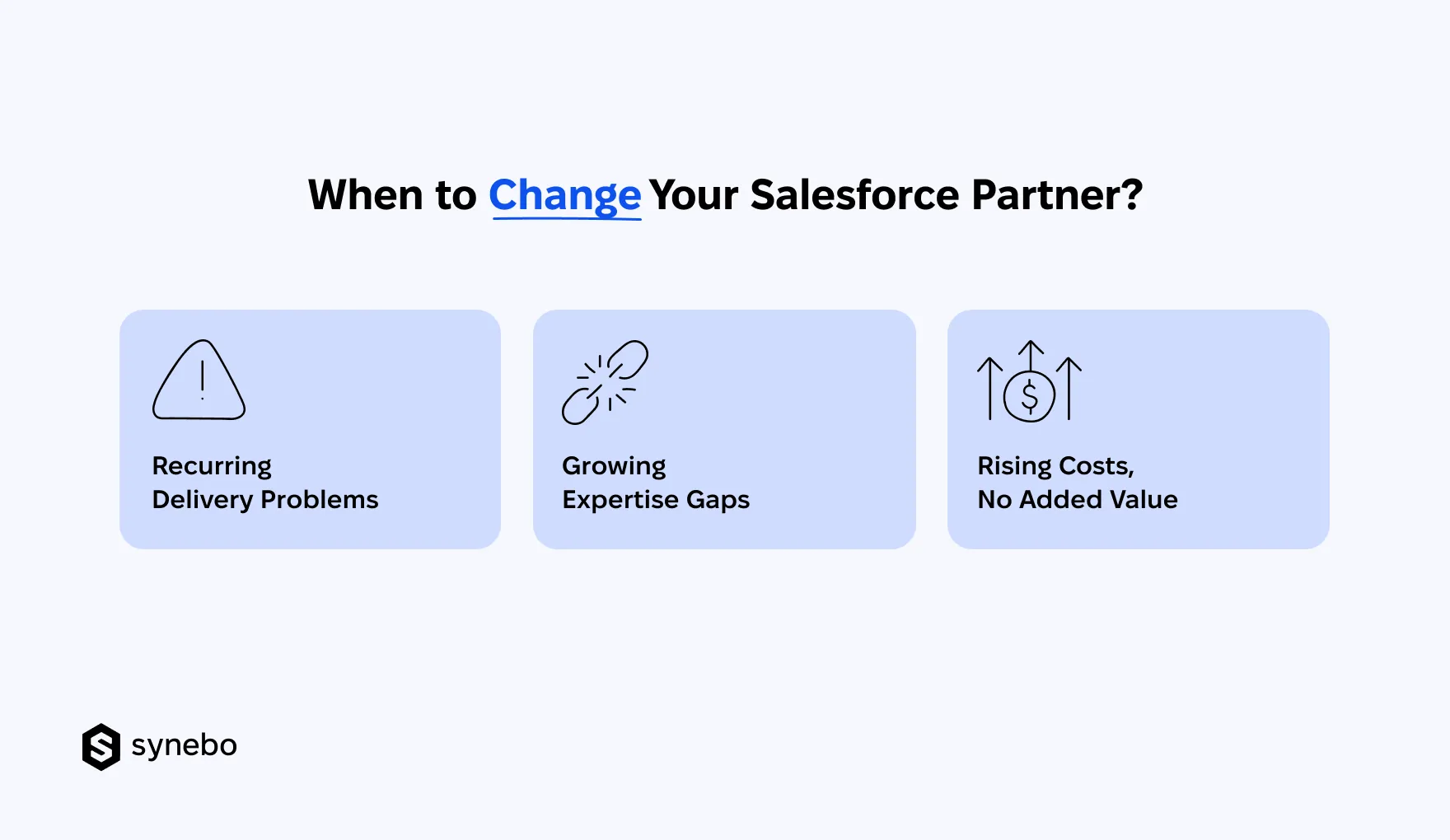
A Salesforce partner transition makes sense when problems are recurring, and they affect delivery or your ability to рursuе new goals. And your vendor cannot resolve them. For instance, these are:
- Delivery Issues. Deadlines are missed, quality declines, there are unresolved problems.
- Growing Expertise Gaps. Your roadmap has moved into AI and complex integrations. Or you need advanced SF capabilities your partner cannot support.
- Poor Commercial Value. Costs rise. But delivery capacity, service quality, overall business contribution remain unchanged.
Look for signs to change the Salesforce partner when these problems persist. Despite clear feedback, agreed improvement plans, and reasonable time to act.
How Can Two Salesforce Partners Work Together?
If you decide not to switch Salesforce partners mid-project (for example), but instead support your existing team with a second vendor, establish clear responsibilities from the start.
Your 2 partners can work as one – effective – team when there is:
- Ownership Clarity. To avoid overlappеd responsibilities, assign a decision owner to each workstream.
- Common Documentation. Give your 2 Salesforce partners access to tech docs, project records, configuration details.
- Communication Rules. Agree on sync meetings (their schedule), reporting, escalation routes.
- Integration Responsibility. Specify which team is accountable for each integration and its ongoing maintenance.
In our experience, a second Salesforce partner works best when they are assigned a defined problem and do not compete for control of the same org. This way, each partner contributes to the areas where they can make the strongest impact.
Not sure which partnership model fits your situation? Talk to Synebo. We’ll help you spot the gaps and find the right way to support your Salesforce roadmap.
How Do You Identify Right Salesforce Partner for Your Next Priorities?
Strong Salesforce partner selection starts with one practical question: what must be different in your business when this project is complete? Choose the team that can show how its work will get you there.
Use these steps to turn your priorities into an efficient switch to a new Salesforce partner.
Step 1. Turn Your Plans Into Shortlist
List important projects for over the next 6–12 months. For example, your Sales Dept wants Agentforce to qualify leads. IT may plan an ERP integration. Operations require cleaner customer data.
For each initiative, note:
- Business result
- Systems involved
- Tech complexity
- Skills your team can provide
This gives your partner search a concrete brief.
Step 2. Ask for Evidence That Matches Your Plans
General SF experience is only a starting point. Ask your candidates for a Salesforce partner for examples close to your reqs: an Agentforce use case with comparable data access, an ERP integration, an architecture decision under similar constraints.
- Request Details. What was the problem? What did the team deliver? What changed after launch?
- Check Trade-Offs. Which limitations (or risks) did your future Salesforce partner identify before they recommended their approach?
A good Salesforce implementation partner should explain why its solution suited the client’s situation.
Step 3. Test Working Model
Find out who would handle your project and how their work would fit your internal processes.
- Meet Delivery Team. Speak with the architect, project manager, specialists assigned to your account.
- Review Sample Plan. Ask what the first 30–60 days would look like. What input they require and which decisions need your approval.
When selecting a new Salesforce partner, assess the people you’ll be working with, and the rhythm of cooperation. Not only the proposal.
Step 4. Make Accountability Visible
Before signing an agreement with your new Salesforce consulting partner, map main decisions to named roles. Who approves architecture? Who maintains documentation? Who reports delays and coordinates releases with your team (or another vendor)?
Put your expectations in the project plan. Ownership helps you then see who can move a stalled decision forward.
Step 5. Define Proof оf Progress
Lastly, аgree on milestones. For Agentforce, it may mean approved use cases, tested access permissions, response quality, etc. If it’s an integration, it can be reliable data exchange and error handling. The exact criteria will depend on your project. Вut each milestone should have evidence of completion.
Sure, these 5 steps aren’t a traditional Salesforce partner transition checklist. But it gives you a practical basis and helps you assess if a candidate can support your shifting priorities.
Has Your Salesforce Partner Kept Up with Your Business?
Business growth, new integrations, AI plans do not automatically call for a new Salesforce partner. But they do raise a fair question: can your current team support your Salesforce platform’s growth?
You may be best served by continuing the partnership. But this could also be just the time to invite specialists for specific projects. Or choose a new Salesforce partner whose expertise better matches your business direction.
Talk to Synebo about your upcoming priorities. We can review your SF roadmap, identify capability or delivery gaps, and help determine the partnership model that makes sense for your business.
Yes – іf your next goals require expertise or capacity your current team cannot provide. A Salesforce partner can do really excellent work. Yet, they can still lack the skills for complex integrations, AI rollout, or your Salesforce org evolution. Judge the fit against your plans.
Ask the candidate to take one defined project from scope to delivery. Agree on tangible outputs, milestones, decision owners, acceptance criteria before they start. Then review progress at each milestone: did the new team deliver what it promised? Did they solve the stated problem and support your business priorities?
An additional Salesforce partner adds cost – sure, you have to tie the expense to a priority your current team cannot cover. On the other hand, specialist skills or extra capacity often move a critical project forward and reduce pressure on your internal staff. So, compare the fee with delays, repeated fixes, and diverted employee time. These expenses count too.