AgentExchange vs. Traditional AppExchange: What Changed?
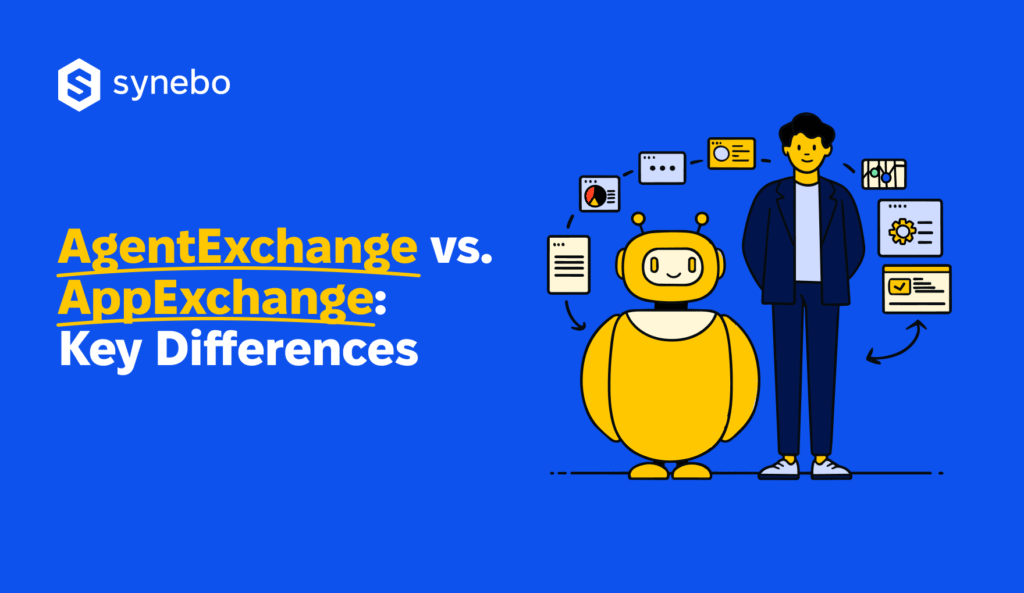
For years, AppExchange has served as the go-to SF marketplace. It’s been a well-stocked library where you grab pre-built apps to extend your CRM. It worked well when the goal was adding functionality. Today’s enterprises don’t need more tools to support their workflows. They need systems that run those workflows. And this is the pressure behind AgentExchange – Salesforce’s AI agent marketplace built for the Agentforce era.
The need for this shift becomes clearer if we look at the numbers. The АІ-powered CRM market is expected to jump from roughly $11 bln in 2025 to $38+ bln by 2029. 88% of sales pros say AI improves their chances of meeting sales targets.
Traditional AppExchange apps automate tasks when told to. AgentExchange applications act. Proactively and contextually. And they don’t wait for a prompt. It’s a totally different layer of the SF ecosystem, built when AI maturity and business pressure converged.
AgentExchange vs AppExchange – what’s the difference? What are the main Salesforce AgentExchange features? How to be successful if you (want to) build AgentExchange apps? The article explores the questions.
What Is AgentExchange?
There is a huge temptation to think about AgentExchange as another toolbox: thousands of apps waiting for someone to pick them up. Yet, it is different in kind and degree.
We’d compare it with a workforce.
“The Salesforce AgentExchange marketplace is where you find, deploy, and manage AI agents – autonomous actors that handle defined jobs end-to-end,” explains Anatoliy Voronov, CTO at Synebo.
These agents can qualify leads, respond to requests from customers, route cases, trigger actions inside SF environments, and do many other things.
So, what is AgentExchange, exactly – in more tech terms?
It’s the Salesforce AI agent marketplace, purpose-built for the Agentforce platform – a dedicated AgentExchange portal where AgentExchange ISVs, AgentExchange partners, and internal teams publish ready-to-deploy agents. These aren’t applications in the traditional sense of installable packages. They are configured, goal-oriented agents that operate in your org’s data, rules, and permissions.
Let’s look at the concrete AgentExchange vs AppExchange distinctions – in brief, first:
- Applications vs. Agents. AppExchange applications extend your team’s capabilities. AgentExchange applications replace specific manual tasks entirely. They need no trigger from a human.
- Predefined vs. Intelligent. Traditional AppExchange apps follow fixed logic. Salesforce AgentExchange agents reason through context and make quite independent decisions on the next actions.
- Features vs. Roles. An AppExchange app – again – adds a capability. An AgentExchange app fills a role (for example, handling after-hours lead engagement or managing tier-1 support requests automatically).
The AgentExchange connection to Agentforce is foundational. Salesforce AgentExchange for Agentforce functions as the supply side of that platform. It’s the place where the agents that power Agentforce actually come from.
Without it, Agentforce is an engine without fuel.
Comparing AppExchange to AgentExchange: Core Differences
Now, after we get a general impression, let’s get more specific – because the real understanding of the AppExchange to AgentExchange shift comes when you line up what each model does and where it stops.
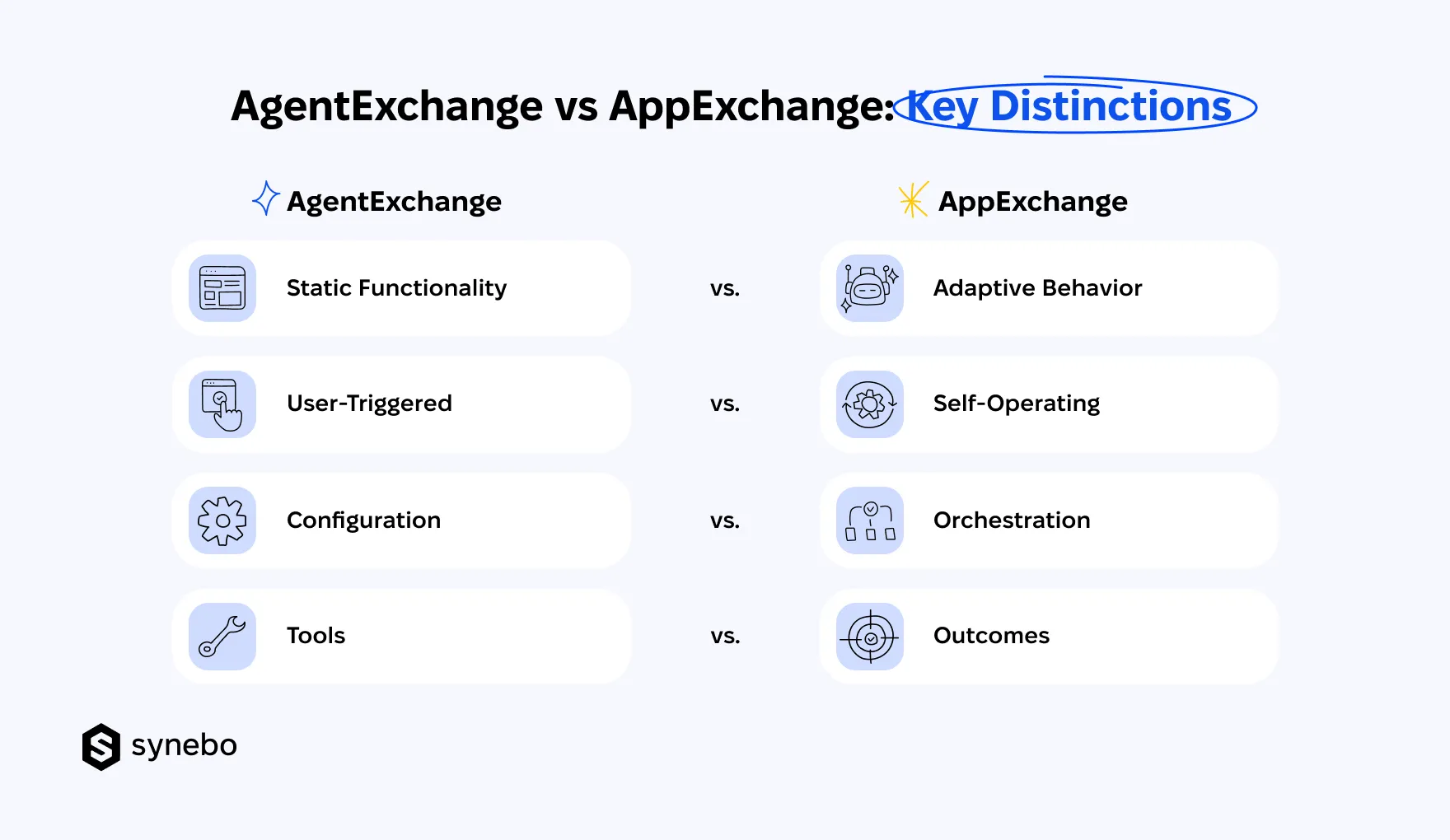
Static Functionality vs. Adaptive Behavior
- Fixed By Design. A traditional AppExchange app does exactly what it was built to do, every time, in the same way. It has no awareness of context. Іt executes a defined function and waits for the next instruction.
- Context-Aware By Default. An AgentExchange solution reads the situation. It evaluates available data and determines the appropriate path. Then acts – without a human scripting each decision in advance. This is what makes AgentExchange Salesforce not a shinier version of what already existed, but fundamentally another layer.
User-Triggered vs. Autonomous Execution
- Waiting for a Signal. AppExchange apps are inherently reactive. Your rep clicks, a flow fires, a form submits – the app responds. Here, the human stays in the loop at every step.
- Operating Without a Prompt. AgentExchange solutions hold a standing mandate. A deployed agent in the AgentExchange Salesforce marketplace monitors conditions and detects when action is required. Then it moves forward independently. You don’t have to click any button. Or have no queue to check.
Configuration vs. Orchestration
- Building a Tool. Deploying an AppExchange application means configuration (fields, mappings, triggers). The admin defines the logic. Аnd the app follows it – rigidly.
- Directing a Workforce. AgentExchange agent development focuses on orchestration. In brief, it means that Salesforce AgentExchange agent partners don’t wire together static rules. They design goal-driven agents that coordinate sub-tasks, call external systems, and adapt mid-process when conditions shift. Salesforce AgentExchange features are built around thіs orchestration layer.
Tools vs. Outcomes
- The Old Metric Was Functionality. Did the AppExchange app install cleanly? Did the integration pass its test coverage? Traditional AppExchange success was measured by deployment health and feature completeness. If the app worked as specified, that was enough.
- The New Metric Is Results. For the AgentExchange marketplace in the Salesforce Agentforce ecosystem, success means outcomes that you achieve when you use the agent. I.e., cases closed, leads qualified, renewals flagged. AgentExchange app development services are now scoped not around feature lists, but around business results.
We can say that the gap between these two models isn’t cosmetic. It’s architectural. It changes what AgentExchange ISVs, AgentExchange partners, and enterprise teams need to think about. Before their next deployment decision.
Below, you’ll find the key distinctions between the two marketplaces which we gathered in one quick-reference table.
|
AppExchange |
AgentExchange |
|
|
What Is It? |
|
|
|
Unit of Delivery What you install |
|
|
|
Trust & Safety Review model |
|
|
|
Target Buyer Who installs it |
|
|
|
Runtime Model How it executes |
|
|
Do you need guidance on architecture, orchestration, or deployment? Contact Synebo. As an AgentExchange agent development company, we’ll help you build AI agents that successfully solve business tasks.
What AgentExchange Means for ISVs
If you view “from the outside” – a new portal, a new name, a new category of listings – the shift from AppExchange to AgentExchange is easy to underestimate.
But for ISVs, the implications go deeper.
“Two structural changes are already reshaping how Salesforce Agentforce AgentExchange operates as a business channel. And understanding them is like the difference between riding the wave and noticing it from the shore,” notes Anatoliy Voronov.
Let’s take a closer look at these changes.
Key Change 1. New Go-To-Market Model
First of all, SF is redesigning how solutions get discovered, evaluated, adopted. If you are an AgentExchange ISV, this directly transforms how you reach buyers – and how buyers find you.
More to the point:
- Discovery Moves From Browsing to Recommendation. The old AppExchange model gave good visibility through search ranking. Keyword optimization was critical. AgentExchange introduces AI-guided discovery: the system itself suggests solutions based on context, use case fit, and trust signals (just metadata is not enough). If your product doesn’t fit the platform’s agent skill categories, it won’t surface at all.
- Competitive Visibility Shifts. On AppExchange, the question was: who ranks higher? On AgentExchange, the question becomes: who gets recommended by the system? This is a fundamentally different competition. It is defined by trust scores, skill classification fit, and Responsible AI compliance (instead of review count or category position).
“You’re no longer a listing competing for attention. You’re either recommended by the AgentExchange system. Or you’re not visible to the buyer who may need you most,” says Anatoliy Voronov.
Key Change 2: One Ecosystem, One Funnel – Bigger Reach, New Rules
AgentExchange consolidates the AppExchange, Slack Marketplace, and the broader Agentforce ecosystem into a single, connected discovery experience.
For AgentExchange partners, this brings a meaningfully larger addressable market (but its activation mechanics work differently from anything that came before).
To put it more concretely:
- Bigger Market Through One Channel. Where ISVs once needed separate strategies for AppExchange and Slack, AgentExchange creates a single funnel that covers the entire SF + Slack environment. One listing, broader reach (provided that your product is architected to operate in both contexts).
- In-Workflow Discovery. A buyer’s first encounter with an AgentExchange application may happen not on the marketplace. The app can be surfaced mid-task, inside an SF workflow or an Agentforce interaction, at the exact moment a user needs it. This is a materially different adoption pattern. And a materially different expectation of how the product behaves when it’s encountered cold.
- Shorter Sales Cycles, High Stakes for First Impressions. AgentExchange streamlines discovery, activation, аnd deployment. It can shorten the path from evaluation to adoption. The upside: faster conversion. The implication: there’s less time to recover from a weak onboarding process. Products that work without config overhead carry a significant advantage.
We can add that on AppExchange, your solution lives in a store. On AgentExchange, it shows up and reaches users inside their operational routine. Which means it has to be ready to perform the moment it arrives.
Is “Classical” SEO Dead on AgentExchange?
If you sell on AppExchange, you probably know: for years, getting found there followed more or less the same logic: optimize your listing title, load the right keywords, collect reviews, and you’ll earn your place in search results.
Many ISVs treated it like Google.
On the Salesforce AgentExchange AI agents marketplace, such a playbook, well, doesn’t disappear entirely. It just stops being enough.
The AgentExchange is powered by SF Data 360, which means discovery shifts from keyword matching to intent-based recommendations.
The platform reads context:
- What the user is trying to accomplish
- What tools they already use
- What outcomes they need
– and then AgentExchange surfaces solutions accordingly. Here, a perfectly optimized listing title won’t help if the product doesn’t map to how the system categorizes agent skills and use cases.
So, what exactly changes for AgentExchange ISVs from an SEO perspective? Here are several areas worth paying your attention to.
1. Keyword Optimization Becomes Context Optimization
The new currency on the AgentExchange Salesforce agents marketplace is relevance – if your agent solves the right problem, fits the operational context, and proves useful fast (i.e., outcomes → use case fit → skill taxonomy alignment).
Synebo’s tip: Describe what your agent achieves, not just what it contains.
2. Performance Signals May Carry Weight
In a recommendation-driven model, how a Salesforce AgentExchange app performs in production could influence visibility much more than static listing attributes (this marketplace becomes a kind of a feedback loop).
Synebo’s tip: So, for your app’s success, essential are completion rates, error frequency, user retention.
3. Trust and Compliance Become Discoverability Factors
The Salesforce ISV partners that pass SF’s Responsible AI review and meet data grounding requirements may receive preferential placement. The review process stops being just a gate. It becomes part of the ranking signal.
Synebo’s tip: Treat Responsible AI readiness and data governance as part of your go-to-market strategy.
Open Questions – No Definitive Answers Yet
Meanwhile, some of the most interesting questions about AgentExchange don’t have clear answers yet.
They will.
And when they do, the ISVs who were paying attention early will have a head start.
Let’s watch this evolution together to understand:
- How exactly does an AgentExchange listing earn a recommendation from the system? Аnd what inputs does SF weigh?
- What signals drive visibility alongside usage data, trust scores, and customer outcomes?
- How much control will AgentExchange ISVs have over how their listings are surfaced?
So far, it’s obvious that classical SEO rewarded you if you described your product well, and your clients loved using it. The emerging model on AgentExchange may reward those whose product works in the hands of users. Аnd shows it through results.
Early Movers’ Window Is Open
So, AgentExchange is not a renamed version of the “old app market”. Тhe Salesforce AgentExchange Agentforce marketplace is a new layer that operates on different logic and rewards different things. And it opens up possibilities that AppExchange was never built to handle.
The change is already underway. The window is open. Аnd in a space that is still taking shape, showing up first is a position worth holding.
If you, as an ISV, pay your attention to the opportunity now – before the rules solidify – you will be the one who will have shaped those rules by the time everyone else catches up.
If you’re evaluating what AgentExchange means for your product and want a thinking partner who is already deep in it, Synebo is an experienced AgentExchange app development company ready to help you move from questions to a plan. Let’s talk.