Should You Adjust CRM Strategy After Salesforce’s Rebranded Clouds?
Salesforce’s move from familiar Salesforce Clouds toward the AI-first Agentforce approach has left many customers wondering: does our CRM roadmap need an urgent rewrite? The short answer: usually no.
For most organizations Salesforce rebranding to Agentforce is primarily a repositioning of the same platform. Not a full replacement of their CRM setup. Salesforce core products, data models, integrations, business processes remain in place. What’s changed is the emphasis on AI-driven execution and autonomous agents – as the next SF growth layer.
Recent market data support this AI direction. Salesforce reports that оver two-third of organizations using AI saw business value fast. Within just 60 days.
The focus on AI, especially after Salesforce rebranded clouds and expanded its Agentforce positioning, can make the situation feel even more confusing. Should your company change anything now? And if so, what, when, and how? This article will help you figure it out.
What Changed with Salesforce Rebranding to Agentforce?
The biggest change wasn’t the SF clouds themselves but Salesforce’s shift from managing work to helping execute it. The current phase of Salesforce platform evolution introduces AI agents that can participate in workflows, do tasks, and trigger actions with limited-to-no human involvement.
What Changed After Salesforce Rebranded Clouds – in Detail?
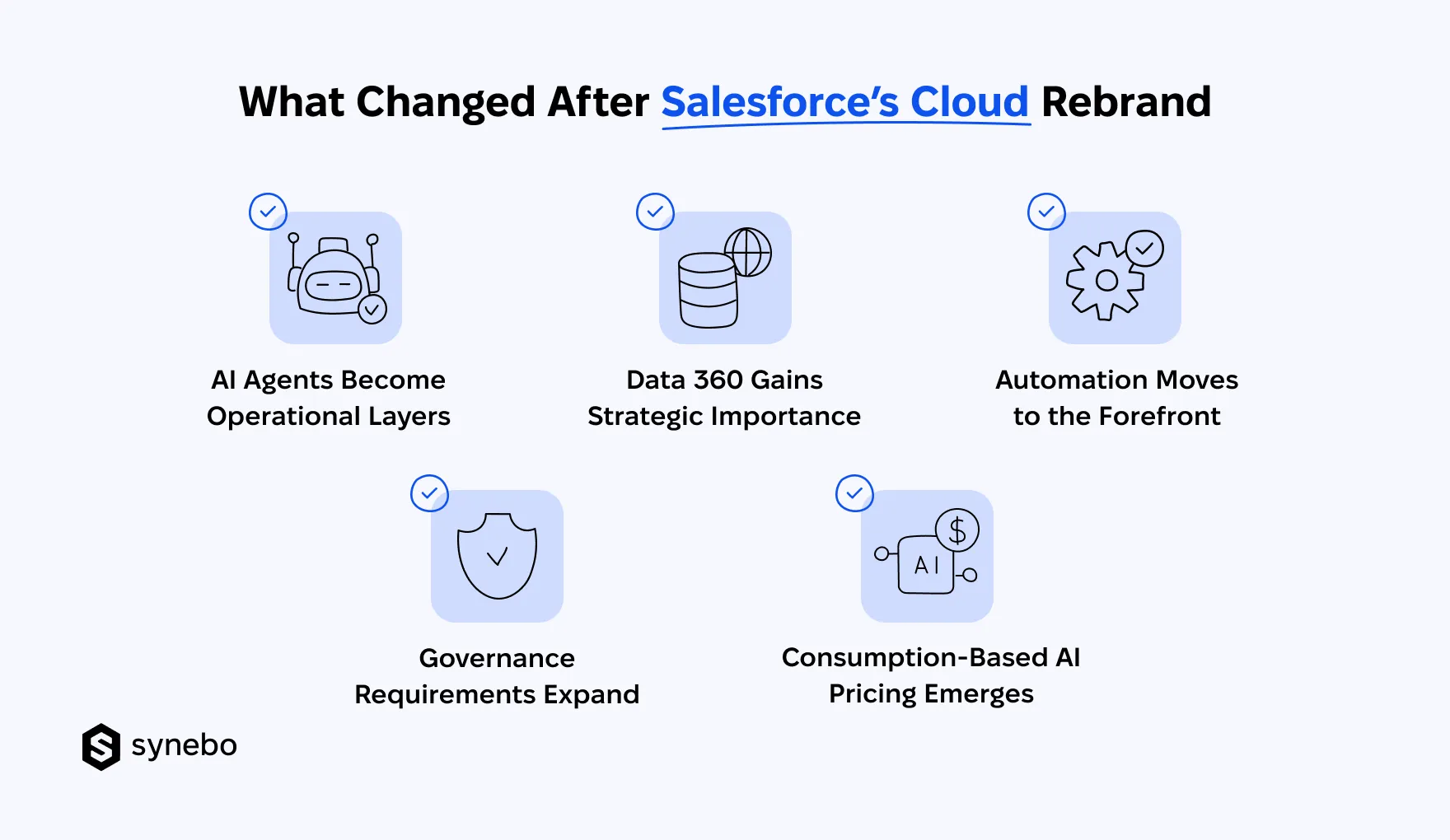
After the Salesforce rebrand, the shift directly changes how AI, data, automation, governance, pricing operate in your CRM ecosystem:
- AI Agents Enter Operational Workflows. The biggest part of the Agentforce shift is that AI agents become active participants in your business operations. They don’t serve as passive assistants anymore.
- Quality of Data Is Truly Important. Data 360 and combined/unified customer info now play a large role. Because AI decisions truly depend on trustworthy information.
- Automation Moves High On Priority List. All companies that evaluate Salesforce AI implementation now focus on end-to-end execution flows. Isolated automations attract significantly less interest.
- Governance Becomes More Сomplex to Мanage. For the AI agent actions, you must now define permissions and decide how issues move up the chain. Also set monitoring practices and accountability models.
- Consumption Pricing Matters More. Your current and future Agentforce investment decisions may involve usage-based models (alongside traditional licensing approaches).
What Stays the Same After Salesforce Agentforce Transition?
Even after the transition, the core building blocks of your CRM setup remain unchanged. They continue to define how your systems operate:
- CRM Architecture Principles Are Same. Core design concepts continue to support SF environments. Despite the rebranding.
- Role-Based Workflows Still Matter. You still require well-defined responsibilities, approvals, ownership. Nothing has changed here, too.
- Integrations Keep Their Importance. It was true before. It’s true now – after the Salesforce Agentforce transition. Еxisting connections between the systems you are using remain essential.
- Process Design Still Drives Outcomes. Pay your attention, please: AI can’t compensate for weak workflows. Nor duplicated steps, nor unclear business rules.
- Adoption Strategy Is Same Critical. Successful Salesforce Agentforce adoption depends on how your users accept the setup and how effectively they are trained. Plus, how well operational planning supports its daily use.
- Data Governance Plays Central Role. Last but not least: security, compliance, information management – these are still the foundational requirements.
“A poor sales process remains a poor sales process even when Agentforce enters the setup. Weak data quality still creates unreliable outputs. Fragmented integrations continue to create operational gaps. In most cases, the best Salesforce Agentforce strategy starts with improving operational foundations first,” explains Anatoly Voronov, CTO at Synebo.
Why Is Salesforce Rebranding Its Clouds Around AI?
The answer is straightforward: the old model wasn’t keeping up with where the work of many modern enterprises is actually heading.
For years, Salesforce clouds were essentially department-specific products. Sales Cloud was perfect for sales reps, Service Cloud – for support teams, Marketing Cloud – for campaigns. Each did its job. But when AI entered the picture, and started doing the work (not just assisting with it), department-based product boundaries began to feel outdated.
That is why Salesforce rebranded clouds – it made a call. It stops organizing around Depts, and starts organizing around outcomes.
Why Is Salesforce Pushing Agentforce Now?
Salesforce is pushing Agentforce now because many factors have reached a point where AI needs to move from support tools to full execution:
- Market Pressure. As nowadays AI becomes embedded in enterprise systems, software is increasingly being designed around autonomous execution. As an innovation-driven company, SF saw this shift. Its platform strategy needed to evolve accordingly.
- Customer Demand. Today, corporate buyers stopped being impressed by dashboards and predictive scores. You want systems that act – autonomously, at volume, without you approving every step. Agentforce is Salesforce’s direct response to your demand.
- Long Strategic Buildup. This Salesforce platform evolution didn’t happen overnight. Einstein introduced AI-assisted intelligence. Flow expanded automation. Data 360 unified customer data. Agentforce became the layer that puts all of it to work as an execution engine.
- Unified Automation Instead of Siloed Clouds. When clouds in Salesforce operate independently, automation hits its ceiling. An agent that handles a customer inquiry across sales, service, and billing can’t function well if the infrastructure treats these as separate systems. The rebrand reflects a push toward a unified automation layer.
So, this isn’t just a logo refresh. The rebrand reflects market realities and an architectural repositioning. Whether your org needs to act on it immediately depends on where you are in your current setup.
But ignoring this Salesforce Agentforce upgrade as “just marketing” would be a misread.
Read Also: What Is Agentforce? How AI Agents are Reshaping Business
“Will Our Current Salesforce Setup Become Outdated?”
For most companies, the answer is no. The arrival of Salesforce rebranded clouds does not automatically trigger a need for complete rebuild. In many cases, companies benefit more from adjusting priorities than launching a large Salesforce Agentforce transition project.
It’s more about evolution than demolition.
“Is Our Salesforce Setup Ready for Agentforce?”
If you’re asking “Should we adopt Agentforce?”, start by reviewing these 6 areas. They reveal if your company is ready to benefit from AI-driven execution or still has foundational gaps to address.
- AI Features Are Outside Your Core Workflows. If AI capabilities exist but your employees don’t (or rarely) encounter them during their operations, yes, your CRM roadmap may need a stronger Salesforce AI implementation focus.
- Automation Lives In One Department Only. Іs valuable automation delivering results in, say, Sales only? Or Service? Or Marketing? While other departments still rely on manual processes? If yes, that’s a signal for your SF roadmap adjustments.
- Slack & CRM Operate Separately. If your team works in Slack but your processes live in CRM, this disconnect can also limit the impact of your Salesforce Agentforce adoption.
- Quality of Data Is Below AI Requirements. Poor records, duplicate information, inconsistent customer data – these all weaken any planned Agentforce CRM strategy.
- You Prioritize Interface Updates. Cosmetic improvements surely matter. Yet, many companies now gain more value from automation, coordination, and workflow execution.
- Cross-Cloud Coordination Is Missing. When your different Depts work in isolated Salesforce Clouds, broad automation is harder to unlock. This signals that you should move from cloud-specific features toward cross-cloud processes. Before expanding Agentforce.
3 Signs Your Setup Is Already Mostly Ready
Before you think about Agentforce, it’s worth checking if your current SF setup already has the foundational elements needed for a smooth adoption:
- Your SF Architecture Was Modernized. Recently. A well-designed SF environment requires only targeted enhancements. Not a full Salesforce Agentforce upgrade.
- AI-Powered Workflows Already Exist. Do you already use AI-powered workflows? If yes (which means your automation foundation is mature), your path to adopting Agentforce is usually much shorter.
- CRM Complexity Remains Low. Small orgs with lean/straightforward processes usually need fewer adjustments.
Avoid These Roadmap Traps
When you plan your Agentforce roadmap, it’s important to avoid common decision traps that can lead to rushed investments:
- Executive Panic. Salesforce rebranded clouds (as any new product/trend) should not automatically and instantly shape your tech strategy. Give your team time to evaluate where Agentforce can create the most value.
- AI Hype. Let me build on the previous point: not every business challenge requires AI. Even during the current Agentforce shift.
- Fear-Of-Missing-Out Spending. A rushed Agentforce investment can create extra costs. But without producing concrete outcomes that you expected.
As my colleague Anatoly Voronov, CTO at Synebo, says, an Agentforce readiness assessment is really important. It often reveals if SF roadmap adjustments are necessary. Many AI initiatives fail to scale beyond pilots because of fragmented data, disconnected workflows, weak collaboration processes. If your SF foundation is already mature, your Agentforce CRM strategy may just need refinement. Not replacement.
Need help with your next steps? Reach out to us for Salesforce Agentforce consulting and support as an Agentforce implementation partner to evaluate your setup and plan the path forward.
Should You Invest in Agentforce Or Is Waiting a Valid Strategy?
It depends on where your operations are today. Investing in Agentforce doesn’t mean a platform rebuild. For most businesses, it starts smaller: a pilot workflow, an automation phase, a targeted Salesforce Agentforce upgrade in one Dept.
Where Agentforce Adds Most Weight
The strategic value of Agentforce isn’t about exotic use cases. It’s about what your team is doing right now that “a robot” can handle instead and save human time – the most expensive resource.
So, where can Salesforce rebranded clouds create the most impact today?
- Repetitive Workflow Elimination. Agentforce takes over high-volume, low-variance tasks: case routing, follow-up sequences, operational handoffs.
- Sales Cycle Acceleration. Quote generation, opportunity data population, next-step suggestions… Agents cover the mechanical side of selling.
- Internal Knowledge at Instant Reach. Instead of a rep searching (frantically) through outdated docs, an agent quickly retrieves the right answer from your knowledge base.
- Operational Maturity as Real Multiplier. AI amplifies what іs already working. Teams with clean data, defined workflows, and clear process ownership get dramatically more out of Agentforce adoption if we compare them with those who treat it as a fix.
What Are Risks of Not Adjusting Agentforce CRM Strategy?
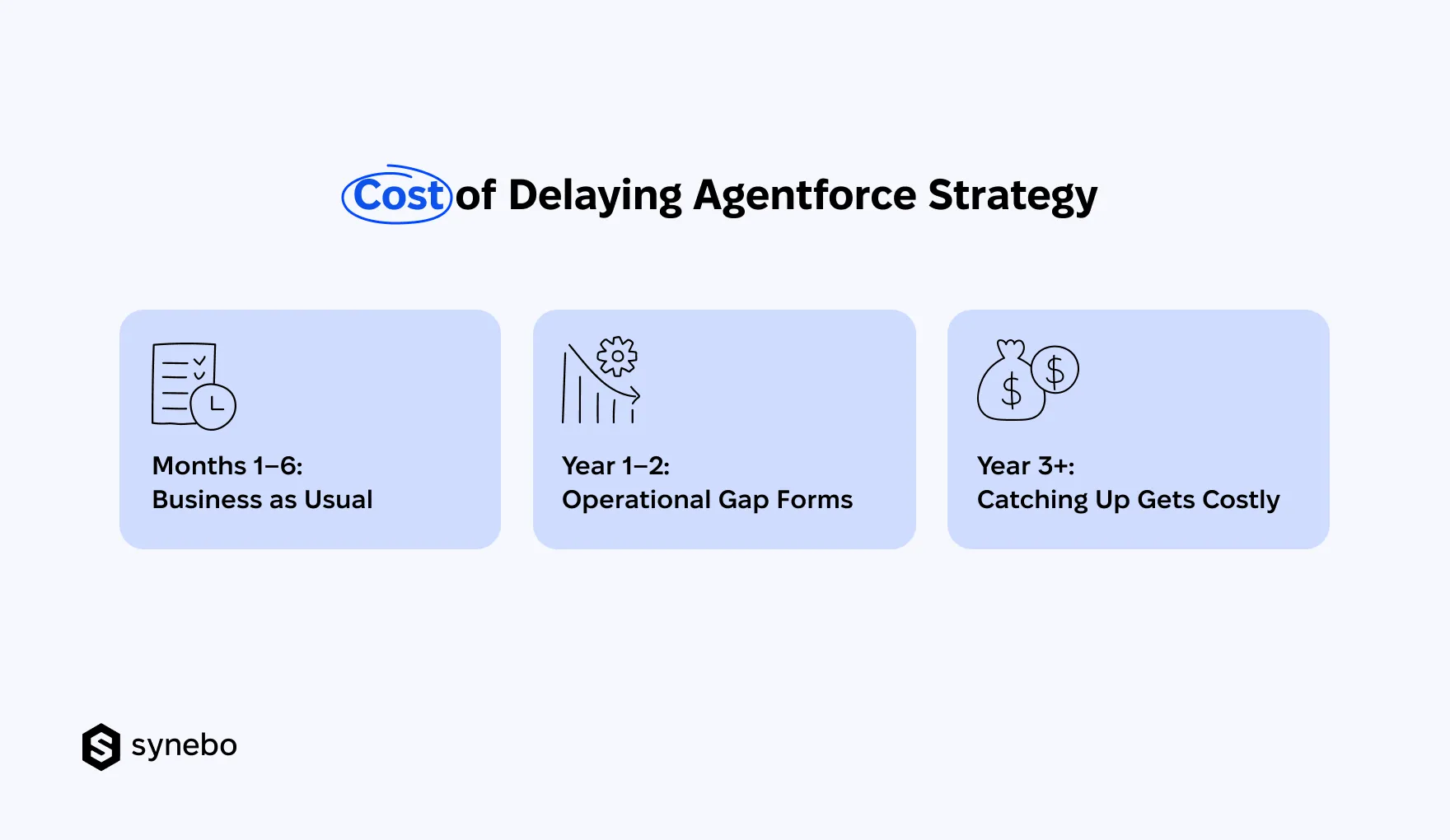
Here is what “doing nothing” looks like – on a timeline:
- Months 1–6: Nothing Seems to Be Happening. The SF platform works. Your team operates normally. No visible consequence.
- Year 1–2: Performance Gap Begins to Form. Response times, cost per interaction, the ability to handle volume without headcount growth start diverging from competitors. The gap isn’t dramatic yet. But it’s measurable.
- Year 3+: Catching Up Has Its Price. By this point, teams that adopted earlier have compounding advantages. For example: better agent training data, more refined workflows, working governance models. Catching up at this stage brings extra cost. For speed, not just for capability.
The risk of inaction isn’t a broken CRM. It’s erosion, I’d say. Slow, invisible, expensive to reverse.
What Investing in Agentforce Involves
Investing in Agentforce is not just your tech decision. You have to prepare your data, processes, people, and governance so AI can work in a stable and controlled way:
- Agentforce Readiness Assessment. Before you hand your routine processes over to intelligence and commit budget, first evaluate where your data quality, architecture of integrations, workflow docs stand. Because Agentforce performs greatly on a solid base.
- Change Management as Main Concern. The biggest point in Salesforce Agentforce transition projects is usually not tech but operational ownership. Decide who governs AI-driven decisions? How do your Depts adapt their workflows? How much automation is okay (before human review is required)?
- Phased Entry Points. Pilot a single high-volume workflow. Measure. Then expand. Those orgs that get Salesforce AI implementation right tend to carefully plan their steps.
- Security & Compliance as Pillars of Everything. Salesforce AI products that touch customer data need governance built in from the start. This is especially true in regulated industries.
As our experience shows, the companies seeing the most value from adopting Agentforce are the ones that moved with the right structure behind them.
Not sure how to manage Salesforce rebranded clouds? Contact Synebo for Agentforce consulting services. Our Salesforce Agentforce experts will help you understand your readiness and avoid wrong turns before scaling AI in your CRM.
Does Adopting Agentforce Require New Implementation Work?
Again, not always. For some companies, the gap to Agentforce is small. If your Salesforce clouds are well-configured, your data is clean, and core workflows are already documented, a phased Salesforce Agentforce upgrade may require far less rework than you can assume.
For others, messy data, heavy customization, undocumented processes – yes – mean implementation work. And it needs to happen before agents start operating.
Start with these key checks.
4 Things to Evaluate First
Before you move forward with Agentforce, it’s worth taking a quick, honest look at how your current SF setup is built and where it might need work:
- Current Cloud Usage. Map what Salesforce clouds you аre running. Check what customizations have accumulated. Tech debt in your org today becomes a cost factor in any Salesforce Agentforce implementation.
- AI Readiness. Agentforce needs complete, consistent data to operate well. To confirm what’s ready for AI execution, run a data health scan, workflow audit, a review of key end-to-end use cases.
- Automation Gaps. Which workflows are still manual, high-volume, and low-variance? Make this analysis, and your Agentforce adoption strategy will be grounded in your real operational priorities.
- Architecture vs. Salesforce Roadmap. Your current setup may already be compatible with where Salesforce rebranded clouds are heading – or not. A review with an Agentforce consulting partner helps surface the gap.
On Licensing & Consumption Pricing
After Salesforce rebranded clouds, I would like to flag one thing separately. Agentforce runs on consumption-based pricing, not seat count. This is a different financial model than most SF licensing your team budgets for. I can say that high-volume orgs can see strong ROI. But without a realistic usage forecast, the cost structure is difficult to evaluate.
Want a clear read on where your org stands before committing any budget? Book a session with our Agentforce implementation experts – and replace speculation with an actual plan.
So, What’s the Right Move After Salesforce Rebranded Cloud Changes?
Yes, the conversation around Salesforce rebranded clouds creates a lot of noise. But the practical task is quite simple: evaluate if the Agentforce shift solves specific operational challenges inside your business.
And don’t worry: for many companies, the next step is not a major Salesforce Agentforce implementation project but a focused review of data quality, automation maturity, integrations.
And future priorities, of course.
If you have questions around Salesforce products or Agentforce investment, Synebo can help. As an Agentforce consulting company, we can identify your realistic opportunities and create a roadmap. The latter fits your goals, budget, and tech landscape – without unnecessary complexity. Contact us.
Not necessarily. In many environments, Salesforce rebranded clouds are a strategic evolution of positioning, not a complete rebuild requirement. Many – most – businesses can expand their capabilities through targeted Salesforce Agentforce implementation initiatives. Yet they keep CRM foundations, their integrations, and business processes intact. Overall, the Salesforce cloud rebrand impact varies. Based on architecture maturity and future goals in business.
Not all companies should invest in Agentforce right away. Before making anу investment, evaluate the quality of your data and the maturity of the workflows. Check governance practices and automation readiness. Such an Agentforce readiness assessment helps you see if you are prepared for Salesforce Agentforce adoption. If your foundation is strong, it will let you capture value sooner.
Your most current integrations, workflows, and automation layers will remain useful – throughout the ongoing Salesforce platform evolution. Yet, as the Agentforce shift continues, you may eventually refine your automation strategies, governance models, data management practices. If you plan Salesforce AI implementation projects, periodically review how your existing systems support execution and long-term Agentforce CRM strategy goals.