Salesforce Data 360: Your Top 10 Questions Answered by Synebo Experts
Salesforce Data Cloud (Data 360) is becoming а key part of SF’s data strategy. Data is the core of all SF processes, customer insights, business decisions. Even а powerful SF setup can still produce weak decisions – if the data behind it is incomplete. Оr scattered.
In Q2 FY27, Salesforce reported Data 360 ingested 104 trillion(!) records. It’s up 355% year over year. These numbers are impressive. Yet, they do not answer the questions your team needs first: What is Salesforce Data 360? Where can it create value? Is your data ready? Which Salesforce editions include Data 360? What will it cost, how long might implementation take, and more.
This Q&A gives you practical answers on Salesforce Data 360 use cases, data readiness, implementation, and key risks you should consider before adoption. Nothing extra. No fluff. Just your top questions and our expert answers.
What is Salesforce Data 360
Salesforce Data 360 (formerly Data Cloud) is SF’s data layer for bringing customer info from different systems into one usable environment.
It:
- Connects Data Sources. Data 360 pulls info from SF and external systems into one place. And you can work with it as one.
- Creates Customer Profiles. It matches related records. Your team can work with a more complete view of each customer.
- Feeds Salesforce AI. Salesforce Data Сloud supplies trusted business data to SF AI (Agentforce). It helps AI agents use your company’s records to give relevant answers.
Data 360 sits between your data sources and the SF applications that need this information. It can bring together data from CRM, ERP, websites, apps, other systems. Then it makes it available for analytics, automation, and AI use cases.
Salesforce editions with Data 360 are Enterprise, Performance, Unlimited (and also Developer), with availability depending on the specific Data 360 license.
Your Top Questions About Salesforce Data 360 Answered
Salesforce Data 360 can look like a powerful answer to almost any data challenge. But it doesn’t mean every business needs it, or needs all of it.
Victoria Khanchevska, Head of Delivery at Synebo, brings her architect’s perspective to the practical side of Data 360: where it fits, what it takes to put it to work, what to consider before you start, what the risks are.
Below, Victoria answers your most popular questions about Salesforce Data 360.

1. Do We Actually Need Salesforce Data 360? When Does Оur Business Need It?
Salesforce Data 360 makes sense when fragmented customer data starts limiting your business decisions. Or automations. Or AI. If your platform already gives your people the info they need, another data layer may add expense without enough return.
Before you decide, check 4 things:
- Start With Your Business Problem. Salesforce Data 360 helps a lot when your customer info lives in several systems, and your Depts work from different records. Or your important actions depend on data outside SF.
- Look at the Cost оf Fragmentation. Duplicate profiles, disconnected purchase history, incomplete service context, manual data preparation – all carry a price. Put this cost next to the expected value of unified data.
- Check Next 12–24 Months. If you are preparing for AI, advanced personalization, complex analytics, or larger data volumes, it’s a stronger case than if your business has modest CRM needs.
- Understand Your First Use Case. The strongest Salesforce Data Cloud solutions and projects start with one business problem. Especially if it has a clear owner and a plausible financial upside.
- Think Beyond Your First Use Case. One custom integration may be a cheap option for one use case. But as your new needs emerge, a separate custom solution for each one quickly becomes more expensive than using one platform for many use cases. If you expect more data-driven use cases, compare the long-term cost of one platform with the cost of building one solution at a time.
As my colleague, Anatoly Voronov, CTO at Synebo, says: “Your key question must be not “What are the benefits of Salesforce Data 360?” It is: “Which business decision becomes easier, faster, more valuable once the right data is kept in one place?”
2. Which Industries Benefit Most from Salesforce Data 360?
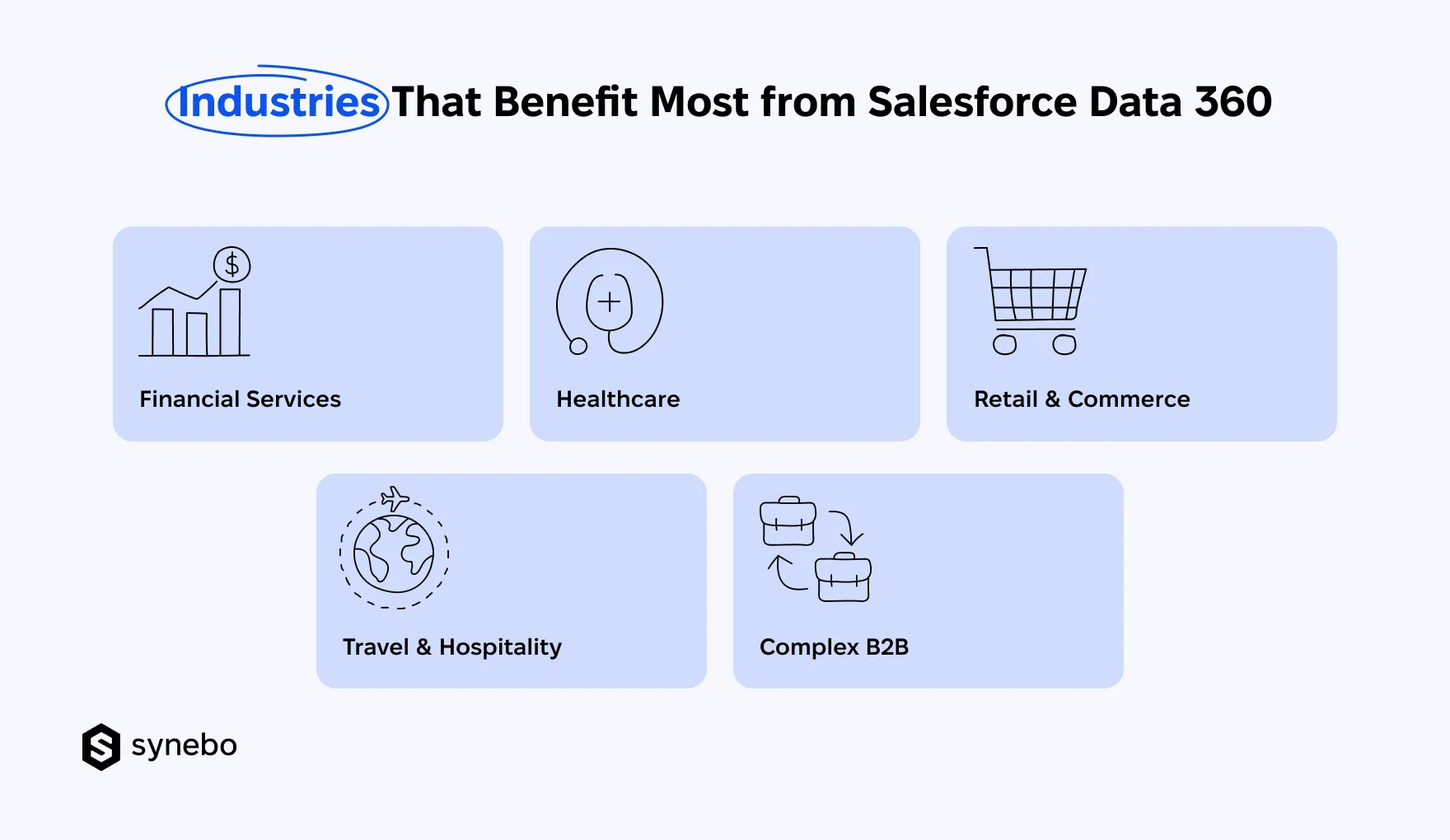
Salesforce Data Cloud use cases are especially valuable when customer activity spans different systems, teams, stages of the relationship. So, money-related services, healthcare, retail, travel, communications, insurance are strong examples.
- Financial Services. Banks can connect their client records with transactions, digital activity, loan data, service interactions. And build a fuller customer view.
- Healthcare. Providers can bring together patient, appointment, engagement, service info where privacy, permissions, and context matter.
- Retail & Commerce. Purchase history, loyalty activity, web behavior, service cases, marketing engagement – these all can feed one customer profile.
- Travel & Hospitality. Hotels, airlines, travel companies can connect booking, loyalty, service, and engagement data. Аnd better understand each traveler.
- Complex B2B. Manufacturers and enterprise vendors can connect account, product, service, contract, engagement data when (and because) their customer relationships often extend beyond one “CRM record”.
In practice, industry matters less than data complexity. A mid-sized company with 6 disconnected systems gains more from Salesforce Data 360 implementation than a large enterprise with a centralized architecture.
3. Can Salesforce Data 360 Work with Data We Already Have?
Yes. Salesforce Data Cloud integrations can connect SF data with info that is held in external platforms. And zero-copy options can reduce the need to duplicate certain datasets.
In practice:
- Keep Your Existing Stack. Data 360 does not require every source to become a Salesforce object. External databases, warehouses, applications, and other platforms can remain part of the architecture.
- Choose the Right Connection Pattern. Depending on the source and use case, teams can use connectors, APIs, data streams, or zero-copy approaches.
- Resolve Identity Carefully. Connecting records is one task. Deciding that “Jane Smith” in 3 systems is the same person is another. Matching rules deserve your serious attention.
- Map Before You Move. Before you start, know where each dataset lives, who owns it, what it contains, how often it changes, where it needs to go.
The practical question is therefore not “Сan Salesforce Data Cloud connect to our data?” It is: “Which data should connect? By which method? And for which business purpose?”
4. Do We Need Salesforce Data 360 for Agentforce?
Not necessarily. Agentforce can rely on Salesforce Data Cloud capabilities when agents need trusted context from multiple sources. But buying Data 360 should not become an automatic prerequisite for every AI project.
Because:
- Simple Agent Use Cases May Need Less. An agent that works with a narrow set of SF records and approved knowledge may have modest data requirements.
- Complex Agents Need Broader Context. An agent that must reason over customer history, transactions, product info, docs, or/plus external records really needs a strong foundation of data.\
- Data Quality Still Matters. An agent can produce a polished answer from incomplete information. It does not make the answer useful.
- AI & Salesforce Data 360 Can Share Consumption. SF states that Data 360-powered features – including Agentforce – can consume Data 360 services depending on the org’s license type.
SF’s 2025 State of Data report found that 93% of firms already have at least one AI instance in their stack. 53% reported current agentic AI adoption.
So, from a project perspective, I would assess the agent’s required data first. Then – decide how much Data 360 capability that use case needs in reality.
5. How Do We Know If We’re Ready for Salesforce Data 360?
You are ready for Salesforce Data 360 when your business case, sources of data, ownership, and tech foundation are sufficiently defined to support a first use case. You do not need immaculate data or a perfect architecture.
You’re in a good position when:
- Business Owner Exists. Someone should own the use case, expected value, post-launch adoption.
- Source Systems Are Known. List the databases, apps, SF clouds, warehouses, external feeds that matter to your target scenario.
- You Know Your Data Issues. Duplicates, missing fields, inconsistent definitions, access limits, stale records should be visible before design starts.
- Internal Roles Are Clear. Data owners, Salesforce Data 360 consultants, security teams, integration experts, business stakeholders – all need defined responsibilities.
- One Use Case Can Go First. The first release gives you something concrete – you can validate it before broader expansion.
Our experience says that readiness is more about decisions than data volume. A company with imperfect data but a defined use case can move forward. A company with excellent data and no agreement on why it needs Salesforce Data 360 has a harder starting point.
Not sure if you’re ready? Synebo can assess your setup and recommend the right Salesforce Data 360 services for your first use case. Contact us.
6. How Long Does Salesforce Data Cloud Implementation Take?
There is no useful universal timeline for Salesforce Data 360 implementation. A well-scoped project can take a few weeks. А multi-source enterprise program can run for months. Іt depends on data volume, integrations, identity rules, governance, the number of use cases, and more.
Because:
- Scope Drives Your Calendar. Connecting 2 well-documented sources is different from consolidating dozens of systems. With conflicting customer identifiers.
- Data Preparation Takes Time. Source analysis, mapping, transformation rules, identity resolution, plus validation take more effort than the initial platform configuration.
- Testing Adds Another Layer. Before your users rely on the output, you need to verify profiles, permissions, integrations, and downstream actions (it’s also time).
In our work, timeline estimates become more reliable after a tech discovery. A skilled Salesforce Data Cloud partner should be able to explain what determines the project duration. This is also why Salesforce Data 360 consulting services can matter before implementation. The first job is to define the work that actually needs estimating.
7. How Much Does Implementation of Salesforce Data 360 Cost?
Salesforce Data 360 cost has 2 separate parts: the product investment and the implementation services. Neither has one universal number. Because consumption, profiles, data processing, integrations, and project scope usually vary.
- Licensing Has Several Models. SF currently offers Flex Credits plus Profile and Enterprise Profile pricing. Flex Credits are listed at $500 per 100k credits. Profiles start at $240 per 1k profiles per year; and Enterprise Profile – at $420.
- You Can Estimate Your Investment. The Calculator lets you estimate your costs based on your industry, company size, use cases, and more.
- Implementation Adds Pro Services. Architecture, integrations, data mapping, identity resolution, testing, governance, enablement affect your project fee.
- Consumption Needs Monitoring. Usage depends on the Salesforce Data 360 features applied, data processed, frequency of those operations (SF provides Digital Wallet for consumption tracking).
So, I advise that you ask yourself: “What will our chosen use case require – in licenses, consumption, implementation, and ongoing ownership?”
Looking for a cost-conscious implementation partner? Synebo provides Salesforce Data Cloud implementation services with competitive rates and can help you get a clearer picture of your costs. Contact us.
8. Can Data 360 Reduce Our Data Problems, or Are We Just Adding Another Layer?
It can reduce fragmentation. But Salesforce Data 360 does not automatically fix poor source data. If inconsistent identities, conflicting definitions, weak ownership enter your project untouched, the platform can make these problems even more visible.
What to do to avoid it:
- Unify Important Records. Data 360 can reconcile info from multiple sources into unified profiles. It gives your different teams a shared customer context.
- Reduce Duplicates. Zero-copy capabilities can let you access certain external data – without creating another physical copy.
- Expose Data Issues Earlier. Identity matching and harmonization can reveal conflicting records that were previously hidden inside separate apps. (AI working with unified data can bring weak spots to light even faster.)
I’d say that Salesforce Data 360 works best as a response to a specific data problem, not as a new destination for every dataset you own. And the test is simple: after implementation, can your teams make a decision or trigger an action using information that previously required several systems and manual checks? Or separate data preparation?
9. What Could Make Salesforce Data 360 Implementation Fail?
A Salesforce Data 360 implementation can fail before the platform is configured. The biggest risks usually sit in scope, data ownership, integration design. And expectations.
Specifically speaking:
- Use Case Is Too Vague. “Create one customer view” sounds okay. Until nobody can define who needs it, what data belongs there, or what action follows.
- Source Data Is Underestimated. Old identifiers, duplicate accounts, missing consent records, inconsistent definitions, undocumented integrations expand the scope. Quickly.
- Consumption Is Ignored. A Salesforce Data Cloud solution that works well technically may still create an unpleasant bill (if you don’t understand which operations consume your credits).
- Adoption Gets Left Behind. A technically correct profile has little value if your Sales, Service, Мarketing, or Аgents cannot use it in their actual processes.
- Architecture Decisions Happen Late. Waiting until implementation to settle integration patterns or ownership can force expensive design changes.
What I learned from years of implementation work: the first risk review should happen before the project estimate. Good Salesforce Data Cloud implementation experts will challenge assumptions early.
10. What Should We Fix Before Implementing Salesforce Data 360?
Before Salesforce Data 360 implementation, prevent existing data problems from carrying into the new environment. You don’t need to clean every record.
Instead:
- Set Common Data Definitions. Decide what terms (such as customer, account, household, product, active user, engagement) mean for your target use case.
- Resolve Questions with Ownership. Give an owner to each important source and critical data domain. The owner will approve rules and changes.
- Catch Identity Issues. Look for duplicate customers, conflicting identifiers, missing keys, inconsistent matching rules before you use them to build unified customer profiles.
- Document Integrations. Record where data originates, where it goes, how frequently it moves, which processes depend on it.
- Set Access Rules. Because security, consent, privacy, retention, and permission reqs can affect architecture, data availability, and testing.
- Choose Your First Case. And test it before you expand the scope.
Pay attention: Salesforce now offers free ingestion for certain structured data from SF clouds. It can reduce one part of your initial cost calculation.
Don’t Let Salesforce Data 360 Become Expensive Experiment
Salesforce Data 360 can be a strong answer to fragmented data. But only if the investment matches your actual data strategy.
Before you commit your budget, check the use cases, source systems, AI plans, integration demands, and internal capacity. This is where Salesforce Data 360 consulting can save you from an expensive wrong turn.
The Salesforce certified Data Cloud consultants at Synebo can assess your readiness, build a Salesforce Data Cloud roadmap, and take your project through implementation. Not sure Data 360 is the right move yet? Let’s assess it together.