Top 7 Tips for ISVs Building for AgentExchange
Let’s leave AgentExchange aside for a second and look at the bigger shift. Does marketplace browsing seem to… stop recently? At least – reduced dramatically? We all seem to see it in everyday practice: a growing number of CRM buying decisions now begin with just AI recommendations. SF reports employee interactions with AI agents grew by 65% month over month in the first half of 2025. And agent creation inside companies increased by 119%.
For ISVs, this changes the entire approach to building for AgentExchange. Success inside the Salesforce AgentExchange marketplace now depends on how effectively products fit AI-driven discovery, Agentforce workflows, trust requirements, recommendation logic. Publishing an app alone no longer guarantees visibility.
Many AgentExchange ISVs now face growing uncertainty: which use cases deserve investment, how AI agents should communicate value, and – sure – how to make money on the emerging Salesforce AI agent marketplace.
In this article, we explore the new approach required for Salesforce ISV partners and share practical tips for building apps for AgentExchange for strong positioning inside the evolving AgentExchange Salesforce marketplace.
Scorecard Is Different Now: New Approach For AgentExchange ISVs
If you treat AgentExchange as another extension of AppExchange, this assumption creates dangerous blind spots.
Read Also: AgentExchange vs. Traditional AppExchange: What Changed?
The AgentExchange marketplace in Salesforce follows a very different logic: buyers no longer search for software features only.
“Buyers now evaluate if an AI agent can make decisions safely and complete operations independently. Also, if it operates inside the enterprise governance requirements. For ISVs, the market currently doesn’t feel like a mature ecosystem. It’s more like an undeveloped territory where standards and expectations still shift,” says Yana Chekan, Head of Delivery at Synebo.
New Opportunities
So, what opportunities is the AgentExchange Salesforce agents marketplace creating?
Here they are:
- Agents Run Entire Business Processes. Inside the marketplace, products no longer play a supporting role. A mature AgentExchange app may handle onboarding flows, service coordination, approvals, or customer communication with limited human involvement. For companies building agents for AgentExchange, this opens far larger product opportunities than traditional automation of workflows.
- Early Vendors Shape Category Standards. The current AgentExchange marketplace in the Agentforce ecosystem still lacks stable benchmarks. This creates rare momentum for those ISVs who are willing to move quickly. Devs developing for AgentExchange today can influence pricing expectations, evaluation criteria, and product architecture patterns. Long before this market settles.
- Category Positions Become Hard To Replace. Once trust is established, enterprise buyers often stay cautious with autonomous systems. And an early AgentExchange application that gains credibility inside a category may keep this advantage for a really long period.
New Challenges
As these opportunities emerge, what challenges are starting to surface as well?
At the moment, 4 core challenges stand out most clearly:
- Enterprise Trust Requires Stronger Proof. Autonomous products trigger heavier scrutiny from your security, legal, and compliance team members. Many AgentExchange partners/ISVs now face evaluation standards far stricter than “traditional” reviews.
- Preparation for Security Review Starts Much Earlier. This point is closely connected to the previous one. Тeams creating apps for AgentExchange now need to think about SF security review requirements, audit logging, permission controls, AI governance checks long before release preparation begins. For many ISVs, these requirements already influence architecture and product design decisions at an early stage.
- No Proven Approach Exists Yet. Even experienced Salesforce AgentExchange partners still test positioning, technical architecture, monetization – in parallel. True: proven frameworks don’t merely exist.
- Procurement Teams Still Lack Evaluation Models. Many enterprises remain uncertain about how to assess risk, accountability, governance inside autonomous systems built for the Salesforce AgentExchange for Agentforce ecosystem.
These all create a difficult balancing act: ISVs have to move fast enough to secure an early market position. Yet, still build the governance, trust, and operational safeguards enterprise buyers now expect from autonomous products іn AgentExchange.
If you build for AgentExchange, Synebo provides AgentExchange app development services focused on enterprise-ready architecture, governance, and operational execution. Contact us.
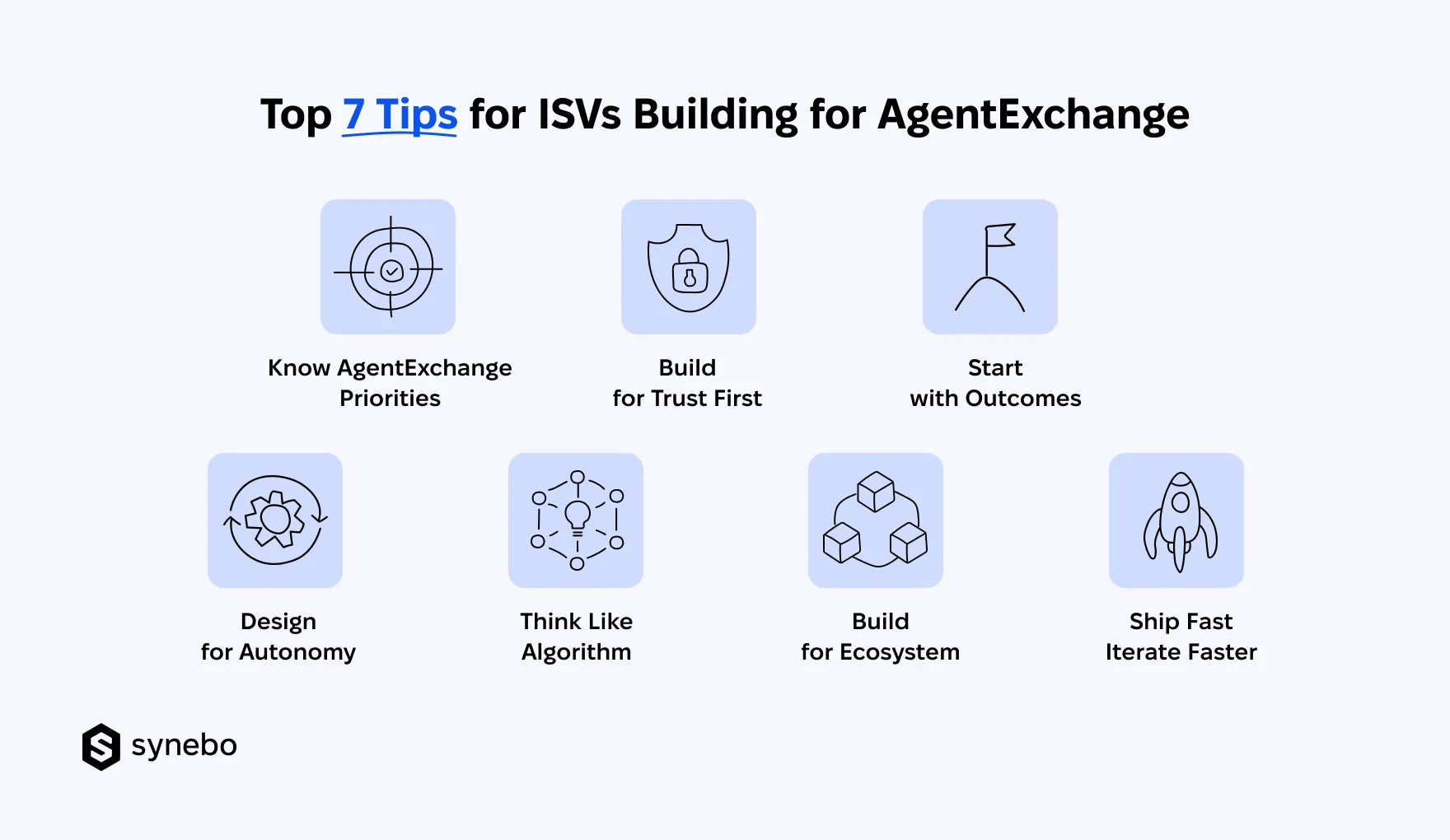
Top 7 Tips For ISVs Building For AgentExchange
The first wave of winners inside AgentExchange will not necessarily come from the largest vendors. More likely, success will belong to ISVs that understand how autonomous products get evaluated, trusted, recommended, and adopted inside AgentExchange.
So, making the most of the opportunities this new marketplace opens up requires a focused strategy.
Here are a few tips from Synebo, as an experienced AgentExchange agent development company.
Tip 1. Understand What AgentExchange Rewards
There’s hardly anything surprising about the fact that many ISVs still approach developing apps for AgentExchange with an “AppExchange” mindset. Yet, this may create problems.
Discovery inside the Salesforce AgentExchange marketplace of AI agents relies far less on keyword-heavy listings.
It depends more on agent behavior, trust scoring, defined skills, contextual fit. Because:
- Skill Taxonomy Drives Visibility. SF evaluates how clearly an AgentExchange solution defines its scope of operations and supported workflows. Plus, surely, Agentforce compatibility. (Narrow capabilities usually do better than broad positioning.)
- Deployment Logic Has Also Changed. Traditional products focus on installation and configuration. In the AgentExchange marketplace in the Salesforce Agentforce ecosystem, buyers don’t expect agents to answer prompts. They want them to coordinate work, pass tasks between systems, know when to escalate – overall move processes without human input.
- Specificity Beats Generalization. ISVs that try to create universal agents frequently weaken discoverability. If you build apps for AgentExchange, our tip is to define concrete jobs with outcomes you (your bayers) can measure.
Tip 2. Build For Trust
We all feel it: autonomous behavior changes how we evaluate software we want to buy. So, buyers no longer ask only if a product works. We all question whether an agent can act safely inside our sensitive workflows.
According to the research, 76% of sales professionals who work with agents say customer conversations sooner or later land on one topic: data security. So, enterprise buyers increasingly treat security as part of product credibility.
In practical terms:
- Responsible AI Reviews Matter Early. SF applies governance checks that examine security boundaries, decision transparency, and operational safeguards for every Salesforce AgentExchange app.
- Data Boundaries Need Explicit Rules. Strong AgentExchange applications define what agents may access, modify, escalate, reject. Weak governance models create immediate procurement resistance.
- Auditability Becomes Product Capability. Enterprise clients also expect event tracking, decision history, explainability inside products developed for the Salesforce AgentExchange for Agentforce ecosystem.
For many ISVs, SF security review already shapes architecture decisions long before release preparation begins. So, companies/startups creating the Salesforce AgentExchange app(s) need to think about audit logging, permission controls, AI governance checks, escalation logic, data isolation from the earliest stages of product development.
Tip 3. Start With Outcomes. Features Are Secondary
Feature-heavy positioning performs poorly inside AI-driven discovery systems. Autonomous ecosystems prioritize business outcomes. Capability lists go second, if you will.
What matters most is how clearly the agent’s business role comes across. We mean:
- Outcome Language Improves Relevance. An AgentExchange application that reduces onboarding delays or accelerates approval cycles communicates its value fast. Much faster than a generic productivity platform.
- Workflow Thinking Is More Important Than Feature Depth. Devs developing for AgentExchange should map such operational sequences that AI agents can execute independently.
- Jobs-To-Be-Done Increase Potential for Recommendations. AI-driven recommendation systems favor products that have clearly defined execution scenarios.
“If a product cannot quickly explain its operational outcome, recommendation engines inside the Salesforce AgentExchange AI agent marketplace may deprioritize it,” explains Yana Chekan.
Tip 4. Design For Autonomy
Because AI agents evaluate context, react dynamically, and independently coordinate and execute tasks, this changes product architecture completely.
And this starts with the following design principles:
- Autonomy Still Loves Boundaries. Strong AgentExchange agent development strategies define when AI agents may act independently. Аnd when escalation becomes mandatory.
- Transparency Builds Confidence. Enterprise users trust systems that explain decisions, display reasoning paths, expose approval controls.
- Excessive Automation Creates Risk. Products that remove too much human oversight frequently trigger procurement hesitation inside regulated industries.
Our experience proves that for many AgentExchange ISVs, the strongest products don’t chase maximum autonomy everywhere. They balance initiative with supervision.
Tip 5. Think Like Algorithm
The recommendation model inside the AgentExchange portal behaves very differently from classic marketplace search.
So, how does discovery work now?
- Intent Signals Replace Keyword Ranking. Discovery increasingly depends on operational context, business intent, historical usage patterns, and workflow relevance.
- Context Influences Recommendation Priority. An AI agent designed for, say, service escalation now appears inside highly specific operational scenarios.
- Performance Signals Are Main Factors for Good Visibility. Recommendation systems evaluate adoption quality, workflow completion rates, and business effectiveness. A high download count alone is not enough any longer.
This changes how ISVs position their products inside the AgentExchange portal. Strong contextual relevance now plays а greater role than generalized marketing language.
Tip 6. Build For SF Ecosystem
Standalone products lose momentum in interconnected AI environments. Our сlients say that today they prefer products that function naturally inside a broad operational ecosystem.
Why does ecosystem compatibility start influencing product value almost immediately?
- Cross-Platform Execution Creates Advantage. The most competitive AgentExchange apps interact with SF, Slack, Data 360, external systems inside connected workflows.
- Contextual Data Improves Decisions of AI Agents. Products that leverage CRM records, communication history, and operational signals typically deliver stronger execution quality.
- Interoperability Expands Use Cases. If you develop an AgentExchange app with ecosystem connectivity, you gain access to wider enterprise adoption paths.
We’d say it straight: at this point, ecosystem compatibility turns from an advantage into a requirement.
Tip 7. Ship Fast, Refine Even Faster
Enterprise expectations inside AgentExchange still evolve. Rapidly. In practice, it means that if you are willing to release focused products, do it early and fast. Then refine them relentlessly.
At the same time, there іs an important reality to keep in mind:
- Credible MVP Focuses On Execution Quality. Successful early products usually solve one operational problem. They don’t offer a massive feature scope. They do one thing, but extremely well.
- SF Resources Already Exist. Many AgentExchange partners leverage PDOs, ISV advisory programs, and Agentforce guidance when they are shaping their launch strategies.
- Feedback Mechanisms Need Boundaries. Enterprise input matters – for sure. But uncontrolled customization can derail product direction quickly.
For ISVs entering AgentExchange, we’d say that speed alone will not determine success. The stronger advantage comes from disciplined iteration, plus clear positioning and concrete outcomes.
And undoubtedly, an enterprise-ready trust architecture.
What Аbout Picking Monetization Model Early?
All things being equal, choosing a pricing strategy would naturally belong among our recommendations in the “Tips” section on how to succeed on AgentExchange. But there’s a problem. The market itself is still testing what enterprise buyers are actually willing to pay for.
Right now, we see experiments with several approaches:
- Subscription pricing
- Usage-based models
- Conversation-based billing
- Outcome-driven pricing
- Hybrid structures that combine multiple layers together.
Some ISVs may charge per agent interaction. Others – tie pricing to completed business actions or operational results.
Іf you create an AgentExchange app(s), monetization currently looks more like an active market experiment. It doesn’t have finalized frameworks yet. And this uncertainty makes early pricing decisions especially important. Because monetization logic now directly influences procurement discussions, adoption speed, and long-term positioning in AgentExchange.
Big ISV Category Winners Are Being Chosen Right Now
So, the companies entering AgentExchange today face an unusual moment: the market still lacks fixed standards, stable category owners, predictable buyer behavior. This creates pressure for ISVs – but also rare strategic leverage.
If you move now with focused execution, enterprise-grade trust models, and strong outcomes in operations, you may shape how buyers evaluate the next generation of AI products inside the Salesforce AgentExchange marketplace.
As a long-term Salesforce ISV partner and a reputed AgentExchange app development company, Synebo helps companies navigate AgentExchange agent development, Agentforce compatibility, AI governance requirements, and scalable architecture.
If you plan to develop an app for AgentExchange or expand your existing product into the Salesforce AI agent marketplace, your strategic product decisions now shape long-term adoption. Оur team works with companies navigating exactly this transition. Contact us.