When Is SF Data Cloud Wrong Choice? Synebo’s Perspective
Salesforce Data Cloud (Data 360) can look like an obvious investment when your data lives in many places, and AI sits on the agenda. But it is not automatically the right answer. The real question is if your data structure (data layer) and business case justify this investment.
The platform is expanding fast. SF reported 200% YoY growth in connected records and 800% growth in processed unstructured data at Dreamforce ’26. This scale counts and matters. But bigger data capabilities do not automatically mean better value for every company.
This article takes the harder question: when is Salesforce Data Cloud the wrong choice? We look at what to fix first and what to check before committing to Salesforce Data Cloud implementation, from data volumes and integrations and to AI readiness.
Is Salesforce Data 360 Really the Solution to Your Data Problem?
Not always. Fragmented data is a symptom. And Salesforce Data 360 (formerly Data Cloud) treats this symptom, yes.
Yet, the real “disease” is usually something far more ordinary. It hides underneath.
Here’s what is often hiding behind “our data is everywhere”:
- Salesforce Adoption Is Poor. If you barely use the SF setup you already have, adding Salesforce Data Сloud solutions will not fix this. First, find out why the existing system is ignored by your people.
- Existing Records Are Unreliable. Duplicate accounts, missing fields, stale contacts, conflicting values – if you put more data on top of bad records, it won’t improve the picture.
- Teams Read Numbers Differently. Your Sales, Мarketing, Finance may use the same customer data but apply different definitions. No Salesforce Data Сloud implementation can settle a business argument about what “active customer” means.
- Nobody Owns Data Quality. This is a surprisingly common gap. What’s more, SF measures the problem and, in its latest data research, says that analytics leaders consider 26% of their data untrustworthy. What’s more, fewer than half (43%) of tech leaders have data governance frameworks in place.
- Your Business Has No Clear Use Case. “We want unified data” is not a use case. A useful one sounds more like: “We need a complete customer profile for this decision, that process, or that AI application that will help us….”
From our Salesforce Data 360 consulting experience, the last bullet point above matters most. Data 360 can connect and activate data. But it can’t decide what the business should do with it.
My colleague, Anatoly Voronov, CTO at Synebo, notes: “If your reports don’t match and your people argue over whose numbers are right, the instinct is to blame the mess on fragmentation. Salesforce Data Cloud connects data, but іt can’t build your business case – your reason “why” you need it. Without it and also without a defined use case, Data 360 just hands you a tidier version of the same mess.”
When Should You Hold Off on Salesforce Data Cloud?
Salesforce Data Cloud may be the wrong choice if your data volumes are low. If your SF budget is limited. Оr іt may be too much technology for a small team without the resources to manage its cost and complexity.
Those are the obvious cases. The more interesting ones are less black and white: you may have fragmented data, AI plans, or integration challenges and still not need Salesforce Data Cloud solutions yet.
Here are the scenarios to check before you move ahead with a Salesforce Data 360 implementation:
- Your Employees Barely Use Salesforce. If it is so, adding another cloud will not fix it. First, find out why adoption is low. And address the underlying issue.
- Your Data Resources Are Unreliable. Salesforce Data 360 implementation cannot repair it. If your key systems produce duplicate, incomplete, or outdated data, before bringing the information together, you’ll have to fix those sources.
- Your Current Integrations Already Do the Job. If your existing setups exchange the data without major gaps, adding Data 360 may create another layer with not enough value to justify it. So, review your Salesforce Data Cloud use cases and ask what your setup can’t do. If there is no big gap, you may not need another data platform yet.
- You Want Data Cloud Mainly Because of AI. Yes, Agentforce creates a valid reason to consider Salesforce Data 360. But “we need AI” is not a use case. Define what the AI should do and which data it actually needs first.
- You Have No Clear Use for Unified Data. Your Salesforce Data 360 implementation needs a destination. If nobody in your company can name the actions, analytics, segmentation, or Agentforce use cases that follow data unification, it may be too early to start this project.
- Basic Analytics Is Еnough for You. Salesforce Data Cloud features go well beyond reporting. If your current requirement is mainly a few dashboards and scheduled reports, a simpler analytics solution may be a better fit for what you need today.
- You Have Not Defined Business Impact Yet. Before engaging Salesforce Data Cloud consultants, it helps to have a general idea of the outcomes you are looking for, how you will measure progress, who will take ownership of the results.
Our lengthy Salesforce Data Cloud consulting experience shows that the strongest projects start with a business problem. The one that Data Cloud can solve. The strongest projects never start with Data Cloud as the starting point.
Read Also: Salesforce Data 360: Your Top 10 Questions Answered by Synebo Experts
What Should You Fix Before You Invest in Data Cloud?
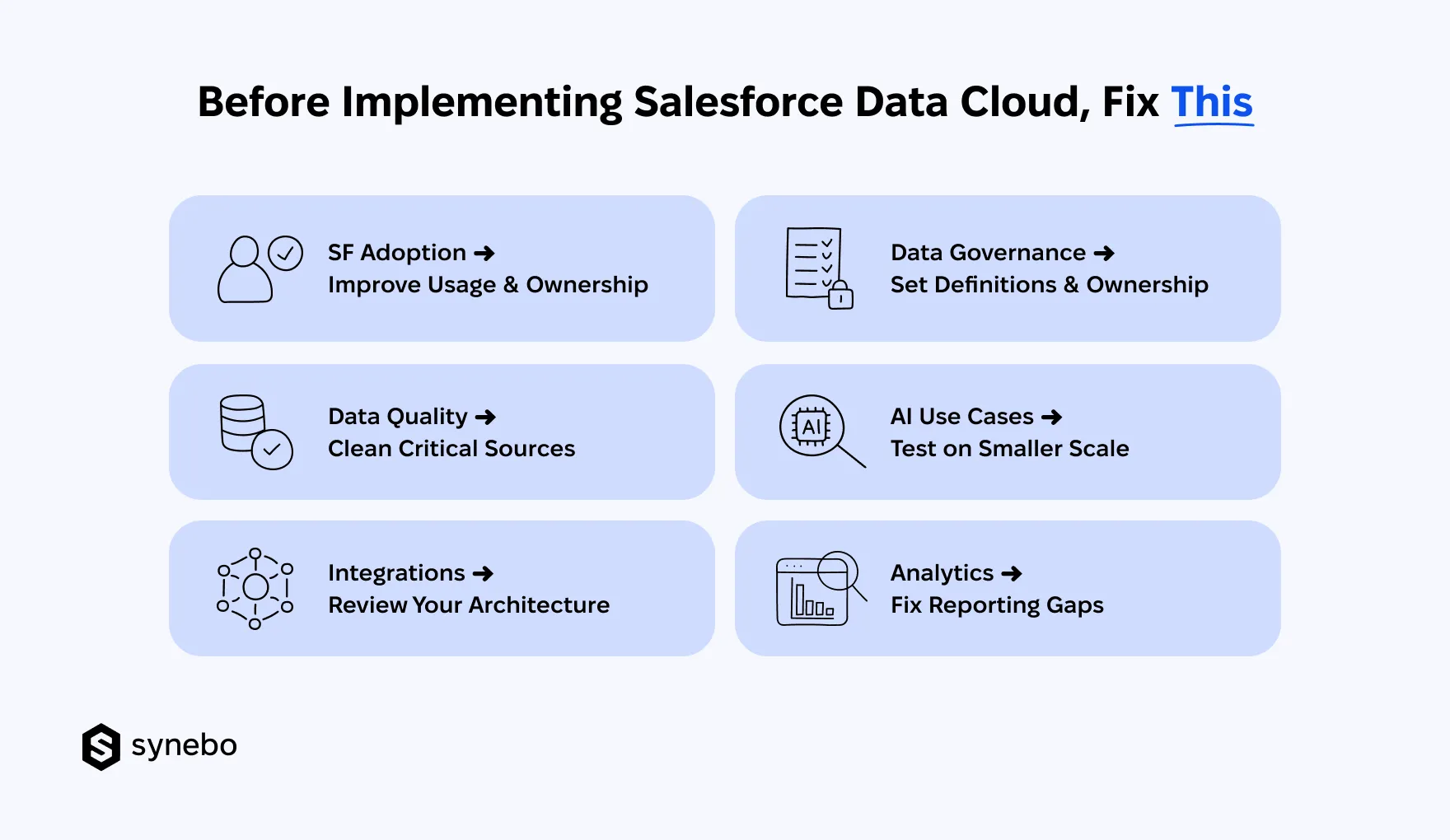
Before you put money into Salesforce Data Cloud, fix your SF data, integrations, governance. And your core use case.
For each of these gaps, there is a more practical next step to take.
1. Fix CRM Adoption & Ownership
If your people don’t trust, use, or maintain data in SF setup consistently, start right there. Define who owns key records, which Depts rely on them, what good adoption looks like. A broad Salesforce Data Cloud solution cannot compensate for basic gaps.
2. Clean Critical Data Sources
Bad inputs will not become useful because they enter Salesforce Data 360. Prioritize the datasets tied to your planned use cases. Then address duplicates, missing fields, outdated records, inconsistent formats.
3. Review Existing Integration Architecture
Map where your important data lives, plus how your systems exchange it now. Some companies need new Salesforce Data Cloud integrations. Others first need fewer point-to-point connections, clearer ownership, or a simpler data flow.
4. Establish Data Definitions & Governance
Decide what your key terms, records, metrics mean before combining them. This gives Data 360 experts something concrete to work with. It also helps prevent questions about governance halfway through the Сloud implementation.
5. Test AI or Customer-Experience Use Case
Before you implement a broader Salesforce Data 360 solution, a small pilot can give you many answers about data access, usefulness, expected value. This matters even more if you are preparing for Agentforce. Gartner reported that 63% of organizations either lack or are unsure they have the right data management practices for AI.
6. Improve Analytics If Reporting Is Actual Gap
If you need better dashboards, reporting definitions, analytics access, first address this need. Salesforce Data Cloud features may support broader use cases later. But they should not become an expensive detour from a reporting problem.
Let me give you one practical piece of advice from my experience: not buying Data Cloud today does not mean ignoring your data problem. I’d start by identifying what is getting in your way and focus on fixing іt first.
Buying Data 360 Is Not the Same as Implementing It
Please note: buying Salesforce Data 360 gives you the platform. Yet, it doesn’t give you a working data layer at once. After the licenses are in place, you still need a consultant to:
- Define the data architecture and decide where Data 360 fits which orgs will host it.
- Connect and map data sources across SF and external systems.
- Harmonize and resolve identities, so records can be used consistently.
- Set up access and governance with clear ownership.
- Ingest, validate, and activate your data for analytics, segmentation, SF applications.
This work requires architecture, configuration, data expertise. A clear implementation plan. So the cost of Data 360 is not just the license. It is also the time and work required to make the platform useful for your business.
Need help deciding what is getting in your way or what should come first? Hire Salesforce Data Cloud experts at Synebo to assess your data, integrations, and use case. Our specialists can help you understand the next step before you commit to Data Cloud.
When Does Salesforce Data Cloud Become Worth Your Investment?
It becomes worth considering when fragmented data starts limiting your business. When it affects your decisions, customer experiences, AI plans.
Тhese are the practical signals that Salesforce Data Cloud could make sense for your business.
Customer Data Lives in (Too) Many Systems
- Integrations Are Getting Harder to Manage. CRM, billing, support, commerce, marketing data require more connections to remain usable.
- New Reqs Add New Dependencies. Another point-to-point integration may solve one of your needs. But it adds more maintenance.
Your Different Depts Need One Customer View
- Different Business Units Need Shared Context. Sales, Service, Marketing, and more may (and need to) rely on the same customer info for different actions.
- Your Decisions Depend on Fresh Data. Outdated exports and delayed syncs can leave you working with info that is already outdated.
Personalization Depends on More Than Salesforce Data
- Customer Context Goes Beyond SF. Purchase history, website behavior, service interactions, engagement data sit in separate systems.
- One Action Needs Several Data Sources. This is where Salesforce Data Cloud use cases can become especially relevant.
AI Needs Broader Enterprise Context
- Salesforce Records Are Not Enough. Your SF AI project(s) may require customer, product, transaction, and/or service information from other systems. If useful AI actions depend on connecting thіs broader data, Salesforce Data Cloud deserves a closer look.
Your Business Has Outgrown Point-to-Point Connections
- Every New Integration Adds Work. More connections usually mean more dependencies, testing, monitoring, ownership questions.
- Several Projects Need Same Data. This can also signal that you may want to assess Salesforce Data Cloud implementation as a broader architectural option.
Multiple Salesforce Clouds Need Shared Data
- Several Clouds Use Related Info. Agentforce Sales, Agentforce Service, Agentforce Marketing, Agentforce Commerce may all need access to related customer info. Even when they support different parts of your business.
My other practical advice: don’t count your data. Сount how many times your teams have to reconnect it, clean it, or rebuild access to it. If the same customer data keeps becoming a new integration project, it may be time to rethink the architecture.
Seeing some of the signals in your setup? Synebo’s Salesforce Data Cloud consulting services can help you assess if Data Cloud is the best way forward. Talk to our experts to map the data problem before you invest in the platform.
Is Your Company Ready to Implement Salesforce Data Cloud?
Before you commit, take a quick look under the hood. Do you have the basics in place?
This checklist helps you understand.
☐ We Know What Problem Salesforce Data 360 Should Solve. There is a specific business or customer-experience problem behind the project. (It’s not just a goal to unify data.)
☐ Our Salesforce Data Is Reliable Enough. Critical records have reasonable data quality, ownership, definitions.
☐ We Clearly Understand а Use Case for Unified Data. Our Depts can name the decisions, processes, analytics, and/or Salesforce Data 360 use cases that depend on it.
☐ Our Current Integrations Have Real Gaps. We know what existing connections cannot handle. And why another data layer can add value.
☐ Our АІ Project(s) Has Specific Data Needs. AI is part of our roadmap, and we know which information its use cases require.
☐ We Know Who Will Implement Data Cloud. We have a Salesforce Data Cloud partner we trust. They can/will take care of the tech work and guide our implementation from architecture to deployment.
☐ We Can Define the Business Impact We Expect. We know what should improve, how we will track progress, who owns the result.
If you checked most boxes, you have a strong basis for evaluating Salesforce Data Cloud solutions. If not, the gaps above give you a starting point before you commit to the platform.
Still Wondering If Salesforce Data Cloud Is Right for You?
Salesforce Data 360 is not automatically the answer to your issues with records or AI plans. Or integration complexity. The right start is always your clear business reason. Then come defined use cases, reliable data, and a realistic implementation scope.
If these pieces are still missing, fix them first. If they are in place, your next question is how to implement this Cloud without making the project more complex or expensive. And this is where professional Salesforce Data Cloud implementation services can help. Synebo can look at what you have today, what you want Data 360 to do, and what the implementation would take.
So, if you are still wondering if Data Cloud is the right move, talk to Synebo’s Data 360 experts. Let’s see what makes sense for your setup.
You can think about Salesforce Data 360 implementation when dispersed data limits your decisions, CX, or AI plans. And also when you see clear Salesforce Data 360 use cases to justify this investment. Your data should also be reliable enough for unification. And your team should have a defined scope, ownership, and resources for this project.
Salesforce Data Cloud may be the wrong choice when the core issue is poor quality of your data, your people are reluctant (or hesitate) to use Salesforce, there is unclear ownership, or no practical use for unified data. If the business reason – the impact you expect – is still vague, Salesforce Data Cloud consulting can help test your idea before its implementation.
Before Salesforce Data Cloud implementation, define the business problem you want to solve. Then understand your priority Salesforce Data Cloud use cases, data sources, integration needs. Think of the value you expect. After that, assess your data quality, volumes, technical dependencies. A readiness review with Data 360 experts can help you expose gaps before your project gets underway.
There is no universal price for Salesforce Data 360. The total cost is usually shaped bу your SF setup, data volumes, required capabilities, integrations, implementation scope, internal resources. Salesforce Data Cloud consulting services will give you a clearer view of what your project will require.
Salesforce Data 360 implementation timelines are different from project to project, as data volumes, source systems, integrations, use cases, project scope vary. Typically, a focused setup may take weeks. Broader programs usually require more time. An experienced Salesforce Data Cloud partner can assess your setup and tell you what the implementation will require. And how long it will take.