How Much Does Agentforce Implementation Cost in 2026?
If you look for Agentforce implementation costs on the Net, most content offers vague ranges. And that is probably why Agentforce pricing has become one of the most actively searched topics inside the SF ecosystem in 2026.
The reason for such interest is obvious. More and more companies are moving from evaluating AI to actually funding it. KPMG says companies will spend about $207 mln on AI over the next year (roughly twice last year’s level). And these companies see the challenge.
You could’ve heard about Agentforce implementation complexity, hidden expenses, integration depth, and org readiness. Yes, these all influence the final figure. And none of them appear on a pricing page.
So, what will Salesforce Agentforce implementation actually cost you?
This article offers a detailed Salesforce Agentforce cost breakdown: licensing, implementation costs, operational overhead, and the factors that influence the total investment in practice.
Why Does Agentforce Pricing Feel Confusing?
Agentforce pricing feels confusing because the number most people see first rarely reflects how they will pay in reality.
SF promoted a simple “$2 per conversation” model, and this figure is technically correct. The catch is that it applies to a specific structure, one buying tier, and a fairly narrow use case profile. Apply it to a mid-complexity deployment with multi-step workflows, and the math stops working.
2 Models – And Why You Must Choose Before You Sign
In fact, Salesforce Agentforce pricing has several coexisting models:
- Flex Credits. With this model, priced at $500 per 100,000 credits ($0.10/20 credits per action), you pay for what the workflow actually does. You pay for every API request, data pull, decision AI capabilities make along the way. It is often a good fit for businesses with heavy automation usage and unpredictable interaction volumes.
- Conversations Model. A flat $2 per interaction (regardless of how many steps occur underneath). It’s really cost-effective if/when your workflows are simple and action counts stay low.
(Note: You can’t mix these pricing models in the same org. You have to choose upfront. So, it is important to consider not only your current needs but also future growth).
Employee-Focused Licensing Tiers
Beyond consumption-based pricing, SF offers several employee licensing options. The tiers package Agentforce access (unmetered usage), AI capabilities, industry-specific features, or bundled Flex Credits, depending on the license type.
Why Forecasting Agentforce Implementation Costs Gets Complicated Fast
At first glance, Salesforce Agentforce pricing and implementation look straightforward. Yet, once AI agents interact with CRM records, automate service tasks, trigger flows, access knowledge bases, connect with external systems, the economics become much harder to predict.
One of the biggest surprises for buyers is that AI costs are not always tied to conversation length. A short exchange may initiate numerous backend operations. On the other hand, a long discussion may consume far fewer resources.
This dynamic heavily influences what determines the cost of Salesforce Agentforce.
Why Total Cost of Ownership Gets Underestimated
Most Salesforce Agentforce cost breakdown conversations stop at licensing. They shouldn’t. Because Agentforce implementation cost also includes – among other things – configuration, integrations, testing, governance, user adoption, ongoing optimization, and more. These points also explain why actual Salesforce Agentforce implementation costs may exceed your initial expectations.
And this is exactly why businesses that evaluate Salesforce Agentforce pricing and implementation should look beyond published rates.
Read Also: Should You Adjust CRM Strategy After Salesforce’s Rebranded Clouds?
What Actually Drives Agentforce Implementation Costs?
Licenses rarely or never become your largest expense. The biggest drivers of the Salesforce Agentforce implementation cost are usually behind the scenes – in data, architecture, integrations, governance, and deployment scope. Two companies can purchase the same Agentforce package but end up with dramatically different budgets.
Biggest Cost Drivers
Here are the areas that tend to have the biggest impact on your overall Agentforce implementation costs.
Salesforce Foundation
- Readiness of Your Edition. Companies on Professional Edition cannot access Agentforce without first upgrading their Salesforce edition. This is a separate budget that precedes any Agentforce implementation conversation.
- Readiness of Your Data. Agentforce reads from Data 360 records. If your CRM records are not clean and reliable, agent performance and containment rates drop. What’s more: you – alas – end up paying for an AI that confidently acts on wrong information.
Workflow Types
This is where “What determines the cost of Salesforce Agentforce” gets very concrete. SF’s own examples show the gap: case management runs nearly $1,800/month in credit consumption, Field Service – around $360/month, employee onboarding – only $10/month. The same platform and the same pricing model. Yet, cost variance is driven by action count per workflow.
But workflow design is not the only cost driver.
- Customer-Facing vs. Internal Agents. Your use case matters. Why? The Conversations model is designed (primarily) for customer-facing AI agents. Employee-facing ones often rely on Flex Credits. Or dedicated employee licensing options. And this can also affect your overall Agentforce implementation costs.
- Depth of Integrations. If your source data lives outside SF (in your ERP, data warehouse, legacy system), connecting it to Data 360 also requires additional implementation work and ongoing maintenance. (Please note: each external source is a separate scoping and build item that directly affects Agentforce implementation costs).
Partner & Services Costs
- Consulting Rates. On today’s market, Salesforce Agentforce implementation partner rates can often be found in the $120–$250 per hour range. (Larger consulting firms may charge $350+ per hour). Full deployments with a qualified Agentforce implementation company range from $50K to $200K, depending on the scope, the number of agent types, the integration complexity.
- AI Agent Management and Oversight. Multi-agent workflows, routing rules, and security requirements add configuration overhead. It, surely, extends the Salesforce Agentforce implementation timeline. Аnd requires skilled Agentforce implementation experts to execute correctly.
- Optimizations. Persistent tracking of agent performance, refinement as SF release updates, or your business processes shift – these all also add to your Agentforce implementation cost. And what’s important: this is an ongoing job, not a one-time one.
Sandbox Testing
One implementation area that companies frequently overlook is testing. As Stanford researchers found, AI can make up incorrect information anywhere from 3% to 88% of the time. It depends on how complex the task is and how much reliable data it сan use. So, proper testing before production launch is a critical part of Agentforce implementation. And it directly affects both project timelines and overall implementation costs.
Overall, what influences the cost of Salesforce Agentforce, ultimately, is how far your deployment is from a basic single-agent, internal-only, clean-data scenario. Many enterprise deployments sit very far from it.
Every Agentforce implementation is different. If you need help to estimate costs, our Agentforce implementation services can help you evaluate your architecture, estimate implementation effort, and build a deployment roadmap. Contact Synebo.
What Are Hidden Agentforce Implementation Costs Companies Often Miss?
Most overlooked Agentforce costs come from making the business ready for AI: fixing data quality issues, redesigning workflows, governing agent behavior, maintaining the environment over time.
Hidden Expenses That May Catch You Off Guard
Many companies discover these costs only after they complete planning and approve their budgets:
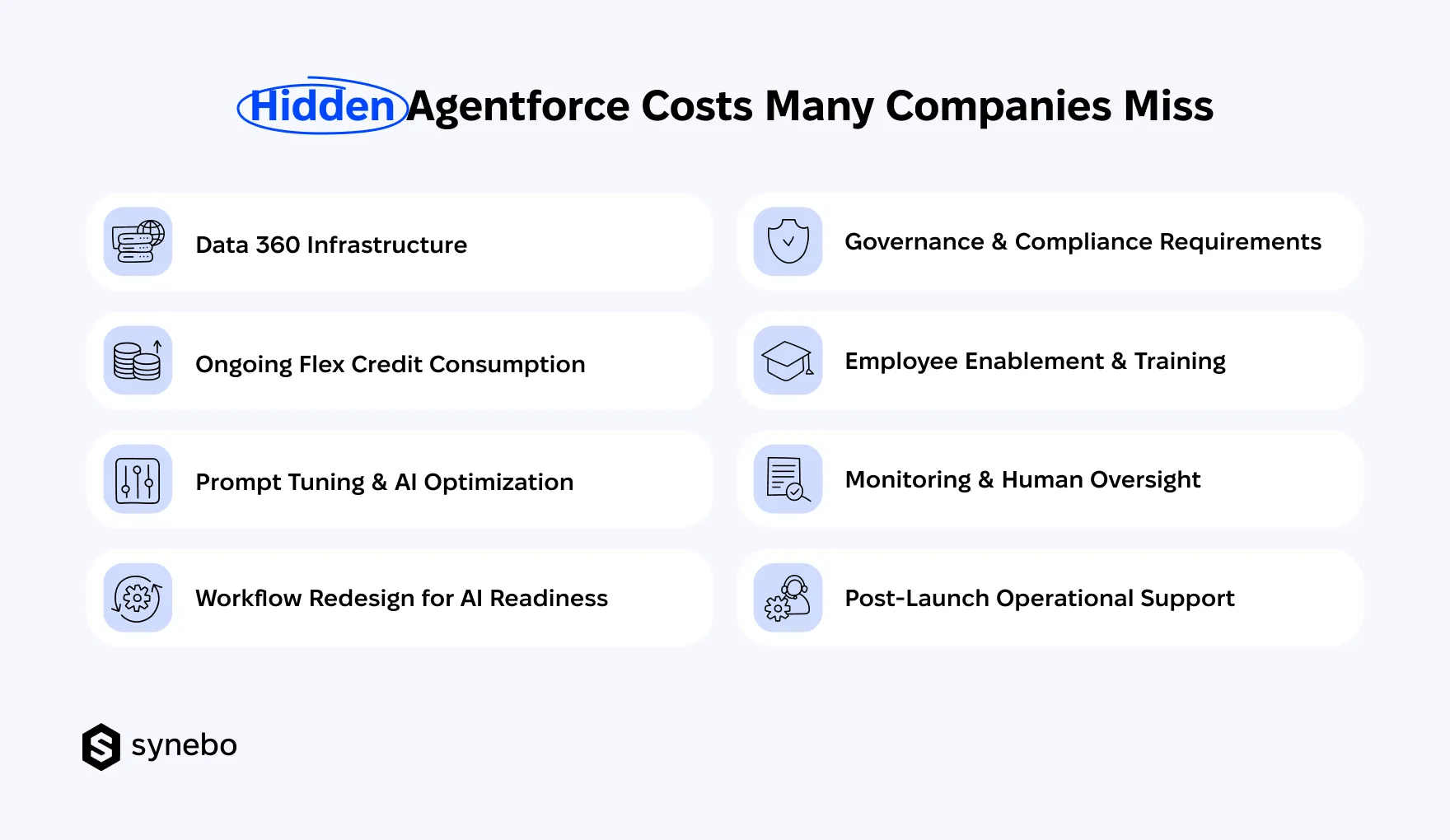
- Data 360 Consumption Costs. This can – arguably – be the most overlooked component in many Salesforce Agentforce cost breakdowns. Under the current Flex Credits model, Data 360 pricing starts at $500 per 100k credits. If you process large volumes of customer data, annual Data 360 spending can quickly grow into a big budget category.
- Ongoing Flex Credit Consumption. You may underestimate how quickly Flex Credits can disappear, as the same credit pool may support both Agentforce and Data 360 activities. Heavy data queries, segmentation, activation, retrieval, agent actions can draw from the same budget. (Overall, credit management is one of the factors influencing long-term Salesforce Agentforce implementation cost).
- Prompt Tuning & AI Optimization. AI agents rarely perform at their best at once. You’ll have to refine prompts, adjust responses, improve retrieval logic. And evaluate outcomes for months after deployment. These activities also create ongoing costs.
- Workflow Redesign. Agentforce automates processes. But it cannot repair inefficient ones. Many companies discover their existing workflows require simplification, consolidation, or even complete redesign before AI can deliver serious results.
- Governance & Compliance Requirements. Security reviews, approval frameworks, audit requirements, access controls, legal assessments, and more require time and budget. The more regulated your industry is, the larger this investment tends to become. So, this is another factor that influences overall Agentforce implementation costs.
- Employee Enablement. Agentforce (as any other new technology) succeeds when people use it effectively. So, training programs, communication plans, support materials, and adoption projects/initiatives also often remain under-budgeted. Despite their direct impact on business outcomes. Experienced Agentforce implementation partners typically include adoption planning as part of the deployment strategy.
- Monitoring & Human Oversight. AI agents require supervision. Teams need performance tracking, quality reviews, escalation handling, usage analysis, and regular audits to maintain reliability and control operational risk.
- Post-Launch Operational Support. Business processes evolve. Salesforce develops new functionality, data sources change – and AI behavior requires periodic adjustment. These activities become part of the long-term Agentforce implementation services costs.
Our experience proves that one of the main reasons that first-year Agentforce implementation costs may exceed expectations is how purchases are presented during the sales process. In many cases, Agentforce licensing appears as one line item.
As a result, a company may approve a $50k Salesforce Agentforce implementation cost estimate and later discover that supporting Data 360 capabilities requires an additional investment. This does not mean the original quote was incorrect. It simply means the quote reflected Agentforce licensing, not the complete environment required to support enterprise-scale AI.
Practice shows that hidden costs can increase the total Salesforce Agentforce implementation cost by up to 300% beyond the licensing figure alone.
How Much Does Agentforce Implementation Cost? Realistic Budget Ranges
The answer to “How much does Agentforce implementation cost?” depends on deployment scope, data requirements, integration volume, operational maturity.
More importantly, Total Cost of Ownership (TCO) and licensing are not the same number.
Small & Focused Deployments
- Typical Budget Range. Approximately $15k-$100k during Year 1.
- Common Use Cases. Internal support assistants, knowledge search, employee help desks, simple automation scenarios.
- Main Cost Components. Licensing, relatively fast Agentforce implementation cycle, basic integrations, relatively modest data requirements.
TCO Gap. In many cases, your final spend may remain quite close to the original quote because Agentforce implementation complexity is manageable.
Read Also: AI in Salesforce: Use Cases for Smarter Sales, Support, and Marketing
Mid-Size Operational Rollouts
- Typical Budget Range. Approximately $100k–$250k during Year 1.
- Common Use Cases. Automation of сustomer service, multi-team workflows, service operations, sales support, AI-powered process execution.
- Main Cost Components. Agentforce licensing, Data 360 infrastructure, implementation project(s), plus optimization and operational support.
TCO Gap. This is where many companies may encounter their first surprise. Licensing may represent only a part of the total Salesforce Agentforce implementation cost. Data, integrations, governance, ongoing support frequently account for a larger share of your budget.
Enterprise-Scale AI Ecosystems
- Typical Budget Range. Approximately $250k or more during Year 1.
- Common Use Cases. Global customer operations, large service organizations, complex compliance environments. High-volume AI interactions. Еxtensive automation programs.
- Main Cost Components. Advanced architecture and large integration ecosystems. Governance frameworks. Data 360 consumption. Implementation programs, dedicated operational support team(s).
TCO Gap. Enterprise organizations typically experience the largest difference between the initial quote and actual spending. Because ongoing support, optimization, monitoring, enhancement activities alone can range from $50k–$100k+ annually after launch.
“The most common budgeting mistake is treating licensing as the project budget. It is not. A proper Salesforce Agentforce cost breakdown should include licensing, implementation, data infrastructure, support, optimization, governance, and adoption activities,” says my colleague Anatoly Voronov, CTO at Synebo.
That is why an experienced Agentforce implementation partner usually estimates costs using a full TCO model. It provides a far more accurate view of what you are likely to spend during the first year of Agentforce implementation.
Evaluating Agentforce? Need a realistic budget assessment? Synebo can help. As an experienced Salesforce Agentforce implementation partner, we provide architecture reviews, implementation planning, and TCO modeling – delivering high-quality expertise at a cost-conscious rate. Let’s talk.
How to Keep Agentforce Costs From Escalating
The best way to control Agentforce implementation cost is to make key architectural and operational decisions before your usage starts to scale.
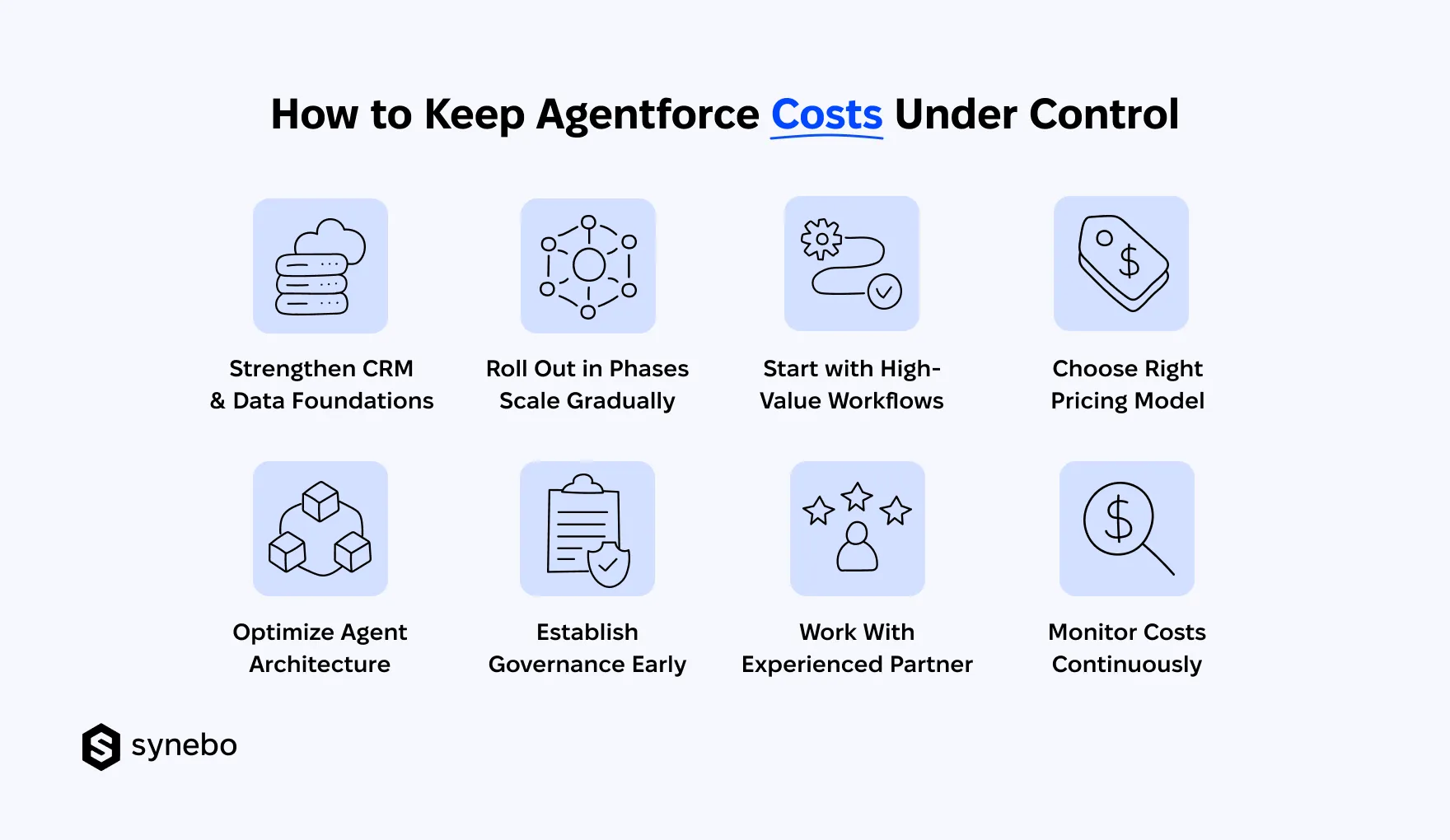
- First Build Strong CRM & Data Base. Dirty data does not become more reliable when AI sits on top of it. Better data quality leads to better agent performance and lower Agentforce implementation complexity.
- Roll Out іn Phases. A focused deployment is relatively easy to manage (easier than an enterprise-wide launch). It also gives you time to see results before expanding further.
- Start With Your Highest-Value Workflows. With those processes that handle large volumes and deliver real value. These use cases provide the fastest ROI.
- Choose Right Pricing Model. This decision deserves careful attention. Because moving from Conversations to Flex Credits, if you have an active contract, may require replacing existing SKUs. It introduces unexpected commercial and admin effort.
- Optimize Agent Architecture Upfront. Careful design helps reduce unnecessary AI actions and data retrieval requests. And so – avoidable credit consumption.
- Establish Governance Early. Because decisions around access, approvals, spending, escalation are much harder to revisit after adoption starts accelerating.
- Select Experienced Partner. A knowledgeable Agentforce implementation partner can see risks early and save time and your budget. They can also recommend more efficient Agentforce implementation solutions.
Finally, we can recommend that you continuously monitor your costs. SF Digital Wallet helps you monitor how Agentforce is being used. Аnd so make more informed budgeting decisions.
What Budget Should You Really Plan For Agentforce?
The answer to “How much does Agentforce implementation cost?” is rarely the number shown on a pricing page. Licensing costs tell only part of the story. Much of your budget is (or will be) tied to ecosystem preparation, cross-system coordination/integrations, operational oversight, readiness of your staff, continuous improvements, ongoing management.
If you build a realistic budget early, you’ll see stronger ROI and fewer surprises later.
Before you commit а budget, make sure you are solving the right problem with the right AI model. A few decisions can shift your projected costs by tens or even hundreds of thousands of dollars.
Talk to Synebo’s Salesforce Agentforce experts to evaluate your environment, uncover hidden cost drivers, and build a realistic implementation roadmap – affordably.
The realistic Agentforce implementation cost range in 2026 starts around $15k–$100k for focused deployments and can exceed $250k for larger enterprise programs. In practice, organizations are not paying for an AI agent alone. They are funding the infrastructure and business environment readiness required to make that agent useful, reliable, and scalable.
Budgets may increase because AI usage expands. New workflows, additional business teams, higher consumption of data. Plus, AI optimization and operational support – these all contribute to rising costs. This is one of the main reasons why companies underestimate Agentforce implementation costs during initial planning.
Not always. Yet, many advanced Agentforce use cases really rely heavily on Data 360 (former Data Cloud) capabilities. The more context, customer data, and personalization an AI agent needs, the more important Data 360 becomes. That is why, Data 360 may appear as a major component іn your Salesforce Agentforce cost breakdown.
Yes, many orgs can adopt Agentforce without its complete rebuild. Your success, however, depends on the current state of your SF environment. Older integrations, fragmented/inconsistent records, outdated processes may require modernization (usually they do) before AI deployment. And these factors significantly influence Agentforce implementation complexity and your long-term project costs.