Agentforce in Healthcare: Improving Patient Engagement and Support
Your patients don’t compare your healthcare organization with another hospital anymore. They compare you with every great digital experience they have. Your organization can impress your patients – and improve engagement – by implementing Agentforce in healthcare. AI in Salesforce automates communication, reduces response times, supports your patients between visits.
Recent research by Philips also shows growing readiness of healthcare providers for AI. 85% of medical professionals say it can reduce admin workloads.
This is where – specifically, in reducing admin workload – Salesforce Agentforce for healthcare creates value. Instead of replacing care teams, it handles routine requests, supports appointment scheduling, follow-ups, and onboarding. And does so much more.
So, what is Agentforce for healthcare? Let’s learn the most valuable use cases, understand where to begin the Agentforce implementation, and see the business outcomes you can realistically expect.
How Can Agentforce Improve Patient Engagement Between Visits?
Most patient relationships don’t break inside the clinic. They break between visits. Agentforce in healthcare helps keep your relationships with patients strong. It reminds patients about upcoming visits, checks if they follow their care plan, answers typical questions, sends helpful guidance, and more.
A recent PLOS study found that patients who interacted with reminders had 19% higher prescription fill rates and 6% lower readmission rates than those who did not.
Meanwhile, patient reminders and care-plan follow-ups are among the most valuable Agentforce use cases for healthcare. With SF AI, you don’t wait for patients to reach out to their healthcare providers. AI agents check in after every visit, using your patient data, care plans, and preferred channels. And deliver messages from your clinic.
Here are the areas where Agentforce in healthcare has the most to offer:
- Reminders About Appointments. Patients receive timely reminders, preparation instructions, and rescheduling options. These reduce no-shows. What’s more, your staff has no extra work.
- Ongoing Care Plan Check-Ins. Healthcare AI agents check if your patients completed recommended steps. Agents gather feedback and detect possible concerns. Then – notify healthcare providers when their attention is needed.
- Support for Medication Adherence. Agentforce for healthcare helps your patients stick to their medication schedules. It sends reminders, refill notifications, and simple check-ins. Those encourage your patients to stay on track between visits.
- Helpful Content on Healthcare. Patients receive recovery tips, condition-specific guidance, and/or tips on lifestyle. These all are based on their diagnosis and help them feel informed long after leaving the clinic.
For your patients, Agentforce for healthcare organizations means quick answers, timely and clear updates, fewer unanswered questions. For your providers, it reduces admin workload, increases follow-up completion, strengthens relationships with patients. It gives your care teams more time for jobs/conversations that require clinical expertise.
Is Patient Data Safe with Agentforce?
Healthcare organizations understandably have one key question before they introduce AI into their communication with patients: Will sensitive medical data remain protected?
Agentforce for healthcare ensures exceptional security:
- It keeps sensitive data unreadable to unauthorized users
- It gives you precise control over permissions
- It maintains a detailed history of system activity
- It supports consistent oversight across AI operations
The platform supports HIPAA-ready implementations for healthcare organizations in the U.S. It also helps address privacy and security requirements under regulations such as GDPR in the EU. А well-designed Agentforce implementation ensures AI assists your patients and doesn’t expose their confidential medical info.
Want to improve patient engagement with AI? Synebo’s Agentforce consulting services can help you turn your ideas into successful AI projects. Let’s talk.
Which Patient Support Workflows Should Healthcare Organizations Automate First with Agentforce?
The best place to start Salesforce Agentforce implementation in healthcare is not the most complex process. Choose the one your staff repeats hundreds of times every day. High-volume, rules-based workflows usually deliver the fastest operational gains. They consume valuable staff time and don’t require clinical judgment.
Read Also: What Is Agentforce? How AI Agents are Reshaping Business
If you’re evaluating Salesforce Agentforce healthcare use cases, these are some ideas before you move to more advanced scenarios.
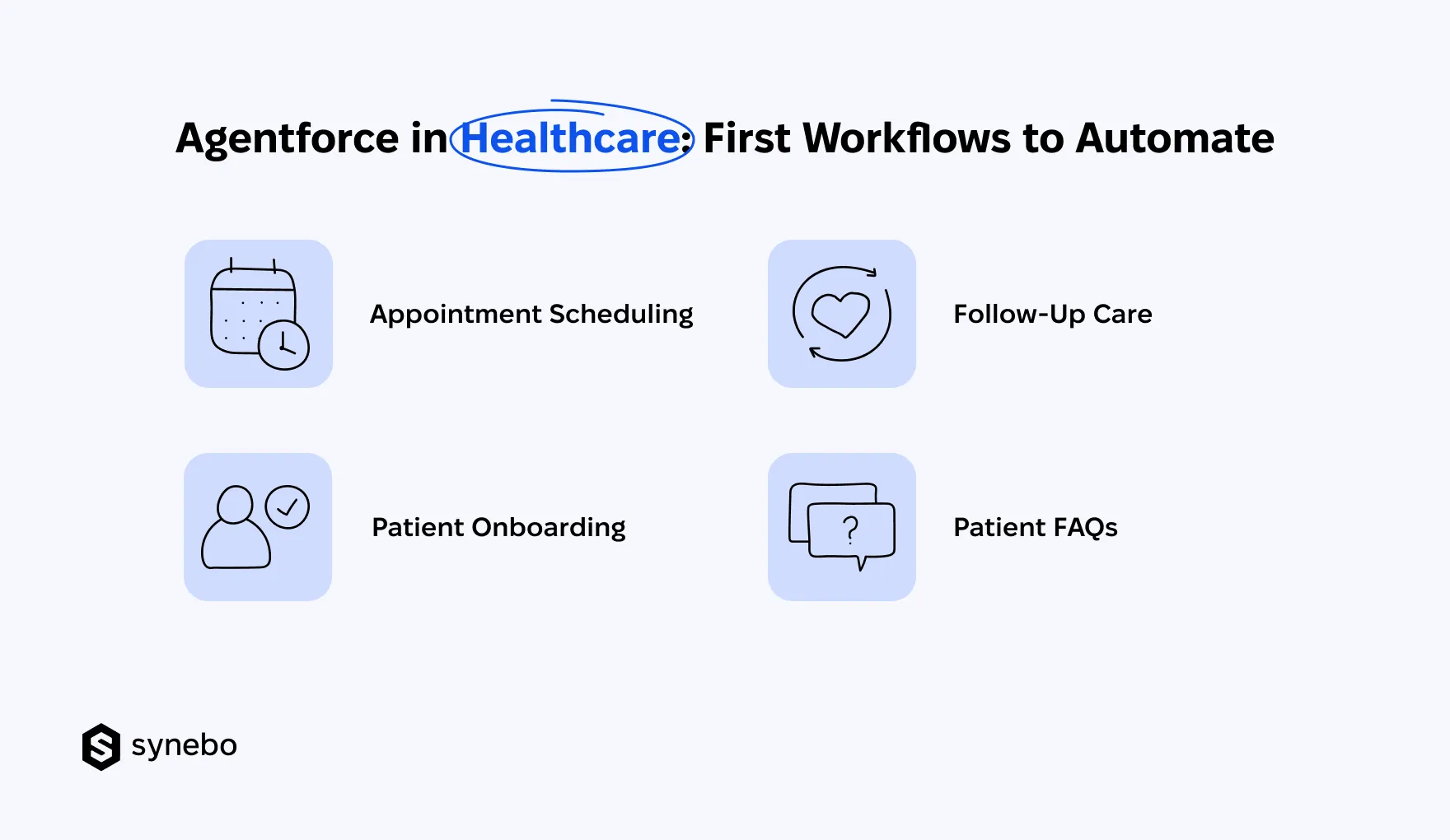
Appointment Scheduling & Rescheduling
Because it follows rules and happens at scale, appointment management is one of the strongest starting points for AI agents for healthcare.
AI helps:
- Reduce Volume of Incoming Calls. Your patients can book, cancel, reschedule their visits themselves. You eliminate those annoying wait times on hold and give your front-desk team time for complex requests.
- Provide Faster Access to Care. Agentforce agents instantly suggest available time slots and offer alternatives if/when schedules change. Agents also help fill last-minute cancellations.
- Offer 24/7 Self-Service Support. Patients can manage their visits outside your business hours. They do it through whatever communication channel, even when your clinic is closed.
Patient Onboarding & Intake
The first interaction with a healthcare provider sets the tone for everything that follows. Agentic AI in healthcare can simplify this experience – before your patients arrive.
It handles:
- Complete Forms. Digitally. Your patients receive intake forms in advance – before their visit. This reduces paperwork at the front desk in the clinic. This also shortens check-in time.
- Collect Required Docs. Before the appointment, AI-driven agents request missing insurance cards, referrals, identification, medical records. And confirm that everything has been submitted.
- Verify Eligibility. Agentforce for healthcare can guide your patients through eligibility checks. It also notifies your staff when additional review is required.
Follow-Up Communication
Many healthcare organizations lose valuable opportunities after their patients leave the clinic. This is where Agentforce use cases get especially practical.
AI capabilities help with:
- Post-Visit Check-Ins. Agentforce AI agents ask simple recovery questions. Plus – collect patient updates and alert your team when responses indicate some concerns.
- Care Instructions. Your patients receive recovery guidance, preparation details for their future visits, or reminders about recommended steps based on their care plan.
- Making Visits Easy to Manage. Agentforce for healthcare helps patients keep track of their appointments. And helps reschedule their visits if plans change.
Frequently Asked Patient Questions
Many questions are repetitive and predictable – follow the same pattern. This repetitiveness makes them ideal Salesforce Agentforce healthcare use cases.
AI takes care of:
- Clinic Information. Your patients can quickly find your opening hours, location, parking details, accepted insurance plans, contact information. And more.
- Appointment Status. Agentforce in healthcare answers questions about upcoming visits, changes in schedules, cancellations, requests about confirmations, etc.
- Instructions for Preparation. Your patients receive guidance before their procedures, laboratory tests, specialist appointments. Without staff having to answer questions themselves.
The common thread behind these examples is simple: start with repetitive, high-volume, rules-based work. Those processes usually produce faster returns and lower admin workload. They provide a better experience for your patients without disrupting your clinical operations.
Read Also: How Much Does Agentforce Implementation Cost in 2026
As my colleague, Victoria Khanchevska, Salesforce Architect at Synebo, says, once these workflows perform reliably, you can expand Agentforce implementation solutions into more advanced patient support scenarios. And each phase will become easier for you to evaluate and scale.
Don’t start by automating everything. Start with the workflow that will make the biggest difference – and let Synebo, as your Salesforce Agentforce implementation partner, help you build from there. Contact us.
Can Agentforce Reduce Response Times and Improve Patient Satisfaction?
Yes – іf it takes repetitive requests off your team’s hands. Мost delays in healthcare have little to do with medicine. They happen while patients wait for someone to answer the phone, find the right department, check their records, or respond to a routine question.
According to a Press Ganey report, nearly half of consumers have scheduling problems, experience long wait times or poor communication before an appointment. Four out of five say online scheduling influences their choice of provider.
For many healthcare organizations, the challenge is the team at their contact center that spends hours answering the same questions, transferring calls, and tracking appointment requests. By the time a patient receives an answer, their experience may already feel frustrating.
These are just the areas Salesforce Agentforce healthcare use cases can address:
- Route Requests to the Right Places. SF Service Cloud Assignment Rules work well for predefined request types. But healthcare conversations are often less predictable. An AI agent understands the patient’s intent, resolves routine requests, and routes only those that require judgment to the care team. This reduces wait times for everyone.
- Keep Every Conversation Connected. With SF Data 360 providing a unified patient profile, Agentforce in healthcare gives your patients the same accurate information in chats, SMS, emails, and patient portals. People receiving care don’t have to repeat themselves every time they switch channels.
- Give Your Staff More Time for Patients. It also changes how your care teams spend their day. Instead of answering dozens of identical questions, staff focus on work with patients who truly need their expertise and attention. This significantly improves your staff productivity.
AI agents in healthcare let your patients notice the difference quickly:
- They Get Answers in Seconds. Simple requests no longer compete with urgent calls.
- Complex Cases Reach The Right Team Fast. AI collects the necessary details, understands the context of each request, and routes conversations to the most appropriate care team. Your staff steps in with the right context from the start.
- Information Stays Consistent. Every channel reflects the same clinic policies, appointment details, patient history.
- Care Is Better Connected. With Agentforce 360 for healthcare, patients don’t need to repeat info every time they contact your clinic.
- Every Patient Gets More of Your Team’s Attention. Admin burden decreases. There is more time for people who need answers, reassurance, clinical support.
The biggest benefit of Agentforce in healthcare isn’t merely fast replies. It’s giving your patients confidence that your clinic is always ready to help. Be it routine “when?” and “how?” or situations where human expertise matters most.
What ROI Can Healthcare Providers Realistically Expect from Agentforce?
The ROI of Agentforce in healthcare usually appears in operational metrics before you see them in financial reports. Because when routine work moves to AI, healthcare organizations spend more time just delivering care.
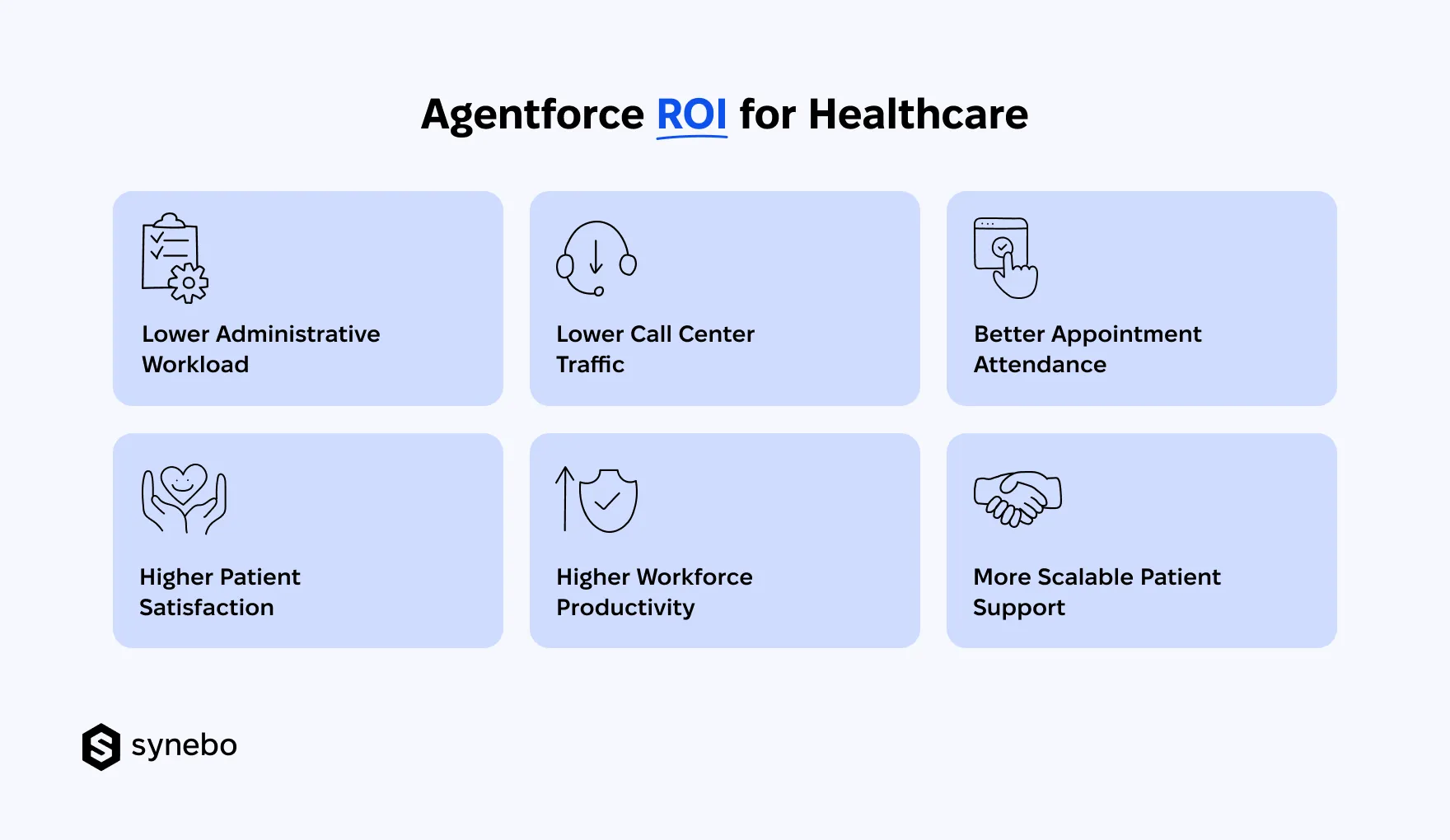
- Less Busywork for Staff. Your providers spend more time helping people with complex needs.
- Fewer Сalls to Your Contact Сenter. Salesforce Agentforce agents handle common questions before they turn into another call to your patient helpline.
- Fewer Missed Visits. Reminders and easy rescheduling help your patients keep up with their care.
- Happier Patients. Prompt answers and reliable communication improve the overall experience of your patients.
- Higher Productivity with the Same Team. Your staff handles more patient requests. Without adding more people to the roster.
- Call Center That Keeps Up as Demand Grows. You can serve more patients without piling more work onto already busy providers.
However, Salesforce implementation in healthcare is not a feature you switch on overnight. The strongest results depend on preparation before the first AI agent goes live.
Important is:
- Data. Accurate – high-quality – patient data is the foundation of successful AI interactions.
- Communication Processes. They must be well-defined. Clear workflows help AI bring correct answers to people at the right time.
- Knowledge Base. It must be reliable. AI is as good as the content it can access. So, it must be current and trusted.
- Governance & Compliance. Healthcare regulations should guide every workflow and response.
- Workflow Design. The best Salesforce Agentforce implementation starts with simple, repeatable processes (more advanced scenarios come later).
“The quality of your AI will never exceed the quality of the data and workflows behind it,” sums it up Victoria Khanchevska.
How Should Healthcare Organizations Get Started with Agentforce?
Healthcare organizations don’t need to redesign every patient interaction at once. When implementing Agentforce in healthcare, pick one high-impact workflow and prove the value. Then expand to additional patient support processes.
For organizations adopting Agentforce 360 for healthcare and life sciences а practical rollout usually looks like this:
- Choose High-Volume Patient Interactions. Focus on the requests your team receives every day (examples: appointment scheduling, follow-ups, FAQs).
- Evaluate Your Data & Knowledge Readiness. Тo provide trustworthy answers, Agentforce in healthcare depends on accurate patient data, plus a reliable knowledge base.
- Pick One High-Impact Use Case for Agentforce. Start with a process that creates visible value for both your patients and staff.
- Launch A Pilot. Before you roll it out more broadly, test Agentforce with a small group of users.
- Analyze Results. Track response times, appointment attendance, patient satisfaction, administrative workload.
- Expand. Step By Step. When your team sees good results, build on this success – introduce additional Salesforce Agentforce use cases.
For many healthcare providers, scheduling, patient onboarding, follow-up communication are the best starting points. These workflows affect thousands of patient interactions and allow you to see the capabilities of Agentforce in healthcare.
From AI Strategy to Better Patient Care
So, you don’t need a bigger team to deliver better experiences for your patients. You need the right workflows, reliable data, and a clear AI implementation strategy. If patients keep waiting and staff keep repeating the same tasks, you’ve already found the first problem Agentforce in healthcare should solve.
If you’re evaluating Salesforce Agentforce implementation services, Synebo can help you turn your Agentforce plans into a working solution. Fast and affordably.
Our Agentforce consultants will help you separate high-impact AI opportunities from ideas that can wait. So every implementation step will solve your real business problem.
AI isn’t valuable because it answers questions fast. It’s valuable because your care teams stop answering the same questions over and over. That’s how we’ll approach your project as а Agentforce implementation partner. Contact us.
The most practical use cases of Agentforce in healthcare focus on patient communication and operational efficiency. Agentforce can automate scheduling of appointments, patient onboarding, FAQ handling, care-plan guidance, and more. Healthcare organizations usually see fast results when they start with high-volume workflows that repeat and consume much time of your staff.
The period depends on your goals, readiness of your data, complexity of workflows. A pilot AI project can launch in a few weeks. Bigger solutions may take several months. Experienced Agentforce implementation experts usually recommend proving one use case first. Then – expand to additional patient support processes.
No. Agentforce in healthcare handles much admin work (repetitive tasks), not clinical decision-making. It answers questions from your patients, schedules appointments, supports follow-ups, and more. This allows your care team to spend their time on patients that require medical expertise. That is why, to find the right balance between AI and human care, many clinics work with Agentforce specialists.
The strongest candidates are rules-based processes that repeat, plus those with high patient volume. Booking visits and first-step formalities, post-visit communication, medication reminders, FAQs usually deliver value early. A skilled Salesforce Agentforce partner can help you focus on the changes that will make the biggest difference and then design your next workflows.