What Does Salesforce Data 360 Implementation Look Like?
A Salesforce Data 360 implementation takes your data, systems, and business use cases and makes them work together inside Salesforce. It starts before configuration: you decide which use cases matter, what data belongs in scope, who owns key decisions, how success will be checked.
The Salesforce Data 360 scale is substantial. In Q2 FY27, Salesforce says Data 360 unified 25.3 bln profiles in production usage and over 104 trillion connected records, including 81.5 trillion Zero Copy rows (its approximately 78% of all connected records). These figures show both the scale of Data 360 usage and how much data it can connect without copying it into SF.
This article walks you through the Salesforce Data 360 implementation process, from planning and data preparation to go-live. It also explores risks and explains where architecture, resources, and business use cases shape the work.
What Makes Data 360 Implementation Different from Typical Salesforce Project?
A Salesforce Data 360 implementation is more involved than a typical Salesforce project because the work goes beyond SF configuration. You must decide what to connect, how to resolve identities, which use cases come first, how the setup should run in the long run.
The main areas that make the project more involved are:
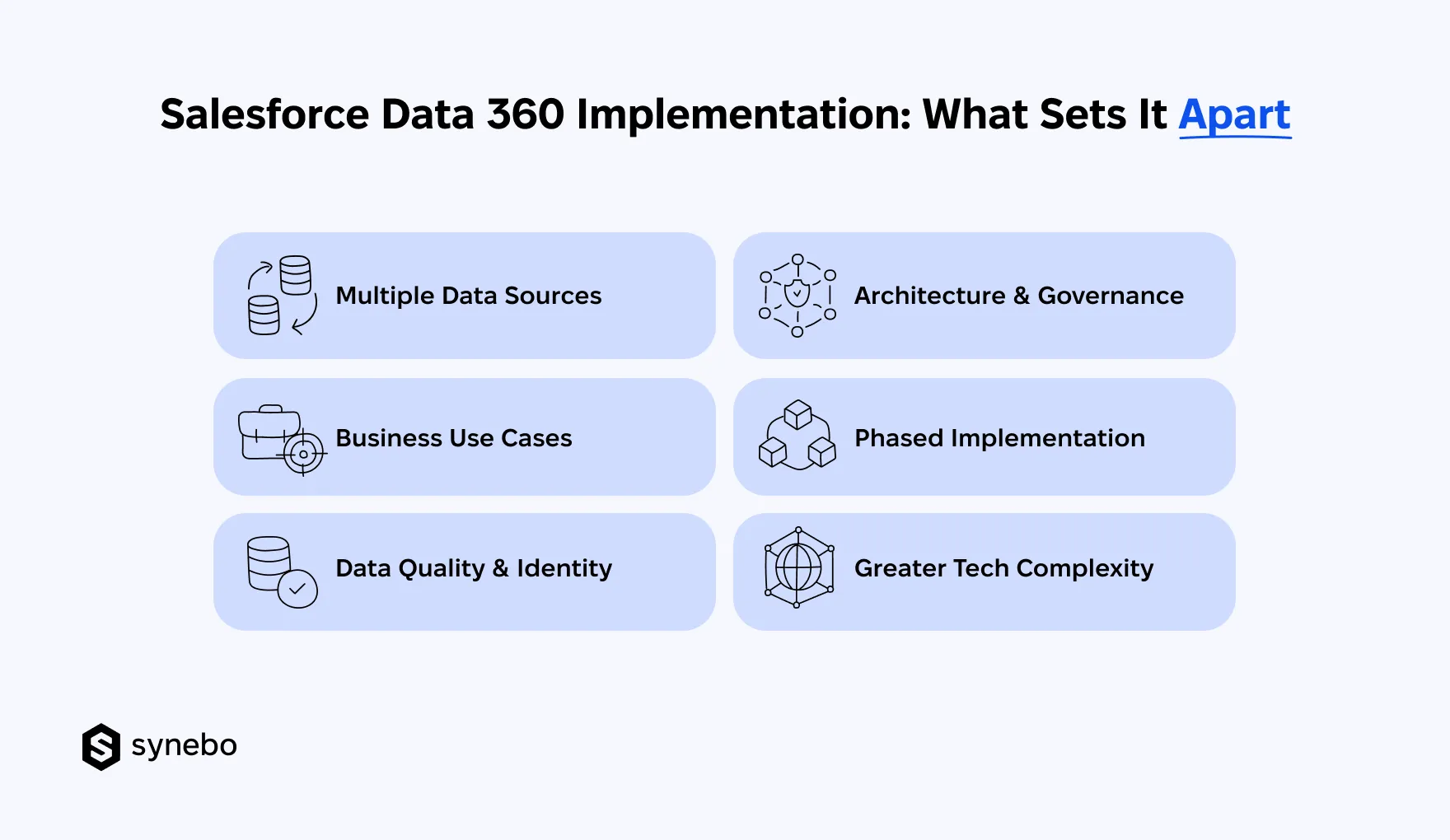
- Multiple Data Sources. Your customer data may be stored in CRM, ERP, commerce, service, marketing. And/or external platforms. Each source has its own format and refresh rules.
- Business Use Cases. Personalization, AI, analytics, service use cases shape Salesforce Data Cloud (Data 360) priorities (i.e., which data to connect, what to configure, and where to start).
- Same Customer, Different Records. Duplicate or conflicting information can affect unified profiles. Identity rules need definition before activation.
- Decisions Have Long Tails. Data access, retention, permissions, integrations, ownership also affect future Salesforce Data Cloud implementation work.
- Phased Implementation. Starting with one use case may make the first phase smaller. But each new use case can bring more data sources, integrations, identity rules, testing work.
- Greater Implementation Complexity. IT, Data teams, business stakeholders may all have a role. A Data 360 implementation is closer to a cross-functional program than a standard rollout.
Your Salesforce Data 360 implementation is shaped by your data estate and what you want to achieve with your data. Besides, the number of systems, quality of your records, integration needs, identity rules, planned use cases – all play their role. They affect your project scope, timeline, and resources required. So, your Salesforce Data 360 license is only one part of the implementation picture.
What Are Main Phases of Data 360 Implementation?
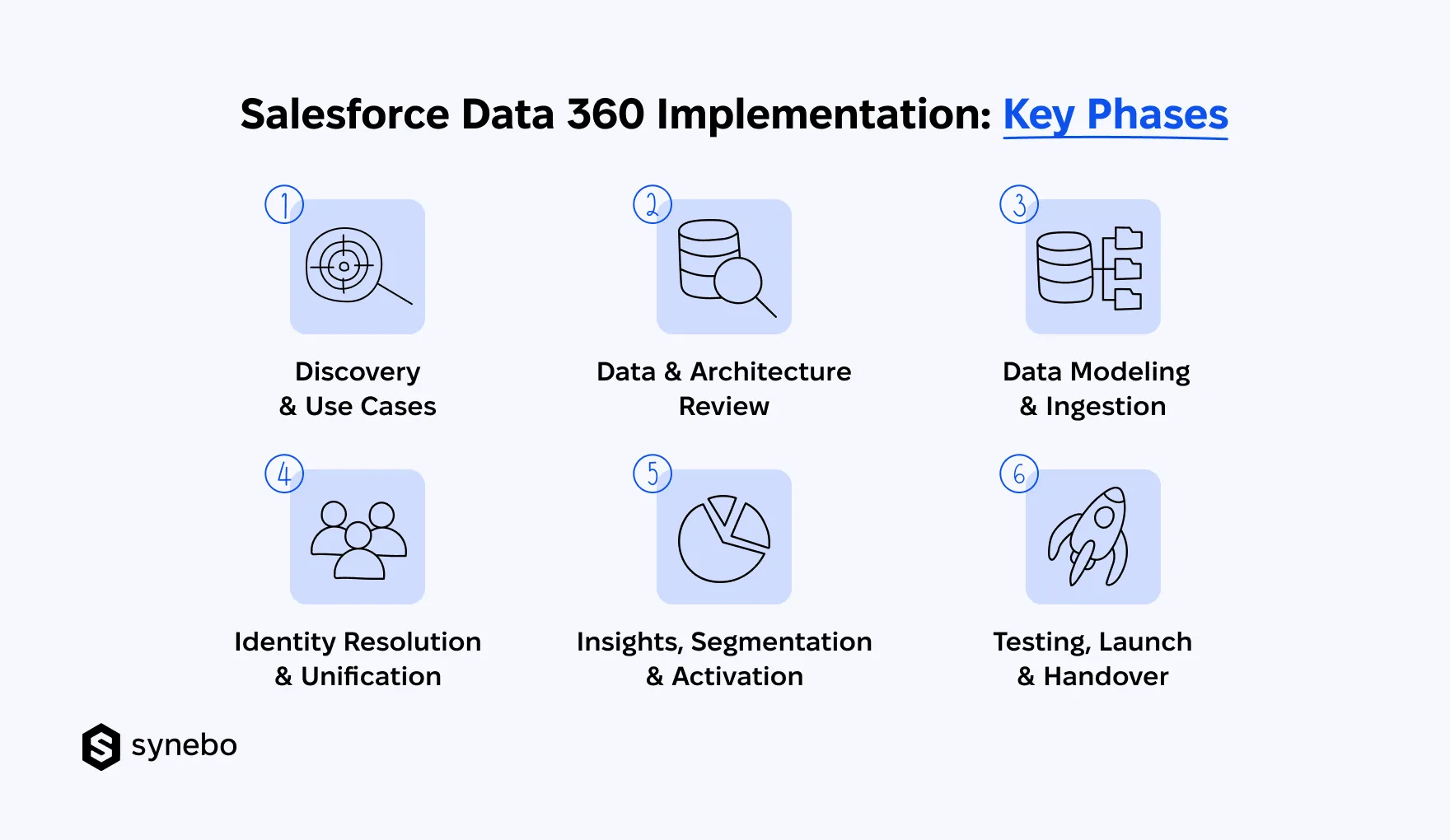
The Salesforce Data Cloud implementation process usually follows 6 phases – from business case to go-live and handover. These phases overlap in practice. So you may revisit your earlier decisions as new data, use cases, or tech constraints appear.
Now, let’s look at how to enable Data 360 in Salesforce through the main stages of an implementation.
1. Discovery and Use-Case Definition
The 1st phase defines what Data 360 needs to accomplish. You (your different Depts) select their priority use cases, users, expected outcomes, an initial scope.
Who should be involved: Executive sponsor, business representatives, SF owner / platform manager. Data 360 specialists / Salesforce Data Cloud implementation partner.
2. Data and Architecture Assessment
For Data 360 implementation readiness, you have to review source systems, quality of your data, integrations, security. The existing Salesforce architecture. Your goal at this stage is to establish what is ready, what needs preparation, which architecture decisions matter and should be preferred.
Who should be involved: Data/Analytics lead, integration specialists, SF owner / platform manager. Data 360 specialists / Salesforce Data Сloud partner.
3. Data Modeling and Ingestion
Your next stage is to define how source data maps into Data 360, plus set up ingestion paths. Data models, mappings, refresh requirements, governance rules take shape right here.
Who should be involved: Data/Analytics lead, IT / integration specialists. Salesforce Data Cloud implementation experts / partner.
4. Identity Resolution and Unification
Salesforce Data Cloud then connects records that represent the same person, account, entity. Important note: matching rules need careful validation. Рoor matches affect downstream use cases.
Who should be involved: Data/Analytics lead. Business representatives. Data 360 specialists or your implementation partner.
5. Insights, Segmentation, Activation
When unified data is available, you create the insights and segments you require for action. These outputs can then feed SF processes, experiences, channels that were defined during the discovery stage.
Who should be involved: Business representatives аnd a SF owner / platform manager. Salesforce Data 360 partner (or specialists).
6. Testing, Launch, Handover
The final phase checks data quality, integrations, identity rules. Permissions and business use case(s). Handover covers documentation, ownership, support, post-go-live priorities.
Who should be involved: Business representatives. SF owner / platform manager. Іntegration specialists. Salesforce Data Cloud implementation experts (or partner).
Read Also: Salesforce Data 360: Your Top 10 Questions Answered by Synebo Experts
From my experience, these phases rarely move in 6 neat boxes. Data modeling can uncover a source-system issue. Testing can expose a gap in the original use case. Identity resolution may send you back to data definitions.
That is normal in a Salesforce Data 360 project. If you are a project owner, this overlap is important – you need some room for iteration in the resource plan. And your major tech decisions should stay tied to the original business case. This keeps your project focused when the implementation inevitably raises new questions.
Read Also: When Is SF Data Cloud Wrong Choice? Synebo’s Perspective
How Long Does Data 360 Implementation Take?
A Salesforce Data 360 implementation can take several weeks if your project is focused (“small”), or several months, if your enterprise (and so Data 360 program) is large.
SF promotes a 4-to-6-week pilot approach if you want to validate one or two core data sources and one specific business case.
Yet, as my colleague, Victoria Khanchevska, Head of Delivery at Synebo, says: “The better planning question is not, “How many weeks will this take?” It is, “What needs to be ready for each phase so that we can move forward?”
True: data quality problems, integration work, governance decisions, an unclear use case can add time surprisingly quickly. This is why I treat Data 360 implementation readiness as an important part of project planning.
Planning your Data 360 project? Synebo’s Salesforce Data Cloud implementation services can help you assess your setup, plan each phase, and prepare for a smooth go-live. Contact us.
What Are Risks & Results of Data 360 Implementation?
Salesforce Data 360 projects can hit trouble when the scope keeps growing, source data is messy, ownership is unclear, and everybody believes the job is done at go-live. Strong results – on the contrary – appear when you tie the platform to your specific use case, prepare source data well and early, and define success after launch.
Here is what can put any Data 360 іmplementation аt risk – in detail:
- Trying to Connect Everything at Once. A broad first release can pull too many systems, data domains, integrations, identity rules into one project. A narrowed first use case instead gives you a practical boundary. It makes your resource needs easier to estimate.
- Starting with Technology Instead of Measurable Use Case. The platform should serve a business question, not become the business question. So, decide what you need to know, which data sources support this question, which metric can show progress. This all gives your Salesforce Data 360 implementation process a clear target.
- Discovering Poor Source Data Too Late. Data quality issues can easily change your timelines after integration work starts. SF recommends – before implementation – analyzing your existing data and data sources, reviewing data accuracy plus field-level details, and deciding how each source will connect to Salesforce Data 360.
- Now Knowing Who Owns What. Yet, someone needs responsibility for source data, identity rules, governance decisions, use-case priorities, post-launch monitoring. Your core team may include IT, Data & Analytics, SF owners, security, business representatives.
- Treating Go-Live as Your Finish Line. Your configured Salesforce Data 360 environment is… a starting point. Then you need usage tracking, data-quality checks, governance reviews, and regular assessment of priority-user needs.
What Should Success Look Like After Go-Live?
Your success should be visible in business terms. A useful Salesforce Data 360 implementation can produce trusted unified profiles, usable data for priority teams, faster access to customer insights. Stronger segmentation, better personalization, and practical AI use cases also become much easier to build.
Set these measures before launch. For better segmentation, track segment creation time or campaign performance. For faster insight, track the time needed to answer priority customer questions. For AI, monitor data quality, usage, accuracy, adoption.
In fact, your successful implementation shifts the question from “Is Salesforce Data 360 configured?” to “What can our business do better now?”
Need help getting your Data 360 project ready for implementation? Synebo is a Salesforce Data Cloud implementation company that can help you plan the setup, integrations, data preparation, and post-go-live work. Contact us.
What Does Experienced Data 360 Implementation Partner Actually Сhange?
An experienced partner changes the Salesforce Data 360 implementation from a platform setup into a plan for solving your specific business problems. You get help deciding what to connect, what to leave out, which use case to start with, what needs to be ready before each phase.
The technical work alone covers a lot of ground:
- Helps select your first use case
- Audits your data sources
- Maps data before configuration
- Defines identity resolution rules
- Рlans integrations and dependencies
- Sets governance requirements
- Defines post-go-live checks
More importantly, the right Salesforce Data Cloud implementation partner changes what the project looks like on your side:
- Scope Gets Smaller & More Useful. Instead of connecting every available source, you start with the data needed for your use case. This gives the project a practical first target.
- Data Decisions Happen Before Configuration. An experienced Salesforce Data Cloud partner turns tech findings into concrete decisions about data, integrations, identity resolution, governance. You can see what needs to be prepared before each phase and what your teams involved in the project should validate before moving forward.
- Integration Work Becomes Easier to Plan. You know which sources need to connect, how exactly each one will connect, what data must be mapped, what needs validation. Your IT and Data Depts can use this Salesforce Data 360 integration plan and estimate effort and dependencies before integration starts.
- Identity & Governance Get Defined in Advance. You establish how records from different sources should be matched, who looks after it, who can access it. Plus, which rules apply before adding more sources or use cases. This gives you clear criteria for future data decisions.
- You See Clear Path After Go-Live. You know what to check after launch: data quality, adoption, activation. You monitor if your first use case delivers the value it must and you need. These checks help you decide what to improve next and which priority to address next in your Salesforce Data 360 implementation process.
With Synebo’s Salesforce Data Сloud implementation services, you always know what you’re connecting, why it belongs in Data 360, what needs to happen before each phase, where to go next. Our focus stays on making each step useful, from preparing your data to validating the first use case. And deciding what comes after go-live.
Salesforce Data 360: What to Sort Out Before Implementation
A Salesforce Data 360 project doesn’t become useful when the platform is switched on. It becomes useful when your people know what they want from it, your data is ready for this work, and the setup fits the way your company operates.
That is where the implementation work starts to pay off.
If you’re planning Salesforce Data 360, Synebo’s Salesforce Data Cloud implementation experts can help you turn the project into a workable setup – from integrations and data preparation to post-go-live support.
Talk to us about what you’re planning, what you already have, and what needs to be sorted out before implementation starts.