Business Impact of Salesforce Field Service: ROI Explained

Field operations now move at a high tempo: schedules are tighter, and customer expectations are higher. Plus, there is constant data flow. Yet the financial outcome behind these shifts – field service ROI – still feels blurred.
Even with Salesforce Field Service, many businesses struggle to quantify ROI in concrete terms. On the other hand, recent research shows a good example of how companies using the platform achieved a 195% ROI over 3 years. Plus, got $5.9 mln in productivity gains.
Tracking the ROI of field service management software gives you something far more valuable than operational visibility. It reveals if service operations contribute to your profitability, customer retention, and growth. In a more practical sense, ROI measurement helps you see at once productivity leaks, workflows that drain margins, and much more.
In this article, we’ll break down the Salesforce Field Service benefits from the perspective of the business impact. We’ll also highlight which KPIs actually signal field service ROI in practice – so you can see where value is created.
Business Impact of Salesforce Field Service in Daily Operations
Recently, we published a detailed Field Service in Salesforce overview that covers what the module does, its key capabilities, and Salesforce Field Service pricing.
This section looks beyond features. It focuses on the outcome. Because the benefits of Salesforce Field Service show up in how work flows through your day – fewer delays, tighter coordination, better decisions, and more. This is exactly where Salesforce Field Service ROI begins to take shape.
And here’s what it looks like in your day-to-day field operations.
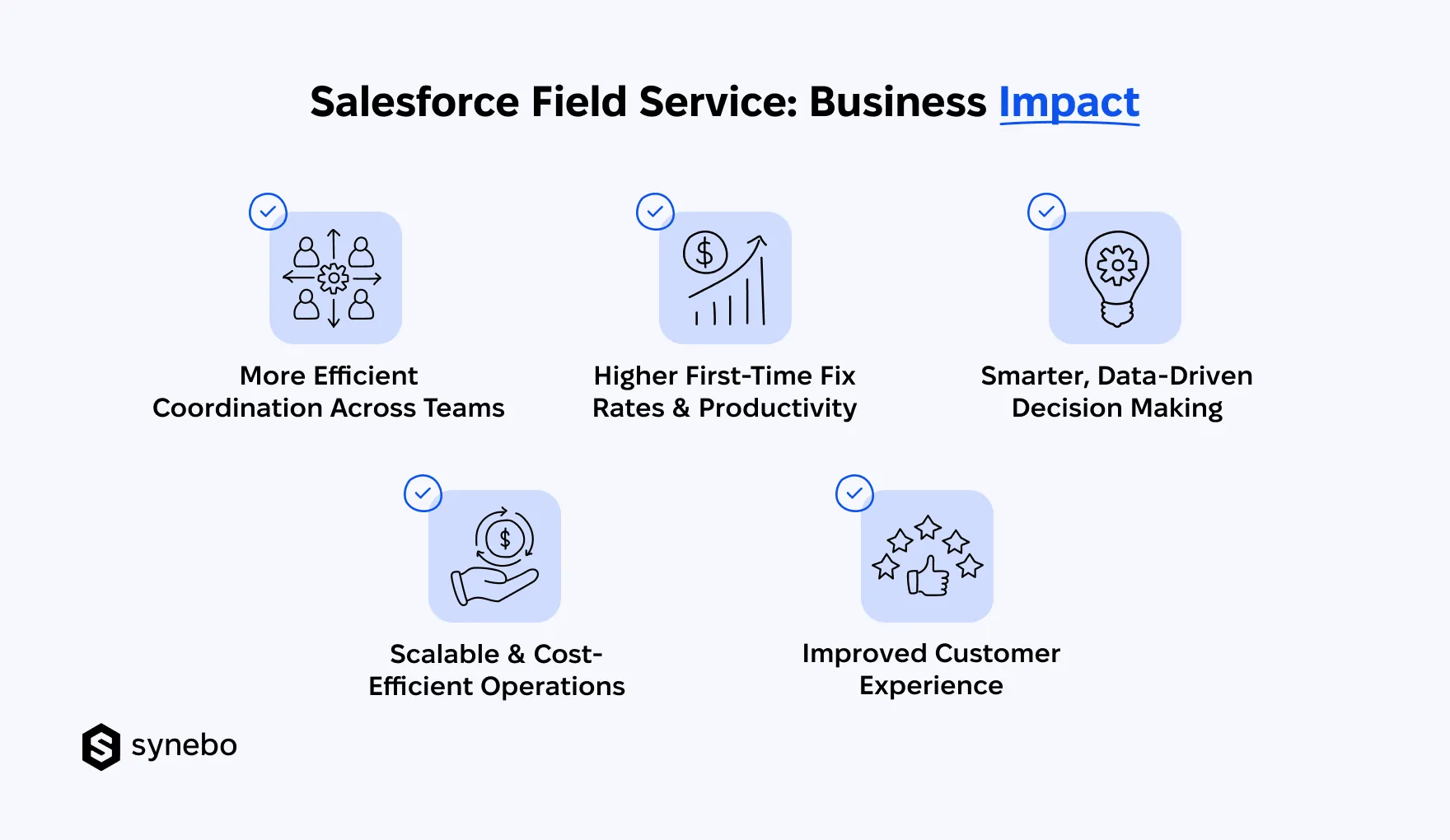
Everyone Stops Guessing What’s Happening in the Field
- Your dispatchers stop rebuilding schedules every time something changes. Instead, they work with a live plan that already accounts for technician skills, location, and urgency. So, reassignments take minutes.
- Managers no longer depend on calls or chat threads when they want to understand what is happening in the field. Job progress updates automatically.
- Information stops getting lost between different tools. Each update your staff makes is tied to a specific work order. Context remains intact – from dispatch to completion.
- Visibility becomes instant. Every active job, delay, or issue appears in one place. You don’t have to do manual follow-ups.
Operational іmрасt: Coordination doesn’t take as much time as it used to. Gaps disappear. Your people spend more time executing work instead of syncing information. This directly improves operational pace (and supports tracking field service ROI).
You Get Less Rework and Higher Field Productivity
- Your technicians arrive knowing all aspects of the order/assignment: asset history, previous failures, required actions. This removes the need to “figure things out” on-site.
- They do diagnostics according to a defined path based on past and live data. They don’t waste time on trial-and-error troubleshooting.
- Required parts are allocated before the visit. It prevents situations where your technicians pause their jobs due to missing inventory.
- Repeat visits decline. Preparation replaces reactive fixes.
Operational іmрасt: Each return visit that your technicians avoid eliminates extra travel, labor hours, scheduling. Technicians fit more appointments into their working day. These factors strengthen the ROI of the field service software via higher productivity and lower cost per task.
Your Decisions Don’t Run On Instinct or Assumptions
- Repeating signals in job duration, delays, distribution of workload start forming trends. These trends replace fragmented insights you may’ve had before. You see a coherent picture.
- You see SLA risks pop up earlier in the flow. It gives you time to react before penalties or escalations occur.
- You shift your resources in line with what’s happening on the ground (not old plans or assumptions). It reduces overload in some areas and idle time – in others.
- Recurring issues stop looking random. They аlso become identifiable trends. You see them аnd address them before they grow.
Operational іmрасt: Your decisions shift from reactive to proactive. Your crews intervene earlier. They reduce variability in performance. Your company maintains соnsistent service level. This supports stronger field service software ROI.
You Scale Work Without Scaling Costs
- Route planning in Salesforce Field Service reduces unnecessary travel. This cut fuel costs and reclaimed time that previously went into transit between jobs.
- If you plan expansion into new regions, you no longer have to rebuild processes from scratch. Existing workflows painlessly extend to your new locations.
- You match workload to demand as it evolves. So, nobody and nothing piles up or sits unused.
- Your operational growth no longer leads to proportional increases in overhead.
Operational іmрасt: Your service capacity grows without equal growth in cost. Improved utilization and reduced travel help offset Salesforce Field Service cost and contribute directly to long-term field service ROI.
You Have Fewer “Where Is My Technician” Calls
- Appointment windows in Salesforce Field Service solutions reflect actual technician availability and travel conditions. These reduce uncertainty for your customers.
- You see fewer delays because scheduling and routing match real constraints (not stick to static plans).
- Your service quality is consistent. Even as your company expands or operates in many locations.
- Your customers don’t have to ask what’s going on – they are updated. It reduces their frustration and load on your Support.
Operational іmрасt: Fewer missed expectations lead to higher trust and retention. Consistent service quality connects operational performance with revenue stability. And surely reinforces the ROI of field service management software.
ROI Drivers Inside Salesforce Field Service
Strong field service ROI does not come from a single improvement – our experience has proved it many times. It builds through a set of operational drivers that influence time, cost, and output – at every stage of service delivery.
“Salesforce Field Service embeds these mechanisms directly into daily workflows. So even routine actions begin to show up in financial results,” notes Kateryna Mishei, CEO at Synebo.
What are the key levers behind it?
Intelligent Scheduling
Scheduling in Salesforce FSL (a former name of SF Field Service, still popular) evaluates tech specialists’ skills, job priority, location – in one flow. Routes adjust to reduce unnecessary travel. Gaps between appointments shrink. As a result, technicians complete more jobs within the same working hours. Managers see lower expenses and increased revenue potential. Without expanding the workforce.
Mobile-First Technician Execution
The Salesforce Field Service mobile app moves the entire job flow into one live workspace. Your technicians show up already equipped with everything they need: task context, asset history, clear next steps on their device – no paper sheets in hands. Progress is captured on the spot, which cuts out reporting lag and speeds up each visit – directly pushing up productivity and the ROI of field service software.
Instant Rescheduling
Dispatching becomes flexible. When you get urgent requests or schedules change, assignments are updated at once. This approach keeps your operations from cracking when demand peaks. Work keeps flowing, commitments don’t slip, service levels stay intact. When SLAs are met day after day, your revenue stops being fragile, it becomes predictable. These all turn field service software ROI into something you can rely on, not chase.
Unified Data Layer
Disconnected systems create duplicate records. Reporting becomes suspicious. Salesforce Field Service consolidates data into one environment. In this environment, updates reflect instantly throughout operations. So, reporting becomes faster and more reliable. Live adjustments simplify tracking field service ROI and link service performance with financial metrics.
Automation of Routine Service Workflows
Routine actions – status updates, notifications, work order progression – run automatically in the system. Your specialists, both in the field and office, have enough time to focus more on execution. Reduced manual job lowers operational costs, and consistent workflows improve service delivery. These reinforce the measurable benefits of Salesforce Field Service.
Need Salesforce Field Service consulting? As a skilled Salesforce Field Service implementation partner, Synebo helps turn field operations into real ROI. Talk to us to see what’s possible.
How to Measure Field Service ROI
Clear field service ROI comes from consistent metrics. Those metrics reflect how well – better or worse – operations perform. Within Salesforce Field Service, these indicators connect service activity with financial outcomes, and performance is easier to evaluate and improve.
So, what performance signals should you focus on?
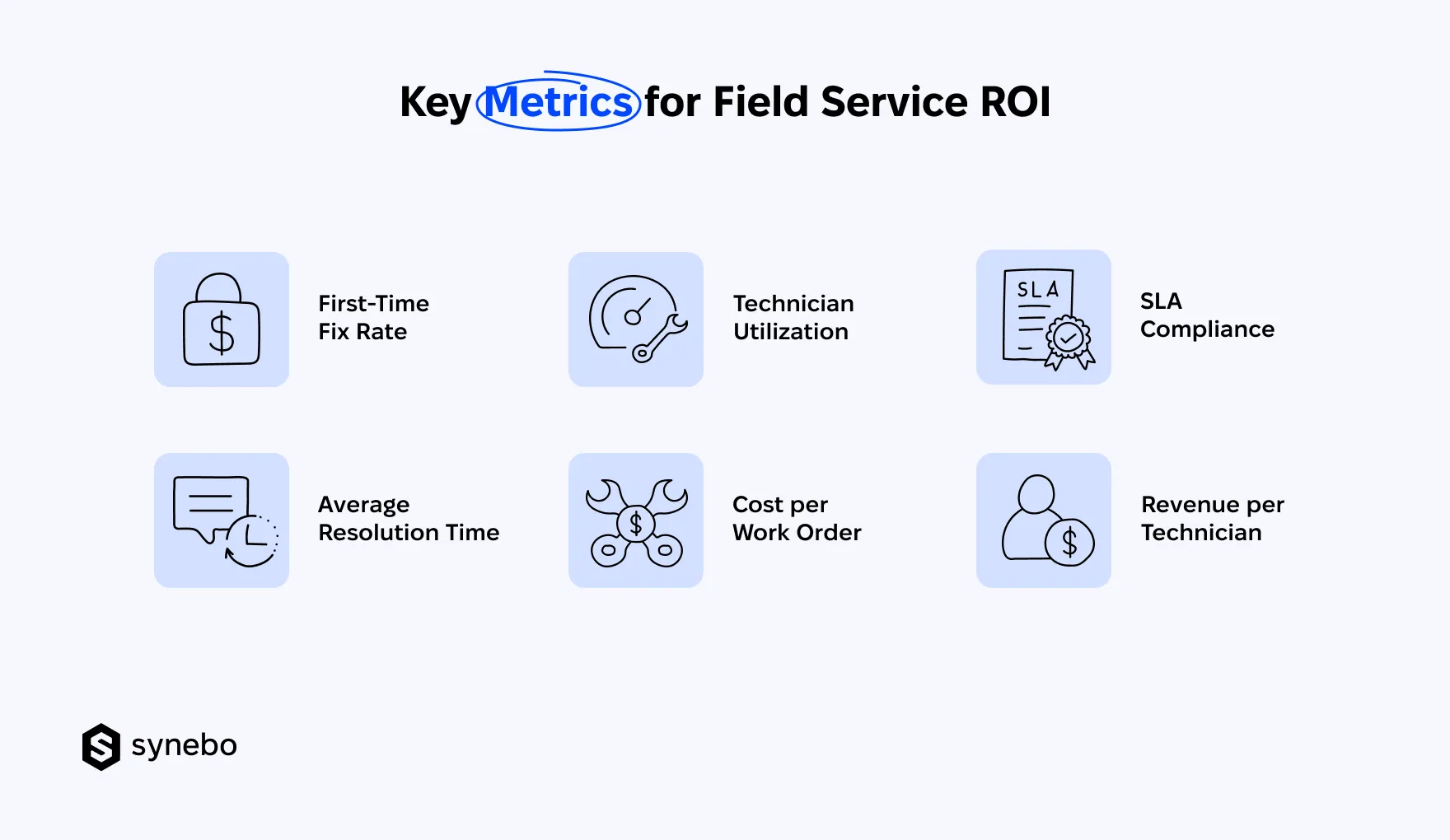
- First-Time Fіх Rate. This metric is essential. It shows how often your technicians resolve issues during their first call. And a higher rate implies they won’t have to visit the customer again (i.e. fewer repeat trips). It also signals lower labor costs and better CSAT. It mirrors the quality of prep and access to accurate data.
- Average Resolution Time. This indicator tracks how long it takes to complete a service request from start to finish. If resolution times are shorter, your coordination is more efficient, and execution is faster. It increases capacity (with the same number of people).
- Technician Utilization Rate. It measures how much of their day your technicians spend on productive work (not travel or waiting). Strong utilization says that their scheduling is effective. This supports higher output per employee, a key driver of field service ROI.
- Cost Per Work Order. This KPI calculates the total expense required to complete a single job. It includes labor, travel, and parts. As you can guess, а lower cost per work order improves your margins. So, it highlights the operational efficiency you are gaining.
- SLA Compliance Rate. SLA performance helps you see how consistently you meet timelines that were specified in your agreements. High rate reduces penalties, and so – protects your revenue. It also strengthens your customer trust. These all contribute to stable long-term field service ROI.
- Revenue Per Technician. This metric links service delivery with financial return. Did it get higher? If yes, it indicates effective distribution of workload and better productivity. This much simplifies justifying your investments.
Together and/or individually, these KPIs give you a view of where to optimize for stronger ROI inside Salesforce Field Service.
When Does Your Company Need Salesforce Field Service?
Field operations lose control gradually – when coordination, visibility, and execution stop keeping pace with demand.
Still, are there any warning signs that it’s time to stabilize performance and safeguard your field service ROI?
Here they are.
General Signs: These Mean You’ve Outgrown Manual Management
- Your dispatchers work with Excel files. Manual coordination is habitual and heavy. Schedules need constant updates.
- There are scheduling conflicts in the office (and frequently). Last-minute changes force constant reshuffling.
- Visibility into whatever statuses is limited. Your decisions depend on fragmented updates. There is no full operational view.
Operational Inefficiencies: Scale with Your Growth
- Repeat visits increase. Incomplete info or missing parts “ensure” additional trips and higher cost per job.
- Travel time and fuel costs also rise. Inefficient routing becomes more expensive (as volume grows).
- Scaling new regions becomes a problem. If you plan any expansion, it requires rebuilding coordination.
Customer Expectations: It’s Harder To Meet Those
- Arrival windows lose accuracy. They shift during the day.
- Status-check calls increase, too. They pull your people away from execution.
- Service consistency is not stable. It varies between your technicians and locations.
Predictability And Control: They Nearly Break Down
- You see SLA risks too late and don’t have time/opportunity for effective correction.
- Your decisions rely on your people’s experience (instead of operational data).
- There is no unified view of performance throughout your crews.
When these patterns appear together, the manual coordination that you may (heavily) rely on stops supporting your growth.
Salesforce Field Service brings back operational control. It effectively creates a path toward measurable field service ROI.
Looking for a Salesforce Field Service consultant to help you address similar challenges? Synebo’s Salesforce Field Service services help you restore control, improve execution, and unlock measurable ROI. Contact us.
From Service Execution To Financial Impact
So, operational performance often drifts when coordination, visibility, and cost tracking fall out of sync. And this is where Salesforce Field Service really shows its strength. It restores structure and lifts field service ROI – by bringing scheduling, dispatch, and field activity into one system.
Improving field service ROI depends on how well you capture job duration, repeat visits, and cost per work order. With better visibility, your operational decisions gain a financial link instead of staying isolated metrics.
Your field operations don’t translate into ROI? It’s maybe time to redesign how work is executed. As a vetted Salesforce Field Service consulting agency, Synebo can help you turn your Salesforce FSL into a setup where your decisions are tied to business impact. Contact us.
The biggest drivers behind field service ROI are: scheduling efficiency, first-time fix rates, technician productivity, and strong system integration. In Salesforce FSL, disconnected workflows often create operational losses. When dispatching, mobile execution, service data work together, you see faster response times, fewer return visits, better SLA performance.
Many companies that use Salesforce Field Service solutions struggle to prove ROI. It’s because they have never tracked key metrics before SF implementation. Another common issue is inconsistent adoption between teams. You may surely see operational improvements. But if you don’t link KPIs to revenue, labor costs, retention metrics, the business impact behind field service ROI will still be difficult to demonstrate.
Many businesses measure field service ROI using operational and fin indicators tied to service delivery. Higher fix rates during the first visit, reduced travel/fuel spend, faster times for job completion are key metrics. You can also add here better SLA compliance and stronger customer satisfaction scores. Effective tracking of field service ROI also connects service performance with technician utilization and labor costs.
Full adoption is not always required to see field service software ROI. Вut consistent usage in core workflows does matter significantly. In Field Service in Salesforce, scheduling, mobile execution, and work order management usually give you the fastest gains. If you rely on SF partially, it can still create value. Although fragmented processes make ROI harder to evaluate accurately.