How Much Does It Cost to Build for AgentExchange?

There’s no single price tag for building for AgentExchange. And this ambiguity is precisely what makes budgeting so difficult for product teams and finance strategists.
At TDX 2026, SF unified AppExchange, Slack Marketplace, and the broader Agentforce ecosystem into one refreshed AgentExchange platform – backed by $50 mln to fuel ISV development. The Salesforce AgentExchange marketplace now hosts over 10k SF apps, 2.6k Slack apps, and 1k+ Agentforce agents. And every quarter, this opportunity pulls more companies into AgentExchange app development.
If the market is already operating at this scale, the next obvious question becomes: what does it actually cost to build for it? And this is where our conversation gets more interesting, provided that AgentExchange development cost spans infrastructure, security review, ongoing maintenance, and more – layers most teams don’t price in upfront.
This overview explores what typically drives Salesforce AgentExchange cost, so founders, CTOs, and product managers building apps for AgentExchange can see what developing for this marketplace realistically demands.
Why Salesforce AgentExchange Pricing Feels Unclear Now
To put potential budget concerns into perspective, it is important to remember that AgentExchange development is still new for stable industry-wide pricing benchmarks.
“The market still behaves like moving terrain: pricing models shift, AI tooling changes, and some AgentExchange ISVs may struggle to estimate their long-term operational spend,” says Yana Chekan, Head of Delivery at Synebo.
Yana specifies what exactly leaves many teams uncertain about how to scope products inside the Salesforce AI agent marketplace without overspending:
- No Standard Pricing Exists. There is no established baseline for the cost of building an AgentExchange application. What’s more, one firm may release a lightweight assistant with limited integrations. Аnother – develops complex multi-agent logic with governance controls and monitoring layers. Their budgets differ – dramatically.
- Agent-Based Products Follow Different Rules. Traditional SF delivery focused heavily on workflows, UI customization, automation. Developing apps for AgentExchange introduces AI behavior testing, prompt handling, fallback logic, model supervision. These requirements reshape the entire cost to build an AgentExchange app.
- Vendors Prefer Ranges. True: many Salesforce AgentExchange partners avoid fixed estimates. The reason is simple: scope evolves fast. You may start with “simple” plans to “develop an AgentExchange app”. And expand requirements after security reviews, integrations, or compliance discussions begin. With weaker vendors, uncertainty grows further, as teams can’t reliably predict how many security review iterations or resubmissions will be needed before approval.
It also explains why even for seasoned SF devs/teams early budgeting for AgentExchange app development still feels a bit tricky.
Read Also: AgentExchange vs. Traditional AppExchange: What Changed?
What’s Inside AgentExchange Solution Cost (Beyond Development)
When many companies enter building agents for AgentExchange, they often think that engineering hours will dominate the budget.
In practice, code represents only one slice of the equation. In fact, a serious AgentExchange agent development initiative behaves more like assembling a high-performance vehicle. Here, the engine matters, sure, yet navigation, safety systems, testing, and handling determine if the ride succeeds.
If I translate this into development terms, the budget for building includes the following stages (and, accordingly, cost categories):
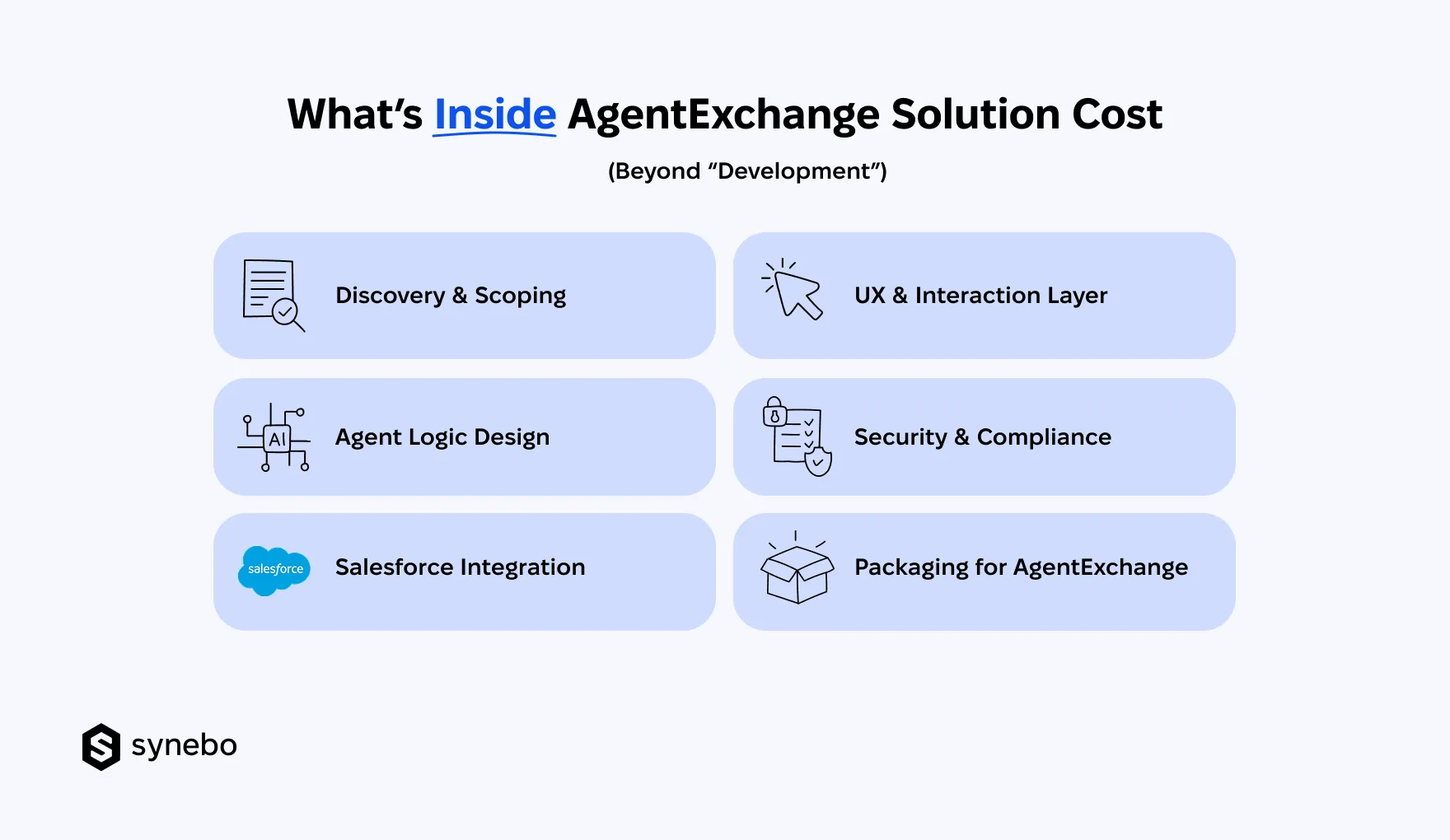
- Discovery & Scoping. Early workshops shape the entire financial trajectory of an AgentExchange application. You define use cases, AI boundaries, fallback behavior, business outcomes before your discussions about architecture begin. Weak discovery frequently inflates the cost of building an app for AgentExchange later. Through scope rewrites and the complexity connected with those.
- Agent Logic Design. This layer is the decision-making core of the product. If you develop AgentExchange apps, you spend significant time on prompt flows, orchestration paths, memory handling, escalation logic, response quality. Our clients – Salesforce ISV partners – share that this phase consumes more resources than UI delivery.
- Salesforce Integration. Connections with Data 360, Agentforce Service (former Service Cloud), APIs, workflows, external platforms add another financial layer to the Salesforce AgentExchange cost. What’s more, legacy architecture, fragmented data, permission models frequently extend delivery timelines (again – resulting in higher budget).
- UX & Interaction Layer. Even advanced AI may lose its value. It happens if users struggle during their conversations. That is why many companies that create AgentExchange solutions also heavily invest in interaction flows, response formatting, conversational design. Why? This helps them keep UX intuitive.
- Security & Compliance. Security reviews, access governance, audit controls, plus overall oversight of AI create high unplanned costs. And this stage becomes especially critical for healthcare, finance, and enterprise SaaS products.
- Packaging for AgentExchange. Launch prep inside the AgentExchange Salesforce Agentforce marketplace includes documentation, partner requirements, testing, versioning. It also demands the marketplace packaging standards. Our experience shows that many companies underestimate this final stretch when they plan the cost to build an app for AgentExchange.
Тhese “surrounding” layers often outweigh just engineering work in the total budget.
If you need help estimating scope, avoiding hidden costs, or planning your marketplace launch strategy, Synebo can support you as an experienced AgentExchange app development company. Reach out to us.
Cost Scenarios: From Lean MVP to Full-Scale Product
If you’ve ever had to defend a development budget, you already know how this goes: before the numbers get approved, someone – usually more than one person – will inevitably ask: “What does something like this cost?”
Fair question. Аnd your answer may greatly depend on what “something like this” means to your team.
When SF first introduced AgentExchange back in March 2025, listings grew from 55 to 114 in just 6 months, with contributions from over 100 unique devs. This growth tells us all one thing clearly: the AgentExchange marketplace in the Salesforce Agentforce ecosystem is filling up fast. And the window for early-mover advantage is still open.
“The companies that move now set the pricing norms. They also capture the audience’s attention that latecomers will have to fight for,” says Yana Chekan.
So what does building apps for AgentExchange actually cost? Our experience shows there are three realistic tiers.
Tier 1. Simple Agent Solution: ~$10K–$30K
This is where most SF ISVs and first-time AgentExchange partners begin. The goal here is to prove the concept, get listed, collect feedback.
This tier 1 features:
- Basic Logic. A targeted set of actions or topics (one workflow, one use case, one integration point). The agent does one thing well. The scope stays tight by design.
- Bare-Minimum Integrations. At this tier, the AgentExchange app connects to the SF core objects (cases, contacts, opportunities). It doesn’t pull in external systems or Data 360 pipelines.
- Simple UI / Listing Readiness. Getting a listing onto the AgentExchange portal requires passing the SF security review, which adds time even for lightweight products. So, budget for that process. It’s not free. And it’s not instant.
Who this fits: ISV founders and early-stage AgentExchange app development companies that are validating a niche before committing to full build-out. This tier lets you learn cheaply (not ship perfection).
Tier 2. Mid-Level Agent Product: ~$30K–$200K
The most serious Salesforce AgentExchange apps go to this tier – products with genuine commercial potential and enough depth to earn 5-star reviews.
- CRM Integration + Multiple Workflows. Such a Salesforce AgentExchange app handles several interconnected processes. For example, a service agent that triages cases, updates records, escalates. Or a sales agent that qualifies leads, schedules follow-ups, automatically logs activity.
- Packaged Listing Readiness. At this level, the product needs quite a lot. Specifically – polished docs, onboarding flows, support infrastructure. Because buyers on the Salesforce Agentforce AgentExchange portal want (and are used to) a certain level of product maturity.
- Expanded Testing Overhead. Unlike traditional apps, agent behavior is non-deterministic (the same input won’t always produce the same output). If you develop apps for AgentExchange at this tier, you need reliable testing frameworks. Strong QA processes uncover suspicious cases before your customers do.
Who this fits: Product managers and CTOs. AgentExchange agent development companies that ship commercially viable product(s).
Tier 3. Соmplех Agent Platform: ~$200K+
This is the full weight class. Here are multi-agent architectures, Data 360 dependencies, Slack integration. Plus, external API orchestration and compliance requirements.
The cost of building an app for Salesforce AgentExchange at this tier reflects every layer of such complexity:
- Multi-Agent Systems. When agents need to coordinate with each other (for example, handing off tasks, passing talk context, escalating critical actions), the architecture multiplies in complexity. Agent development at this scale requires senior SF architects, not just developers.
- Data 360 + External Integrations. Pulling customer data from Data 360 and routing it through an agent’s decision logic adds cost, too. Plus, it adds infrastructure overhead that companies new to developing for AgentExchange frequently underestimate.
- Compliance-Heavy Architecture. Corporate buyers on the AgentExchange marketplace on Salesforce scrutinize security, data residency, audit trails. Building these guarantees into a product from the ground up isn’t optional. It’s what regulated industries demand (and this is also your price of entry to the tier).
Who this fits: Established AgentExchange companies and Salesforce ISV partners with a proven market and a revenue base. Those who can justify a serious platform investment.
If you’re planning to create an app for AgentExchange, Synebo can help you build it efficiently and at very competitive rates. Reach out if you want a practical, cost-balanced approach to your AgentExchange build.
Why AgentExchange Costs Run Higher Than Classic AppExchange Builds
The businesses and entrepreneurs that hire AgentExchange developers after years of traditional AppExchange work may expect significantly higher budgets.
In reality, that is not always the case. Some AgentExchange products rely only lightly on AI capabilities (or use them in narrow scenarios). This keeps development costs relatively close to traditional AppExchange builds.
However, when ISVs introduce advanced agent orchestration, autonomous workflows, or complex LLM interactions, the cost structure changes quickly.
“3 factors typically push AgentExchange cost higher compared to equivalent AppExchange builds,” explains Yana Chekan.
They are:
- Complexity of Managing AI Workflows. Coordinating LLM calls, fallback logic, agent memory in the Salesforce AgentExchange (Agentforce) framework is quite complex. It demands different engineering skills. Those are premium in the current talent market.
- Usage-Based Economics. Flex Credits, consumption billing, and per-conversation pricing mean the cost of building an AgentExchange application extends beyond launch. You need to model how your customers will use your product upfront, or the unit economics will surprise you post-release.
- Non-Deterministic Behavior Testing. Traditional software functions simply: it either works or it doesn’t. Agents behave probabilistically. And validating that an agent performs OK for enterprise use requires many more QA cycles than a standard SF app.
So, AgentExchange costs for custom builds favor those crews that carefully plan their scope and allocate the right people. Plus – it’s a must – treat QA as part of the budget (not something they add at the end).
Where Projects Go Over Budget & How to Avoid It
Many who want to enter the Salesforce AgentExchange AI agents marketplace believe that it’s just tech complexity that drives overspending. Yet, budget problems usually begin much earlier – during planning and product decisions.
These are some typical ones:
- Undefined Scope When You Start. Broad concepts like “AI sales assistant” frequently expand during delivery. What helps control unexpected increases in the costs of the AgentExchange app development services? Clear use cases, concrete outcomes, prioritization.
- Trying to Build “Advanced”, Not Useful. Many companies entering the Salesforce AgentExchange marketplace of AI agents prioritize sophisticated AI behavior, without validating customer demand. Yes, multi-agent coordination or predictive reasoning sounds impressive. Yet simple workflow acceleration often creates stronger adoption.
- Changes After Development Begins. Major architecture revisions after engineering starts can quickly increase the cost of your AgentExchange solution. Especially when integrations, permissions, talk flows change simultaneously.
- Ignoring Post-Launch Costs. Many also overlook ongoing expenses. Such as AI monitoring, API consumption, analytics, model updates, support operations after launch.
- Build a scalable MVP from Start. Companies that architect their first AgentExchange release planning for future product evolution, avoid rewrites later. A well-scoped MVP should support growth into the full product.
As my colleague Yana Chekan says, disciplined scoping creates far better financial outcomes than oversized feature lists.
How to Approach Your First AgentExchange Build Strategically
The strongest early AgentExchange products rarely begin as giant AI ecosystems. Most successful products enter the market with a focused task and clear business value.
To set yourself up for success:
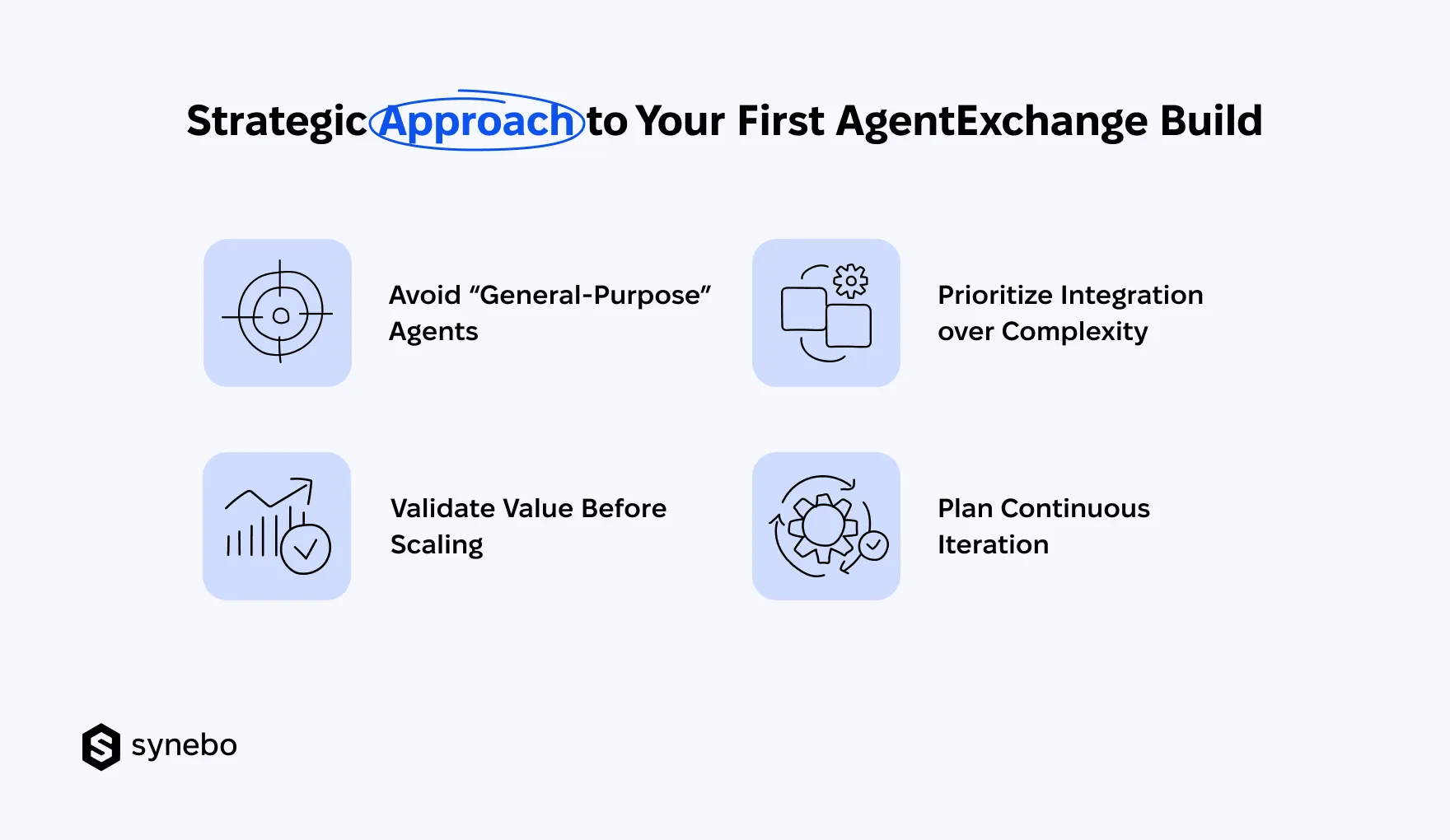
- Start With a Narrow Use Case. Focus on one painful workflow first. Broad “do-everything” concepts often inflate the cost of AgentExchange development services before customer demand becomes even visible.
- Validate Value Before Scaling. A small(er) Salesforce AgentExchange solution with good adoption results typically creates a stronger business case than feature-packed platforms with unclear ROI.
- Prioritize Integration. Complexity Will Wait. Recommend focusing on SF workflows, permissions, CRM data access. On operational fit overall – before expanding AI behavior depth.
- Plan Non-Stop Iteration. Workflows, governance requirements, usage patterns evolve quickly inside the marketplace. That’s why gradual iteration usually controls long-term operational costs more effectively than oversized first releases.
If you want to de-risk your first build and avoid overpaying for scope that doesn’t convert, your fastest wins in AgentExchange will come from staying focused on value.
What Successful AgentExchange Teams Understand Early
So, the strongest products inside the AgentExchange Salesforce agent marketplace usually begin with well-defined scoping and business value. Plus, realistic operational planning. And, as our experience shows, when you create an AgentExchange app, the biggest risk is expanding too early before you’ve proven product-market fit.
A successful AgentExchange Salesforce product requires integration strategy, AI governance, packaging, and iteration planning. They all influence your long-term product viability inside the growing AgentExchange marketplace on Agentforce.
Synebo helps ISVs approach AgentExchange development with practical architecture and marketplace-focused execution. When you hire AgentExchange app developers from Synebo, you move from idea to product with a strong commercial focus. Contact us.
Your budget depends heavily on product complexity. A simple AgentExchange MVP may cost around $10k–$30k. More advanced ones with multiple workflows, external integrations, security requirements, and multi-agent architecture can reach $200k+. Yet, most commercial-ready solutions fall somewhere in between.
Yes. And many successful AgentExchange ISVs follow exactly this path. A focused MVP can later expand into broader workflows, a multi-agent layer, or deeper CRM integration. I recommend planning the architecture properly from the start, even if your first AgentExchange application solves only one operational problem.
For many businesses, it’s AI orchestration and integrations. They create the largest share of AgentExchange development costs. Prompt flows, governance controls, security reviews, testing, external system connectivity – these frequently consume more budget than interface development itself. Marketplace packaging can also add operational and compliance overhead.
A lightweight Salesforce AgentExchange app may reach the MVP stage within several months (4 or sooner). Mid-level products often require 6 months (and longer). Especially when you introduce Data 360 connectivity, multi-agent workflows, or enterprise-grade governance requirements into the architecture.