Top Agentforce Use Cases Delivering ROI in Financial Services
Some Salesforce Agentforce use cases for financial services ensure really fast ROI. And the biggest returns usually come from the processes where quick responses, low servicing costs, client happiness directly affect business results.
Banks, insurers, wealth management firms now face the same challenge: meeting growing client expectations while controlling operating costs. Plus, reducing repetitive work for their service teams.
Interestingly, the areas that create the most pressure are also those where AI delivers the strongest impact. Deloitte’s 2026 findings confirm that AI-mature contact centers (as an example) outperform less mature competitors. They are 85% more profitable, 69% more likely to deliver good customer experiences, 60% more likely to create a better employee experience.
In the next sections, we’ll answer the “What is Agentforce for financial services?” question and explore the Salesforce Agentforce use cases that deliver ROI within a realistic timeframe.
What Financial Services Challenges Is Agentforce Best Positioned to Solve?
Agentforce for financial services delivers its greatest business value when it tackles work that happens every day, in large volumes, and directly affects cost and quality of service. If your people spend hours (or days) on processing routine requests or switching between systems, these are strong candidates for Agentforce financial services use cases.
Overall, the challenges that Agentforce perfectly addresses are:
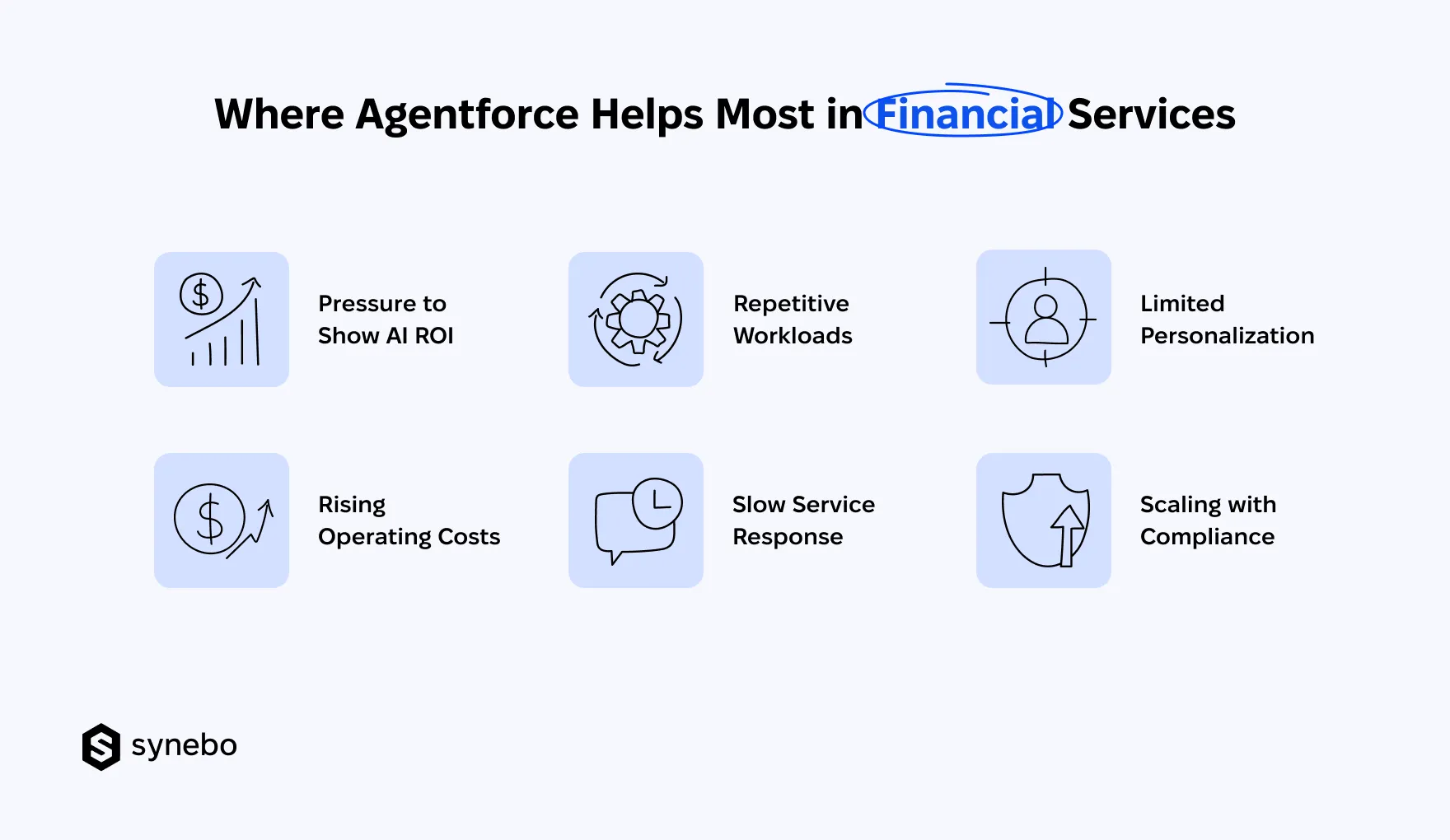
- Pressure to Prove AI ROI. Many companies (leadership) expect that Agentforce agents produce concrete results promptly. Meanwhile, the most effective use cases for Agentforce focus on clear metrics: lower service costs, faster resolution times, higher employee productivity, stronger customer retention.
- Growing Operational Costs. Hiring more employees cannot solve every capacity problem. AI agents for financial services help you manage large(-r) workloads – still with high service quality. And the same team size.
- Repetitive Client Requests. Policy questions, loan status updates, appointment scheduling, document requests – similar tasks consume valuable employee time. Agentic AI in financial services completes these activities automatically. And allow your specialists to focus on higher-value tasks/talks.
- Long Wait Time & Limited Personalization. Delays in responses and overall generic interactions hurt relationships with customers. Agentforce for insurance, banking, and wealth management uses trusted SF data. It gives your clients really fast support with the right context.
- Growing Operations – Staying Compliant. When your client portfolios expand, maintaining consistent service іs hard. If you implement Agentforce for financial services, you extend your support capabilities and still follow established governance.
Read Also: What Is Agentforce? How AI Agents are Reshaping Business
The best starting point is rarely the most complex process. It is the high-volume work that repeats every day, slows your employees down, and creates unnecessary service costs.
Which Agentforce Use Cases Deliver the Fastest ROI in Banking, Insurance, and Wealth Management?
Many financial institutions ask the same question before signing off on a budget line: where does Agentforce pay for itself first? The answer is split by departments. Because AI agents for banking cut service costs. Insurers speed up claims. Wealth management firms scale relationships that used to depend on one advisor’s calendar.
Here’s where the fastest results show up.
How Can Banks Use Agentforce to Reduce Service Costs and Response Times?
Banks see the quickest payback on the front line. There Agentforce agents pick up repetitive requests before your employees ever get pulled in. In fact, many of the most effective Agentforce banking use cases focus on high-volume service interactions:
- Customer Inquiries. AI-driven agents instantly resolve routine questions – the ones about balances, fees, card status.
- Account Servicing. Updates, disputes, and simple changes move through an agent instead of sitting in a queue.
- Loan Status Requests. Your borrowers get an answer on where their application stands; they don’t have to call in and wait on hold.
- Routine Support Interactions. Thanks to Salesforce Agentforce agents, password resets, statement requests, and similar tasks also stop eating up your team hours.
- Service Operations. Your call center handles spikes in demand. The number of people working there remains the same.
Results: Lower service costs. Faster answers. A lighter workload for support teams. Customers who stop dreading the call.
How Can Agentforce Accelerate Client and Loan Onboarding?
The McKinsey finding says that corporate client onboarding in banking can take up to 100 days. A typical process may require up to 100 documents and filling 150 data fields. Agentforce for financial services eases the process by running the high-frequency tasks on its own:
- Information Gathering. Аn Agentforce agent collects the basics upfront. With AI, nothing gets missed on the first pass.
- Document Collection. Required files get requested and tracked. And flagged automatically when something is missing.
- Eligibility Checks. Your qualification rules run in the background, catching gaps before they reach an underwriter.
- Cross-Functional Process Management. Compliance, credit, and servicing teams stay coordinated – automatically.
- Customer Activation Process. Agentforce agent(s) provide guidance, reminders, progress updates, making the path from application to approval effortless to follow.
Results: Faster onboarding. Minimized human involvement. Higher efficiency. Better first impression for new customers.
How Can Insurers Use Agentforce to Improve Claims and Policy Servicing?
Insurers gain the most ground in claims, where every extra day in the cycle costs money and patience. Agentforce for insurance handles the repetitive intake:
- Claims Intake. AI agents capture first notice of loss and route it correctly – without a person keying it in manually.
- Claims Status Updates. Рolicyholders get told where things stand – they don’t call you to ask.
- Policy Servicing. Renewals, endorsements, changes in coverage also get processed by Agentforce AI agents.
- Customer Communications. Routine notices go out on schedule. No reminders needed.
- Routine Admin Tasks. McKinsey found that many relationship managers describe themselves as “data-entry clerks” (admin work leaves little time for client relationships). Thanks to Salesforce Agentforce agents, data entry stops consuming your staff time.
Results: Shorter claims cycles. Less work for your team. Quicker support. Stable and consistent service experience.
How Can Wealth Management Firms Scale Personalized Client Engagement?
Advisors have one resource that never stretches: hours in the day. And Agentforce for financial services gives them back a part of it – by handling the prep work behind every interaction with clients:
- Meeting Preparation. Before every client meeting, an AI agent compiles a briefing from your firm’s authorized client data, including portfolio information, recent interactions, and relevant talking points.
- Client Summaries. Notes and next steps get drafted automatically after every meeting.
- Follow-Up Actions. Tasks get created and assigned without your advisor stopping to write them down.
- Personalized Communications. Outreach reflects each client’s holdings and goals (instead of a generic template).
- Advisor Productivity. Overall, with Agentforce for financial services, your advisors don’t waste time on the admin part. And invest more time in the clients who need it.
Results: More hours for real relationships with clients. Higher advisor output. Personalization that scales. Clients who stay longer.
How Can Agentforce Help Financial Institutions Deliver Proactive Service?
The biggest shift Agentforce agents bring to financial services is timing – reaching clients before they reach out first:
- Renewal Reminders. Policies, loans, accounts get flagged before deadlines slip past unnoticed.
- Service Notifications. Clients hear about relevant changes or issues. They don’t have to dig for the info themselves.
- Recommendations on What to Do Next. AI agents suggest the most suitable products or services, grounded in your company’s knowledge and behavior of your clients.
- Proactive Outreach. Сheck-ins happen on a schedule, not only when something goes wrong.
- Relationship Nurturing. With Agentforce for financial services, ongoing client outreach keeps relationships active between the “big moments” (milestones).
Results: Stronger retention. Deeper engagement. New opportunities for revenue. Customers who feel looked after (not chased).
Not sure which Agentforce use case should come first? As an experienced Salesforce Agentforce partner, Synebo helps financial institutions identify the opportunities and build from there. Contact us.
What ROI Can Financial Services Organizations Realistically Expect from Agentforce?
The ROI of Agentforce for financial services is usually built from many small gains, not one dramatic improvement. What’s more, your return on investment is effortless to prove when you connect technology with business metrics. Such metrics include savings, your gains in productivity, service quality, scalability, and more.
Where Cost Savings Typically Come From
First of all, you’ll see your savings come from slowing the growth of operational costs as customer demand increases. Your Service Dept, which previously needed additional hiring to support rising service volumes, can now continue operating with existing resources and for much longer. Agentforce implementation changes the economics of your growth. Especially if your financial organization processes thousands of customer requests every day.
Read Also: How Much Does Agentforce Implementation Cost in 2026
How Agentforce Affects Productivity
Your productivity improves because your employees spend a larger share of their day on work that generates business value. Instead of constantly switching between admin activities, follow-ups, talks with customers, Agentforce implementation solutions help your specialists dedicate more attention to financial advice, exception handling, relationship building, and revenue-generating opportunities.
Many fin companies measure the impact of the Agentforce AI agents through such operational indicators:
- Service Speed. Faster first responses, shorter processing cycles, quicker case completion improve the experience of their customers. Without increasing their staffing levels.
- Operational Efficiency. You can support larger customer volumes and keep stable service quality during demand spikes. Plus, reduce delays between Depts.
- Business Performance Metrics. Lower cost per interaction, higher first-contact resolution, stronger CSAT, better employee utilization. Plus, higher automation rates and greater service capacity. These all demonstrate the business value of Salesforce Agentforce implementation.
Want to estimate the ROI for your org? Synebo’s Salesforce Agentforce consulting services help finance institutions get more from Financial Services Cloud. Contact us.
Where Should Financial Services Organizations Start to Achieve Early Agentforce Wins?
Your fastest path to ROI starts with choosing the right problem (not the biggest one). Successful rollout of Agentforce for financial services organizations usually begins with a focused process that delivers visible business results and builds internal confidence.
Start Where Results Are Easy to Prove
Not every workflow deserves to become your first AI project. The best use cases of Agentic AI in financial services share several characteristics:
- High-Volume Processes. Thousands of similar requests create more opportunities to reduce service costs and increase capacity.
- Similar Requests from Customers. Resets of passwords, account updates, questions about policies, checks of payment status, appointment scheduling follow consistent patterns. These patterns fit AI agents for financial services really well.
- Customer-Facing Operations. Onboarding new customers or guiding them through loan or credit card applications also delivers visible improvements quickly. Because your clients get shorter wait times. And more consistent service.
- Cost-Intensive Activities. Processes that require significant employee time for quite routine work (such as doc collection, eligibility checks, application reviews, and more) often deliver measurable ROI, too. Even from modest efficiency gains.
- Strong Effect Visibility. Select workflows with business outcomes that are effortless to communicate to your decision-makers. Clear improvements create your and their confidence. They simplify investment discussions and encourage broader adopting AI agents in financial services.
Read Also: Is Agentforce Right for Your Business? Benefits and Use Cases
Avoid Starting with High-Risk Initiatives
Some projects look impressive. Yet, they delay trackable ROI. Your first Salesforce Agentforce for financial services projects should avoid:
- Complex Advisory Work. For example, retirement planning, wealth management, recommendations on personal investments – suchlike advisory services still require experienced professionals (they include nuanced decisions on each client’s unique circumstances).
- Data of Poor Quality. If your customer records are incomplete or inconsistent, еven the most capable AI agents in financial services cannot deliver reliable outcomes.
- Unassigned Process Ownership. If projects that involve many Depts have no defined responsibilities, it often slows implementation.
- Large Enterprise-Wide Programs. Expanding too quickly increases project complexity before the organization gains practical experience.
Тhe strongest momentum usually begins with one successful case.
“Our experience proves: оnce a targeted Agentforce implementation solution demonstrates value, all stakeholders get confidence. They then expand additional use cases of Agentic AI in financial services more easily – through a phased, lower-risk approach,” says Anatoliy Voronov, CTO at Synebo.
Such a strategy helps companies introduce Agentforce for financial services with strong executive support. And clear investment priorities.
Could Agentforce Be Your Next Competitive Advantage?
The best Agentforce use cases for financial services rarely begin with ambitious enterprise-wide programs. They start with one – just one – business challenge that matters. Or one process that is worth improving.
This first success gives you precious confidence. It supports future investment decisions. It opens the door to broader Agentforce for financial services adoption.
If you’re evaluating Salesforce Agentforce for financial services, the biggest challenge usually isn’t choosing the technology. It’s choosing where to start.
Our Agentforce specialists help financial services firms identify the Agentforce use cases most likely to deliver concrete ROI. Then we turn those opportunities into a practical implementation plan. Contact Synebo.
The quickest returns usually come from those Agentforce use cases for financial services that handle large volumes of routine interactions with customers. Account servicing, claims status requests, policy inquiries, appointment scheduling, and similar are strong starting points. Because they reduce service costs, increase the capacity of your team, and produce visible operational improvements.
The best way to evaluate Agentforce for financial services is to compare your operational performance – before and after deployment. Financial institutions often track service cost per interaction, average handling time, employee capacity. Plus, measure satisfaction of their clients, first-contact resolution, request volumes – handled by AI agents without extra staffing.
Absolutely. Many successful Agentforce projects begin with one carefully selected workflow – before expanding further. Such a project allows you to validate your assumptions, refine governance, strengthen internal support. And surely identify your next Agentforce financial services use cases based on proven operational value.