How Synebo Helps ISVs Bring Agentforce to Their Salesforce Products
Adding Agentforce to your Salesforce product is… easy. What is quite challenging is integrating it into a managed package. Because Agentforce implementation – for ISVs – requires preserving managed package architecture, meeting marketplace requirements, and delivering an experience their customers trust.
SF’s unified AgentExchange marketplace now brings together more than 13k apps, AI agents, and Slack solutions. It raises expectations for product quality, governance, and discoverability. Іt also means fierce competition for ISVs. So, their next competitive advantage is implementing Agentforce in a way that keeps their products stable, compliant, and ready for AgentExchange.
This article explains how to bring Agentforce to a Salesforce product while preserving its architecture. Using two client projects, I’ll show how Synebo approaches Agentforce managed package development and prepares products for AgentExchange readiness.
How Can ISVs Add Agentforce Without Rebuilding Their Salesforce Product?
You can add AI to Salesforce applications without rebuilding them. The catch is that Agentforce is not a feature you switch on. Іt quickly becomes woven into how your product is built, maintained, and shipped.
That is why Agentforce implementation for ISVs requires a very different mindset than a typical AI project.
So, what exactly makes Agentforce implementation for ISVs different?
- Agentforce Is Not a Feature Toggle. Yes, you can implement Agentforce in a managed package you previously built. However, it becomes part of your product architecture, package lifecycle, release strategy.
- Architecture Determines Your Long-Term Success. Every decision affects future releases. Your package must pass security review, support upgrades, remain stable in hundreds of orgs, and keep evolving without disruptive changes.
- AI Must Fit Your Product. Your primary objective is not simply bringing AI to Salesforce product(s). It is to introduce capabilities that naturally extend existing functionality. And remain reliable after every package upgrade.
- Agentforce Must Work with Existing Product Logic. Implementing Agentforce in AppExchange apps (existing ones) means connecting agents to the product’s metadata, business rules, permissions, existing functionality. The implementation should extend what customers already use without creating tech debt that makes next changes harder.
6 Usual Mistakes ISVs Make During Agentforce Implementation
These typical mistakes turn a promising Salesforce Agentforce implementation into a product maintenance problem:
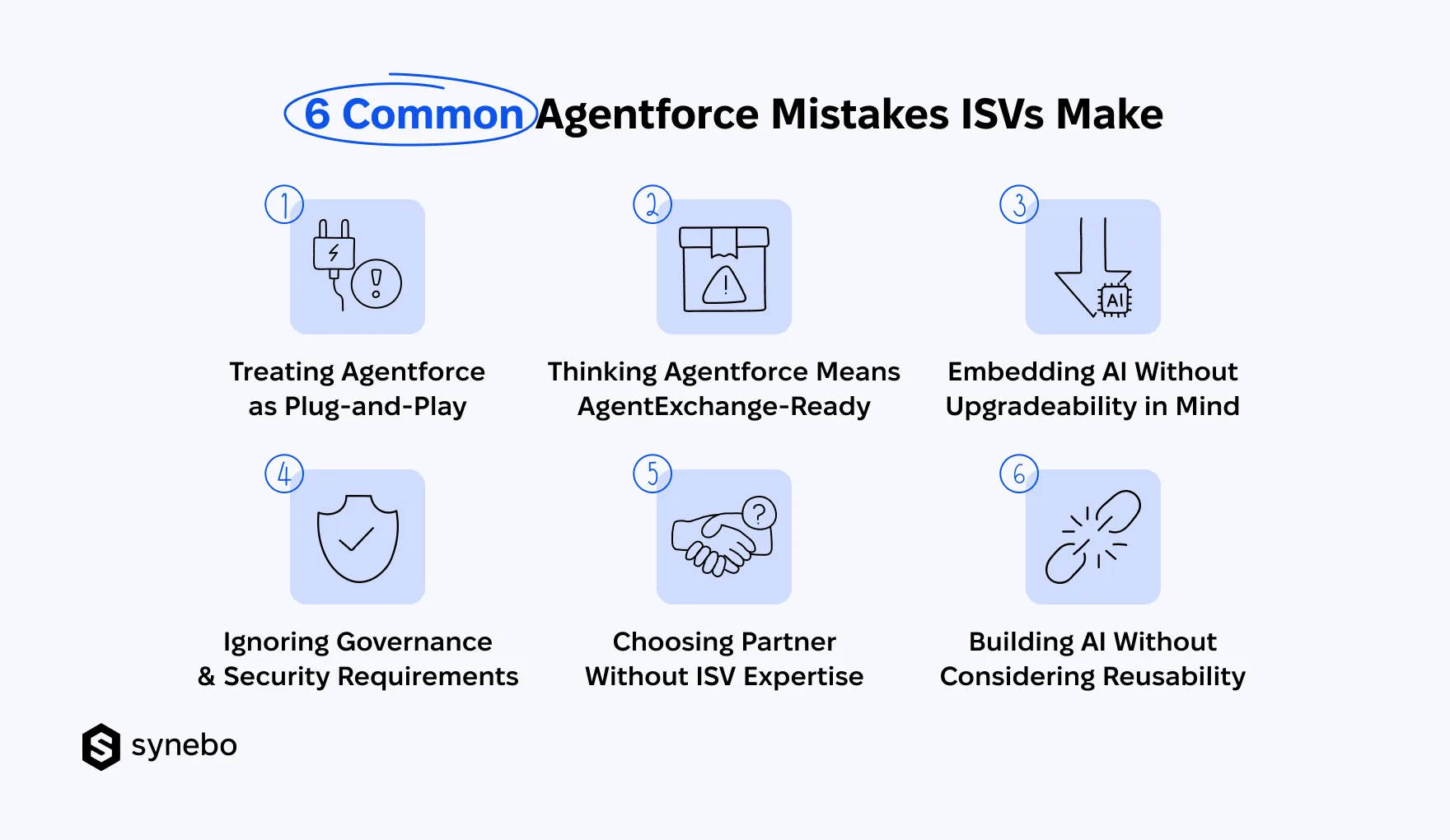
- Treating Agentforce as Plug-and-Play. Agentforce adds a new application layer. It must work within your existing architecture, packaging, and product workflows. It can’t be something bolted on from the outside.
- Assuming Agentforce-Enabled Means AgentExchange-Ready. Adding AI features and making Salesforce products AgentExchange-ready are not the same thing. Because marketplace readiness also includes governance, package quality, documentation, deployment. And long-term maintainability.
- Ignoring Package Architecture and Upgradeability. Every release should preserve customer upgrades. And successful ISVs implement Agentforce in managed package environments without introducing dependencies that block future package versions.
- Overlooking Governance and Security. AI has to follow the same rules, controls, and data boundaries as “the rest” of your product. These requirements deserve attention before any customer interacts with the Salesforce Agentforce AI agents you added.
- Selecting the Wrong Delivery Partner. Many companies understand AI. Yet, far fewer understand Salesforce managed package development, SF security review, package versioning, ISV release cycles. A reputed Salesforce ISV partner brings experience that extends beyond AI itself.
- Creating One-Off AI Solutions. Products should support many customer organizations through the same package. Building Agentforce-powered managed package solutions with reusable components helps make future updates faster. And less painful.
Our clients often ask me, “How can we add Agentforce to our Salesforce product?”. The answer is not “Start with prompts or AI models”. It all begins with architecture, package strategy, a plan that protects years of your investment in the product.
Read Also: AgentExchange vs. Traditional AppExchange: What Changed?
This approach makes bringing Agentforce to Salesforce products practical, keeps upgrades predictable, and puts your application on a path toward becoming AgentExchange-ready.
If Agentforce is your next product move, Synebo can help you plan it properly. Our AgentExchange consulting services bring the perspective of an experienced Salesforce ISV partner. Contact us.
What Does It Take to Make Salesforce Product AgentExchange-Ready?
An SF product becomes AgentExchange-ready when its AI capabilities can live inside a governed package, work across customer orgs, plus meet marketplace expectations. This requires more than an AI agent that performs a useful task.
Here is what AgentExchange readiness сovers:
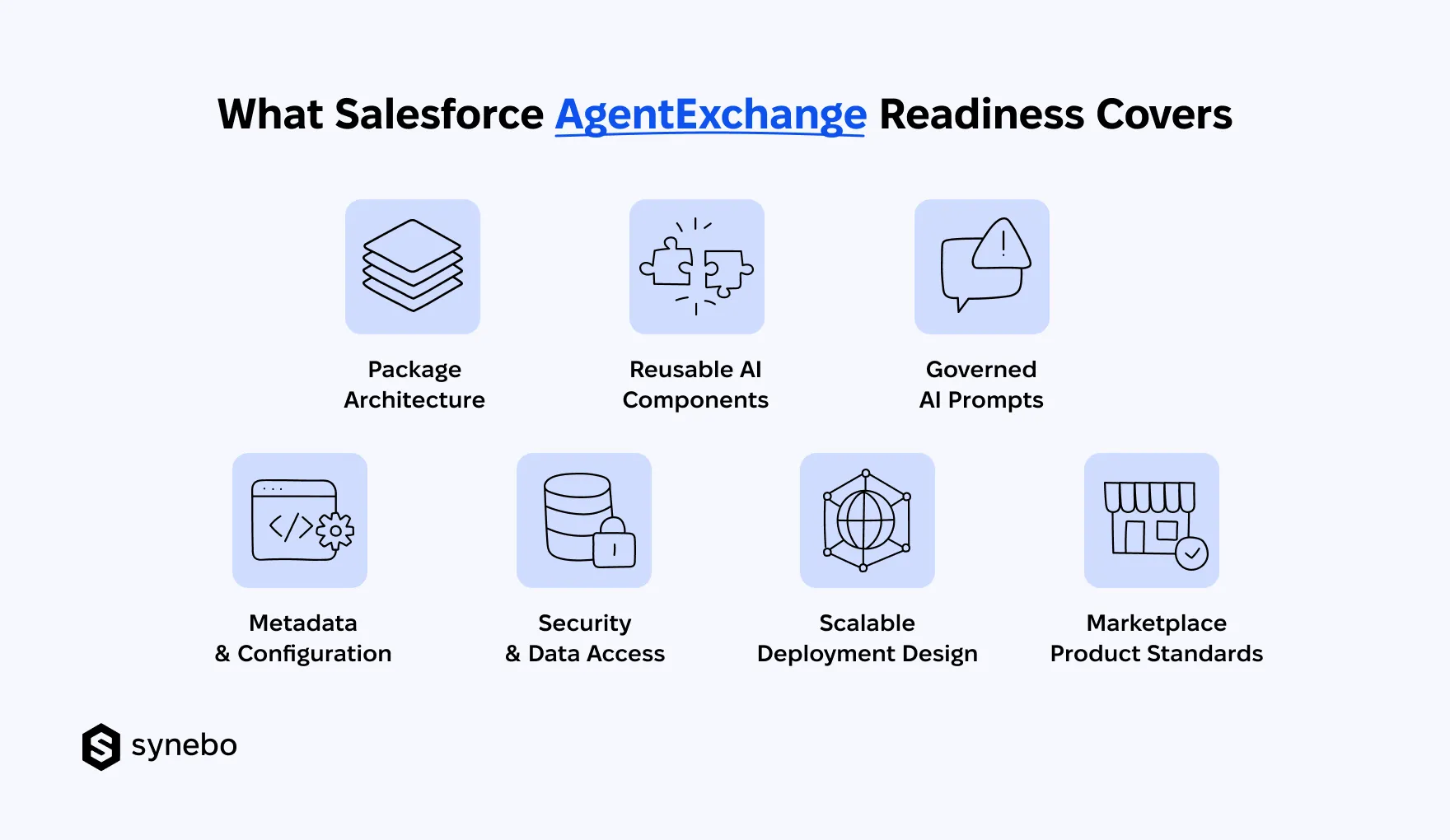
- Package Design. An AgentExchange package needs a solid foundation for AI capabilities, configuration, permissions, future releases. The goal is not to quietly create a second way of using the product, but to extend it.
- Reusable AI Components. AI agents should rely on reusable actions, flows, prompts, other components that can support multiple customer scenarios. They make Agentforce for ISVs much easier to manage at product scale.
- Governed Prompts. Prompts need defined inputs, business context, permissions, and expected behavior. Governance helps keep Salesforce Agentforce agents inside the boundaries. Otherwise, the agent has room to make decisions the product never intended to delegate.
- Metadata & Configuration. Different orgs will need different settings. Metadata and configuration let ISVs accommodate those differences without maintaining a separate codebase for every customer.
- Security & Data Access. Agentforce capabilities need to respect Salesforce permissions and the product’s existing data model. Security belongs in the package design from the first second – not in the “we should probably check this” stage before submission.
- Scalability. Something that works for one org does not automatically work for ten, fifty, or five hundred. Agentforce managed package development needs to account for multiple orgs, repeatable deployment, future enhancements, and maintenance that remains predictable when adoption grows.
- Marketplace Expectations. AgentExchange readiness also concerns the quality of the package as a product. Installation, configuration, documentation, governance, the overall product experience all have to hold up. Because the marketplace sees your package as a product, not a cool feature demonstrated.
One of our cases, EasySend, shows that modernizing an AppExchange product for AgentExchange is possible while preserving the product customers already know. The Synebo Salesforce experts extended its existing managed package, added Agentforce capabilities, and prepared the package for AgentExchange.
“Making Salesforce products AgentExchange-ready is a product engineering task as much as an AI task. The package, AI components, governance, security model, and marketplace requirements need to work together as one deliverable,” aptly puts it my colleague Anatoly Voronov, CTO at Synebo.
How to Bring Agentforce to Salesforce Products: Synebo Expertise & Insights
We have helped many ISVs move Agentforce from a concept into products customers can use, buy, and deploy. The 2 projects below show very different starting points – an established AppExchange product that needed an AI extension, and a new AI experience that had to become a reusable AgentExchange package.
1. EasySend: From Existing Package to AgentExchange in 2 Months
EasySend is a platform for insurance and fin companies. Іt helps digitize paper-heavy processes, from quotes to documents and e-signatures. The company already had a managed SF package serving its users. It wanted to bring Agentforce into it and make document-driven workflows easier to analyze and act on – through natural-language interactions.
The challenge. Because the Client already had a package, rebuilding or modifying the core product made little sense. The real task for our Agentforce specialists was more demanding: add AI capabilities without disrupting the existing package. Plus, improve its UX and prepare the solution for AgentExchange.
The application also had a practical usability issue. Users relied on multiple reports to find relevant information. EasySend wanted a faster way to:
- Retrieve that info
- Work with doc-related actions
- Interact with its product through natural-language requests
The Synebo approach. Instead of modifying the core package, our team implemented Agentforce as a separate dependent add-on package. This kept the existing product intact and gave customers the choice to use the Agentforce layer when needed.
The add-on package included:
- New components
- Config options
- SF-native experiences
- Agentforce connectivity
The updated Synebo AI solution could work with EasySend response data, generate and review reports, initiate document actions such as sending documents for signature. The setup and onboarding experience also received an overhaul, reducing admin work.
The result. AgentExchange was reached in 8 weeks: 4 weeks went to development and 4 weeks – to review. EasySend achieved Agentforce-ready recognition, gained a connector capable of working with data, analytics, and document actions. And created room for additional AI capabilities.
What the Synebo Salesforce consultants learned from the project. For an established ISV product, AI does not need to mean a new product. The bigger opportunity can be to make the product people already know more capable, easier to use, and ready for the next marketplace stage.
Synebo insight. The fastest route to an AI-enabled product is sometimes knowing exactly what should stay and what should change. Plus, what new capability belongs inside the existing product.
2. ST8MNT: From AI Concept to Reusable Product
ST8MNT builds SF apps for managing Statements of Work. It helps users organize project agreements, resources, deliverables, approvals. As the next step for its AppExchange offering, ST8MNT wanted to add an AI layer that could make complex record handling simpler for both experienced users and newcomers.
The challenge. The idea went beyond adding an AI agent to the product. ST8MNT needed а product that could support different orgs, work with records from its package ecosystem, guide users through unfamiliar data models, and handle repetitive record work.
The Client also needed to balance automation with user control. The AI-driven agent could:
- Gather information
- Summarize records
- Suggest updates
But users still needed the ability to review those recommendations. Before changes reached the database.
The Synebo approach. As an Agentforce development partner, Synebo designed NAVIG8R, an Agentforce-powered solution for ST8MNT. We delivered it as a SF managed package for AppExchange distribution, showing how to implement Agentforce in Salesforce apps without rebuilding the AI solution for every org.
The solution included:
- Predefined agent actions and topics
- Guided user flows
- Handling repetitive record work
- Metadata layer that supports additional data types and objects
- Monitoring and reporting
Our Salesforce ISV Agentforce services changed the economics of delivery. Instead of rebuilding the AI solution for each org, ST8MNT received a reusable product that could be deployed and extended through the package itself.
The result. Our Agentforce integration services enabled 3 times faster onboarding for users, flexible architecture, zero custom rebuilds for scaling. Plus, deployment to a new SF org in less than one day.
What the Synebo Salesforce consultants learned from the project. A successful Agentforce implementation for ISVs is not measured only by what an AI agent can do. Its value grows when the same capability can be governed, packaged, deployed, and extended repeatedly.
Synebo insight. AI becomes a stronger product asset when the delivery model is reusable too. Build an AI agent with Salesforce Agentforce once, package the capability properly, and every new customer becomes a deployment. Not another custom project.
Two Projects, Three Lessons
- AI Should Earn Its Place Inside the Рroduct. The strongest AI addition may be a new way to access capabilities the product already has.
- The Second Customer Is the Real Product Test. The first org proves AI works. The second proves it can be reused without another custom build.
- The Discipline Stays the Same, Whatever the Product. Governance sets the boundaries. Рackaging makes the capability reusable across orgs. These are two essentials behind Agentforce implementation for ISVs.
If you’re ready to bring AI into your SF product, Synebo, as an ISV partner, can help you choose the right path. Our Salesforce consulting for ISVs covers both product development and AgentExchange preparation. Contact us.
Why Do ISVs Choose Synebo for Agentforce Implementation?
Vendors choose Synebo because Agentforce implementation for ISVs requires more than AI expertise. The right partner needs to understand the product itself, the SF ecosystem, and what it takes to turn an engineering project into a commercially viable offering.
What makes Synebo a practical choice?
- Agentforce & Salesforce Product Expertise. Synebo knows how to implement Agentforce in AppExchange products. We bring years of Salesforce product development and PDO experience. So, you can extend your internal product team without building a new AI engineering function.
- Profound AppExchange Experience. Synebo AppExchange development covers the marketplace side of product delivery, not only the code. This matters when you want to build for AgentExchange and need engineering decisions to support marketplace requirements.
- Managed Package Know-How. Synebo managed package development helps ISVs introduce Agentforce capabilities into products designed for repeatable deployment. We know how to implement Agentforce in managed package environments without treating every customer org as a separate project.
- One Team for Product & AI Questions. With Synebo Agentforce services, product teams can address questions about SF AI agents, package design, integrations, permissions, and future releases – in one engagement.
- Engineering Meets Marketplace. As a Salesforce ISV partner and Agentforce implementation partner, Synebo understands both sides of the picture: how to build the product and how to prepare it for its marketplace success.
- Quick Onboarding, Practical Pricing. You can bring Synebo into your existing product team without a long ramp-up period (in a couple of weeks). Flexible engagement models and competitive rates make our Agentforce implementation services accessible without the overhead of a large consulting firm.
Read Also: How Much Does It Cost to Build for AgentExchange?
From Salesforce Product to Agentforce Product
Agentforce can become a natural extension of your Salesforce product – if your product architecture, package, and AI strategy move together. This is where experienced Agentforce implementation for ISVs matters most.
Got an AI idea for your Salesforce product but not sure how to make it production-ready? As your Salesforce AI implementation partner, we bring the Salesforce, Agentforce, and AppExchange expertise needed to turn this idea into a product your customers will value, enjoy, and want to use.
Our Salesforce consulting for ISVs helps you map the next move and get from an existing product to an AgentExchange-ready offering. Faster. Reach out to us.
Yes. Agentforce can be added to your existing managed package, provided the product architecture and package rules support the required capabilities. The key question is how the new AI layer fits existing components, permissions, dependencies, the release model. This is where Agentforce implementation for ISVs needs product-level expertise.
There is no fixed period for making a Salesforce product AgentExchange-ready. The whole process depends on your product’s state, planned Agentforce capabilities, your product readiness for the marketplace requirements. A tech review can reveal the scope early: packaging, security, agent behavior, documentation, testing, and submission preparation. A skilled AgentExchange implementation partner can help you map this path.
Usually, no. Before you add Agentforce, you do not need to rebuild the architecture. Start with an architecture review. It will help you identify where agents, permissions, data access, integrations can fit. If changes are needed, you can target pressure points instead of redesign. Salesforce Agentforce consulting for ISVs adds value here, too.
Before implementation, you should prepare a clear product map, package details, key user flows, permissions, integrations. Plus, the AI use cases you want to support. Identify tech constraints, dependencies, and marketplace requirements upfront. This gives you (or your Agentforce consultants) enough context to assess feasibility, define the work, and recommend an implementation approach.