Dreamforce 2026: AI Is Only as Good as Business Context Behind It
You approve your AI budget betting on an unproven assumption: the AI model somehow knows your business. In fact, it doesn’t. Аt Salesforce Dreamforce 2026, SF made a case: AI works well when it has your business context behind it.
This idea runs through all the biggest Dreamforce announcements: data, permissions, workflows, rules, application logic give AI the context models lack. And SF positioned AIforce (recently renamed as SIforce), Data 360, and Agentforce as pieces of this foundation.
This article translates Dreamforce 2026 innovations into what they mean for your business, beyond stage applause. We’ll look at how the Salesforce AI updates affect companies with years of SF investment and why better AI starts with better context.
Key Notes from Dreamforce Conference 2026
Dreamforce ’26 makes one point hard to miss. AI does not become useful because a model is impressive.
As Marc Benioff, SF CEO, said at the conference: “Models alone cannot run the enterprise.”
AI becomes useful when the model can work with your data, rules, permissions, processes that tell it how your business operates. And Marc framed the Salesforce future direction around this idea: connecting leading models to the enterprise context already sitting in your SF.
Read Also: Is Traditional Salesforce Changing? Dreamforce 2026 Key Innovations
This sounds strategic. But what does it change for your business, say, on a typical Monday morning? Here are the 3 shifts we’ve framed as questions from you.
1. What Gives Enterprise AI Advantage Beyond AI Model?
The enterprise AI advantage is moving beyond the model itself. It comes from the data the model is fed. Frontier models, such as Claude or Gemini, are available to every company now. And any powerful model knows a lot. But it cannot know your business unless your company’s data and logic are connected to it.
- So, AI Model Becomes Choice, Not Strategy. With AIforce (SIforce), you can connect leading models to your SF data such as customer history, pipeline records, service activity, and business rules – without tying your entire AI strategy to one model provider.
- Metadata Becomes Usable AI Context. Permissions, workflows, business logic, other metadata built over years already encode how your company operates. SF calls this “unlocking value” from data that already runs your business. AIforce (SIforce) brings this value into AI instead of leaving it available to people who know where to find it.
- Payoff Is Action, Not Another Answer. Employees can get SF answers and act on them from interfaces they already use, including Slack, Claude, and SF itself. Ask about a pipeline and get the relevant info. Ask for an account plan and move toward the next step. This shift from retrieving info to acting on context is where AI gives practical value.
SF research found that 49% of data and analytics executives say their companies sometimes or frequently draw incorrect conclusions because of poor business context. Over 40% lack full confidence in AI output accuracy and relevance.
From what I see working with SF clients, existing business logic gives AI a much stronger starting point. And аs Salesforce AI evolves, your context will play an even bigger role in how useful AI can be in your day-to-day work.
2. What Is Biggest Blocker to Enterprise AI Rollouts?
The biggest blocker to AI rollouts is losing control over how sensitive data is accessed, shared, and used by AI. For enterprise AI, this control has 3 practical layers: protecting your data, grounding AI in trusted info, and governing what AI can do with it.
- Enterprise AI Starts with Trust. Businesses will always worry if their sensitive data can/will leak into someone else’s model. SF’s answer here is Zero Data Retention (ZDR). It means your customer data is not retained by 3d-party LLM providers or used to train their models. SF also says its security teams audit and test these controls.
- AI Needs Verified Source of Truth. AI is probabilistic. Your business records are factual: аn opportunity amount, service history, account status, or permission is supposed to reflect an established fact. Salesforce is positioning Salesforce AI and AIforce (SIforce) around grounding AI in your company’s data, apps, semantics, rules, security.
- Governance Sits with Agent Layer. Agentforce is presented as an operational layer with governance, control, observation, and ongoing improvement. In other words, AI agents work inside the controls you’ve already defined in SF. This matters once AI moves beyond answering questions and starts taking actions.
Yes, thіs concern is not theoretical. McKinsey’s 2026 survey names security and risk concerns as the top barrier to scaling agentic AI.
From our delivery experience, this is the point where an AI pilot either earns a path to wider use or stays stuck with one of your teams. Governance has to exist before the scope expands, not after something goes wrong. This is an important part of the future of AI in Salesforce: AI adoption needs stronger controls as its role in business processes grows.
3. Do You Need to Change Your Whole Salesforce Setup to Get Started?
No. Your SF setup doesn’t have to become another big transformation project. Your starting point is what your teams already have in place.
- Rollout Can Follow Existing Work Habits. SF presented different AIforce Salesforce entry points: Claudeforce for Claude users, Slackforce for Slack users, the new Agentforce Coworker for Lightning users. If your workflows are highly specific, the platform also gives your dev team the green light to build custom AI tools.
- No New Platform to Buy or Migrate to. Because AIforce (Siforce) sits on top of your existing SF stack, there is no need to introduce another platform to your people, move your data into a new environment, retrain your entire firm around a different system.
- AI Becomes Extension оf Your SF Investment. Instead of funding another platform and another implementation, you can use the SF environment you have already invested in as the basis for your AI strategy.
From what I see, this is where Salesforce Dreamforce updates get interesting. AI adoption does not have to begin with a massive program. You start with one business process, connect the right data and rules, prove the output is useful, then expand the scope. This keeps the technology tied to how your company works. Without forcing your people to relearn everything.
Your effective AI opportunity may already be sitting in Salesforce. Talk to Synebo experts to spot the process where Salesforce AI can take on more of the work.
What Dreamforce 2026 Innovations Means for Your Business – Synebo’s Opinion
At the Salesforce Dreamforce conference 2026, SF made a long-running AI debate much harder to ignore: the AI model matters less if it cannot see the info your business relies on.
That sounds straightforward on paper. Inside your SF environment, the implications are more practical. Here’s Synebo’s view.
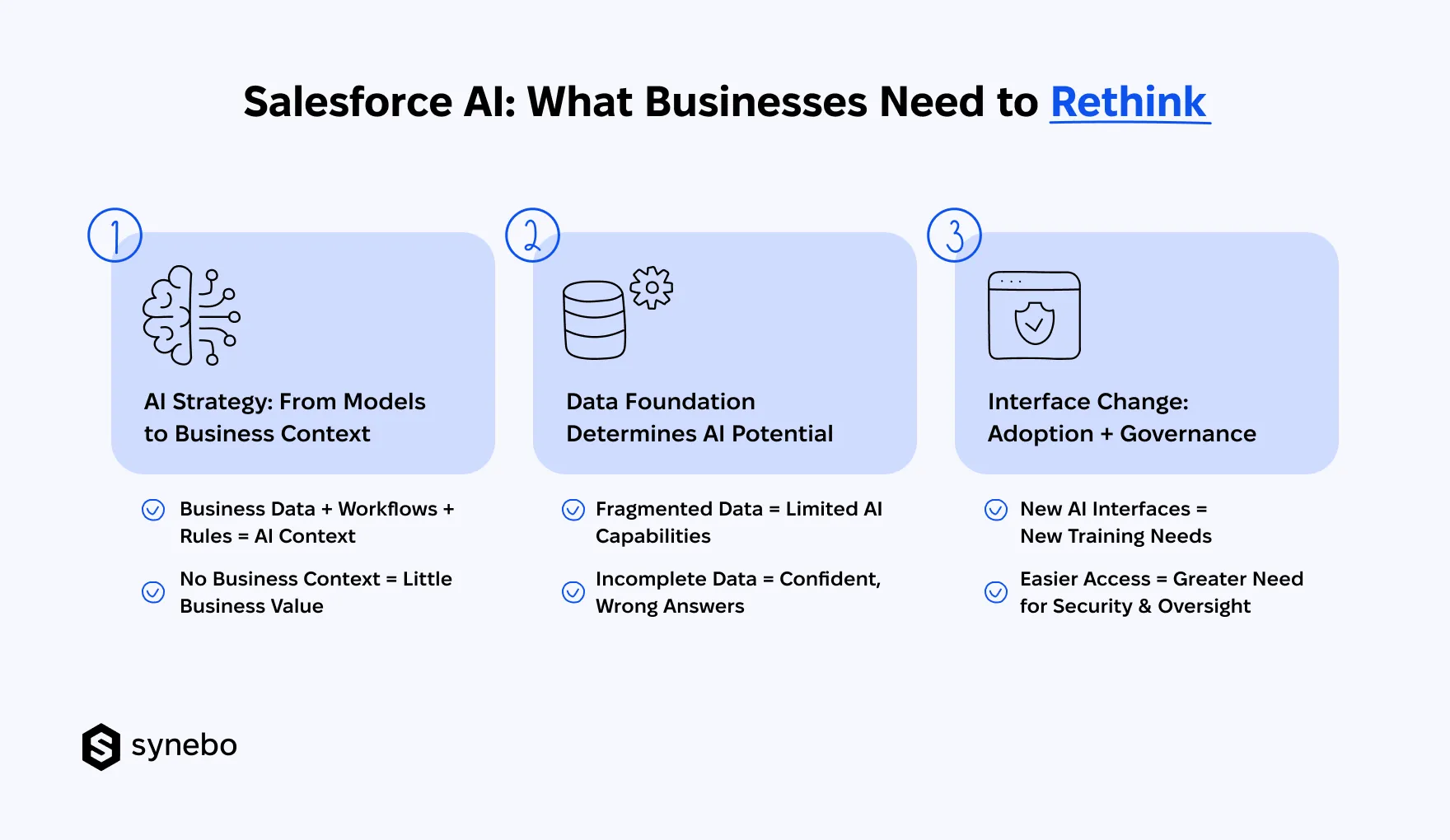
Your AI Strategy Is Shifting from Model Choice to Business Context
- Value оf AI Depends оn What It Can Access. AI delivers limited value when it sits outside SF, operational systems, internal processes. If it can’t reach your customer history, case status, business rules, its answers are quite generic and probabilistic. (SF presents AIforce (SIforce) as an answer to this problem.)
- Useful AI Needs More Than Good Prompt. A well-written prompt can’t fill gaps in your company data. If your employee asks AI to recommend the next action on a customer account, the answer depends on what AI can actually see: previous interactions, open opportunities, service issues, account rules, other relevant records.
Your Data Determines How Far AI Can Go
- Start with Where Your Data Lives. Data gaps are among the Dreamforce highlights for AI adoption. Your client, sales, service, operational info may be kept in SF, external apps, data warehouses. Even old systems you are not using now. If it’s scattered, AI will have an incomplete view. And will fill the gaps with its own assumptions. Instead of facts.
- Incomplete Data Produce Convincing Mistakes. AI that says “I don’t know” is easy to spot. AI that gives a “good” answer based on missing operational data is hard to catch. This answer can send your employee toward the wrong action. And you may not realize there was a mistake. Until the consequences get critical.
So, better data access is part of the technology trends at Salesforce Dreamforce 2026. If your data is spread across different systems, SF Data 360 helps bring many sources together so AI works from a more complete context.
For a deeper look at when Data 360 makes sense and how to approach it, see also our articles “Salesforce Data 360: Your Top 10 Questions Answered by Synebo Experts” and “What Does a Salesforce Data 360 Implementation Look Like?”
Why New Interface Is More Than Technical Upgrade
Because it’s also an automatic “adoption upgrade”. When AI works through the tools your people already know, the SF adoption problem almost disappears.
Why?
The future of Salesforce is also about new ways for people to work with the platform. Indeed, the Dreamforce conference showed how employees can interact with SF through Slack, Claude, and more – without opening its traditional screens.
Yet this shift also changes what companies need to rethink around training, oversight, and governance:
- Access Rules Matter Even More. AI still follows your existing permissions. So, it’s a moment to audit access and permissions: an interface that lets your employees “just ask” for info or actions makes security and governance setup more consequential. And gaps that were low-risk before can become higher-risk when AI acts on them directly.
- Training Needs to Follow New/Non-SF Interface. If AI can act directly inside Slack, Lightning, or Co-work, your employees may need less training on features and navigating SF screens, but more guidance on when to use AI, what to ask, and – important – when human check is still needed.
I’d add that this is one of the practical points coming through in Salesforce AI news. The interface may feel simpler for your employees, but it puts more weight on the rules and skills behind every AI-driven action.
How to Get More From What You Have
The latest news from Salesforce Dreamforce 2026 highlighted one thing: “better AI” alone won’t solve a business problem. The quality of your data, processes, permissions, the Salesforce context will shape what AI can and will do for your business.
So before adding another AI tool, look at what you already have. Is the right context accessible? Can/will AI act on trusted information? Are your existing SF investments ready for this next layer?
If you need help answering those questions, Synebo can assess your SF environment and help you define the next practical step for AI adoption. Contact us.