Salesforce AI Strategy: What US Businesses Should Plan for Next
For many companies in the US using Salesforce, the AI transformation started with Agentforce. Which processes could agents automate? What should we pilot? Are we ready for it overall?
These questions still matter for US businesses. But Salesforce AI now goes well beyond individual agents. The challenge now is to decide how AI fits into your systems, business operations, technology investments. McKinsey’s 2026 research found that 44% of AI-using companies are scaling AI enterprise-wide. Yet only 6%(!) of all respondents qualify as AI high performers.
To join the ranks of high-performers, you need a solid Salesforce AI strategy. And it starts with business priorities, not product announcements. Which Salesforce AI capabilities deserve investment? Is your platform ready? What to start with?
This article explores the key stages of Salesforce AI adoption. We’ll look at what US businesses should prioritize in their Salesforce AI roadmap, and how these stages fit into а broader Salesforce AI strategy.
Salesforce AI Stack Is Getting Wider
Salesforce AI now* spans much more than autonomous agents. SF offers tools to execute tasks, connect data, assist employees, and even bring the platform intelligence into other apps. Each serves a different purpose, so if you want to choose where to invest, they require a closer look.
What Makes Up Salesforce AI Stack?
- Agentforce – AI Agents That Take Action. Agentforce can handle multi-step tasks, retrieve relevant records, update SF data, trigger approved workflows. Its value lies in moving work forward, not merely answering questions.
- Data 360 – Business Context Behind AI Decisions. Data 360 connects your customer info from SF and external systems you are using. It gives agents access to richer context (such as purchase history, service interactions, and other operational data). Better context means you make fewer decisions with half the story.
- Einstein – AI Assistance Inside Salesforce. Einstein capabilities help your employees draft emails, summarize cases, generate content, get recommendations directly in their daily activities (because, in fact, not every task calls for an autonomous agent).
- Claude, Slack, Other Interfaces – SF Intelligence Beyond SF. Salesforce data and supported actions can also become available through external AI environments and collaboration tools (subject to permissions and integration capabilities).
Read Also: Inside Claudeforce: Salesforce and Claude Integration Explained
Yet, а Salesforce AI strategy shouldn’t be a running list of new features to try. For many US companies, adopting more technology isn’t the same as making progress.
As my colleague, Anatoly Voronov, CTO at Synebo, says: “You don’t need every new Salesforce AI capability. You need just the right ones for your business – chosen around what you want to achieve.
*This overview reflects the Salesforce AI stack as of late 2026 and early 2027, with some Dreamforce ’26 announcements still awaiting general availability.
What Should US Companies Plan for Next in Salesforce AI?
The next big move for US companies is to take AI beyond just individual SF tasks and make it work with the rest of their business. A solid Salesforce AI strategy connects your business data, brings AI into different tools you use, and enables smart agents to work together.
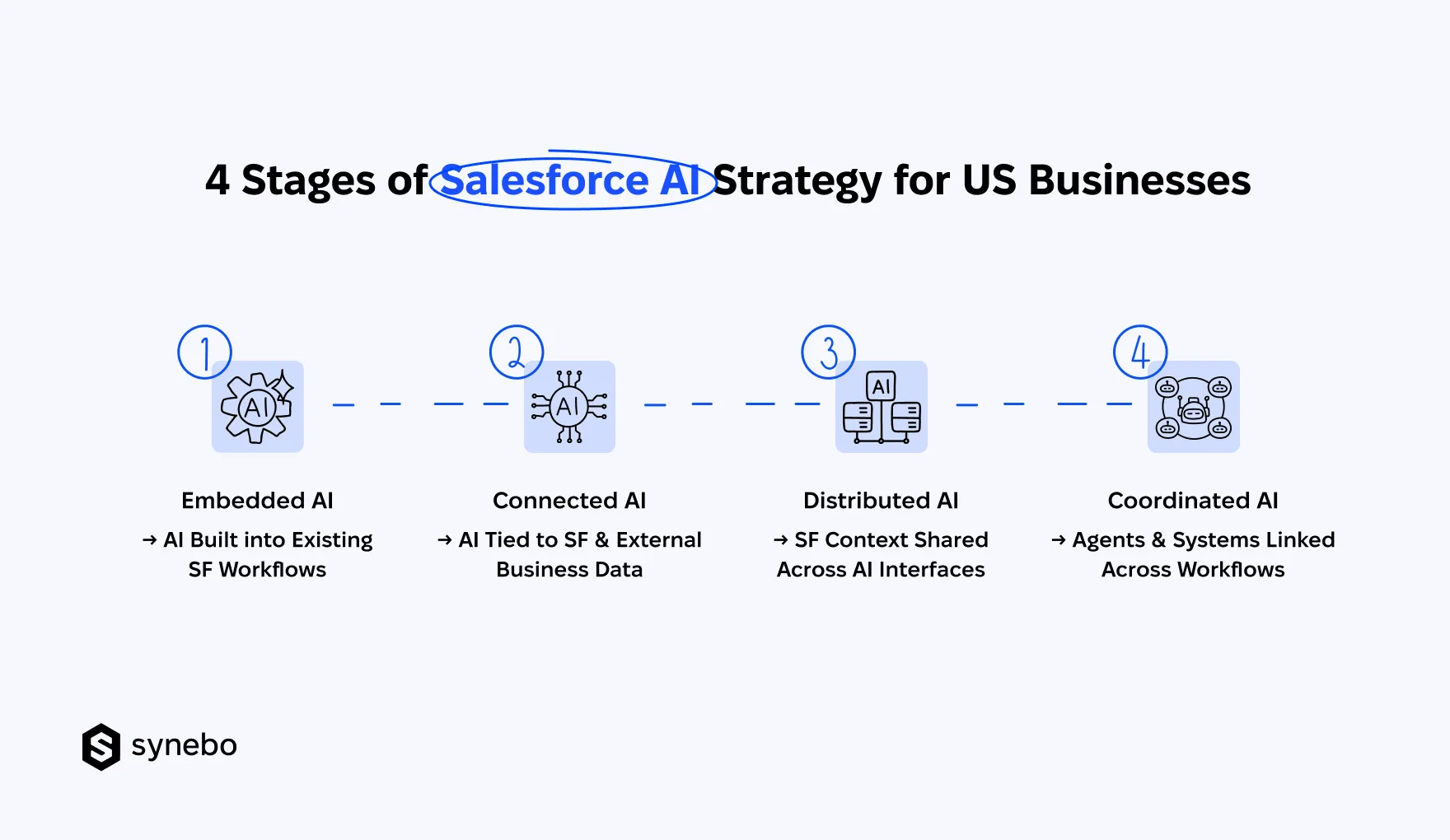
So, how to start with AI in Salesforce and go further through each phase of your company’s growth? Here are 4 stages.
Stage 1 – Embedded AI
Start with AI in Salesforce through Einstein and Agentforce. At this stage, smart agents handle defined tasks, your employees receive recommendations, existing SF processes gain AI support.
Your priority at this stage: Make sure you’ve got an overall proof that AI implementation improves/simplifies your daily work. Important are clear permissions, reliable execution, employee uptake. Assess what results you got.
Stage 2 – Connected AI
Extend AI access to your ERP, finance, service, other platforms you are using – through Data 360 and integrations. Agents can then consider more than SF records before they take any action (they have a much richer context).
This matters: SF’s 2026 State of Sales report found that disconnected platforms are hampering Salesforce AI transformation for 51% of sales leaders.
Read Also: What Does a Salesforce Data 360 Implementation Look Like?
Stage 3 – Distributed AI Experiences
At this stage, you may give your employees access to SF context through Slack, Claude, other supported interfaces. AIforce (SIforce) direction makes SF information and permitted actions available where your people already work.
The underlying principle at this stage: your enterprise AI strategy must account for consistent access controls, regardless of the interface.
Stage 4 – Coordinated AI
The next move in your Salesforce AI implementation roadmap can be getting your AI agents working as a team. For example, a service agent detects a delivery issue. А logistics agent checks the shipment status. Аnd another agent prepares a customer update for approval. Different agents, one business process.
The gap at this stage: Salesforce’s 2026 Connectivity Report found that 50% of AI agents operate in isolation. This stage makes them work together, so your business can handle more complex processes without constant manual handoffs.
Read Also: Dreamforce 2026: AI Is Only as Good as Business Context Behind It
Where Does Koa Fit?
Koa isn’t another stage in building an AI roadmap with Salesforce. It’s a reasoning model for Agentforce, announced at Dreamforce ’26. It helps smart agents reason through complex tasks and makes them more capable at every stage of your Salesforce AI modernization strategy.
It aims to improve how agents interpret your business context, select tools, and then execute those tasks.
Note: Koa still remains an emerging capability, with general availability expected in winter 2026.
How to Build an AI Strategy with Salesforce?
AI strategy for US businesses should answer the following questions: What can AI do for your business today? What’s holding it back? And what deserves your investment next?
Here’s how the 4 stages of your AI strategy may fit into your company’s SF ecosystem:
Agentforce – Data 360 – External AI Interfaces – AI Coordination
Yet, think of these stages in your Salesforce AI strategy as capabilities you can combine and build on – depending on your business priorities. It’s not a shopping list of SF products. And it’s not a strict sequence to follow either.
And before expanding Salesforce AI adoption, these 3 things deserves your attention:
- Understand What Your SF Can Handle. Your AI ambitions may be ahead of your current architecture. Check what your data, permissions, integrations can reliably support.
- Pick Problem Worth Solving. An AI demo won’t impress your CFO for long. Before investing in Salesforce AI, choose a use case that saves time, reduces costs, and/or improves metrics that are important for your business.
- Make One Success Lead to Another. After the use case you picked proves its worth, see what it takes to extend it to more teams, systems, processes. This helps you bring AI into more of your everyday business processes.
I’d put it simply: the best Salesforce AI strategy is the one that turns what you already have into something your business couldn’t do before.
Thinking about implementing AI in Salesforce? With Synebo AI consulting, you’ll find out what your current SF setup can support, where AI can deliver value, and how to put it to work. Contact us.
What Should Leaders Ask Their Salesforce Teams Now?
Before you start preparing Salesforce for AI, get your business and tech teams to agree on what AI should do, what it can access, and how much freedom it should have. These decisions will shape your Salesforce AI strategy far more than the next product release.
There are 7 questions you may discuss with your team:
- What Should Stay Inside Salesforce? Pinpoint tasks/processes that are best handled by Agentforce (or other native Salesforce AI solutions). If you move them elsewhere, you may add complexity without value.
- Who Needs Salesforce Context Elsewhere? Sales, Service, Finance, Operations Depts may need (and benefit from) the platform insights in Slack, Claude, or other tools they use.
- What Data Can AI Access? It’s important. Because a solid Salesforce AI strategy for businesses starts with data boundaries. Decide which records, customer details, business info agents can use. Check permissions before you expand access.
- Which Actions Can AI Take Independently? Routine updates and low-risk tasks – give AI room with these, they are good candidates. Financial commitments and sensitive decisions need better control by your employees.
- Where Must Your People Stay Involved? Establish approval points for actions with legal, financial, and/or customer consequences.
- What Is Ready Just Today? Plan your Salesforce AI integration around production-ready solutions. (Separate them from emerging features that deserve attention but not yet a budget.)
- How Dependent Should We Be On Salesforce? Consider where native capabilities make sense and where external models or interfaces give your company more flexibility.
These answers turn your AI strategy around Salesforce into actual architectural and investment decisions.
If your team is unsure how thеse choices will affect your existing architecture, a skilled Salesforce AI partner can help you assess the technical implications and decide what to implement first.
Your Next AI Investment Should Start With What You Already Have
For US companies investing in AI, the next step in the Salesforce AI strategy isn’t necessarily another AI product. It may be a better use of the AI capabilities your org already supports, the data you’ve accumulated, and the business logic you’ve built over several years.
The main point for you is to know where Salesforce AI implementation can make a difference, what your current setup can support, which capabilities deserve your budget. A successful pilot is a good start. But its real value becomes apparent when the same approach works for more teams and business processes.
The Synebo Salesforce-certified AI specialists can assess your current architecture, spot worthwhile opportunities, and turn your AI priorities into an implementation plan. Talk to our Salesforce AI consultants.