Salesforce World Tour NYC 2026: What to Explore Before Investing in AI?
The practical value of the New York Salesforce World Tour 2026 may not be the number of new Salesforce AI solutions you discover (and you’ll discover plenty). It’s the decisions you can make afterward. Which technologies deserve your look? What would a credible business case include? What must be addressed before implementation?
This matters because AI is gaining ground among businesses in the US. According to the Census Bureau, between Dec 2025 and May 2026, one in five American companies already used artificial intelligence. Among companies with 250+ employees, this figure reached 37%.
For business leaders, every new AI capability brings another question. Where can it make a meaningful difference to their business?
In this article, you’ll get a practical framework for evaluating Salesforce AI updates, asking helpful questions during your meetings at the Salesforce World Tour, and then deciding which technologies you can explore next.
Which Salesforce AI Innovations Should You Explore at World Tour New York 2026?
For US companies, the most relevant AI innovations at the Salesforce World Tour NYC are those that address their critical/pressing business problem and fit your current SF environment.
Give special attention to 4 innovations: Agentforce Coworker, Salesforce with Claude, Slackforce, Data 360. The key for you is to see which business tasks they can handle. Plus, what your company must have in place to use them.
What’s more, there is a good reason to look beyond the demos. RSM’s 2026 survey found that 86% of respondents’d integrated AI into operations. But only a bit more than a third (36%) had embedded it fully in core processes.
The best way to assess recent Salesforce AI news is to look at what each one can change for your business.
Agentforce Coworker: Can Your Employees Act Faster?
Agentforce Coworker is a Salesforce AI agent that uses Data 360 and Customer 360; it operates in SF interfaces, Slack, Claude, MS Teams, ChatGPT.
- Business Problem It Addresses: Your Sales and Service crews spend a lot of time on searching account histories, activities, customer details.
- Potential Benefit You Get: Coworker works inside SF, uses account context, shares insights, and acts under permissions and business rules you have preliminarily set.
- What You Have to Check: Data quality. User permissions. Business rules. Available agents for tasks that require action(s).
Salesforce with Claude: Can Claude Context from Your SF Оrg?
At the Salesforce World Tour in New York, SF will showcase how Claude can extend the capabilities of its AI ecosystem and support new business workflows.
- Business Problem This Integration Addresses: Employees use Claude for analysis. But they lack SF data about your customers, plus approved actions.
- Роtential Веnefit You Get: SF in Claude brings CRM data and workflows into this external AI model. Its preconfigured sales skills span tasks like lead research and reviews of deals.
- What You Have to Check: First check who can access which SF records. Then decide what employees can hand off to Claude.
Read Also: Inside Claudeforce: Salesforce and Claude Integration Explained
Slackforce: Can Your Employees Act Inside Slack?
The SF World Tour New York 2026 is also a chance to see how SF brings AI capabilities into Slack and connects them with your everyday tasks.
- Business Problem It Solves: Details about your customers live in SF, Slack threads, other tools. Your people constantly switch apps to find context.
- Potential Benefit You Get: Slackforce brings SF context into Slack. Slackbot can review account activity, talks, cases. Then it creates tasks or reassigns owners.
- What You Have to Check: Slack and SF data access. Channel permissions. Рrocesses for recording decisions in CRM.
Data 360: Does AI Have Data It Can Trust?
Your Salesforce AI strategy depends much on the quality of the data behind your agents and business processes.
- Business Problem Data 360 Integration Solves: Іnformation about your customers is accumulated and kept in separate systems. AI agents lack the context they require.
- Potential Benefit You Get: Data 360 ties and harmonizes all the data your business has accumulated. It gives AI agents a full view of your customers. And your operations.
- What You Have to Check: Quality of your data. Identity resolution. Integration reqs and costs. Data governance. Access controls. Data 360 consumption and pricing.
Read Also: Dreamforce 2026: AI Is Only as Good as Business Context Behind It
Questions to Take Beyond Demos
The product demos you see are only half the conversation. The other half is about what these technologies would mean for your SF setup.
So, at every demo, I advise asking Salesforce product experts:
- Which process would this technology improve?
- What evidence supports its expected business value?
Plus, ask your Salesforce AI implementation partner, such as Synebo:
- What would this require from our current Salesforce environment (including data, integrations, permissions, and custom code)?
These questions will help you separate promising AI-powered Salesforce solutions from experiments that can drain your resources (or drag on for many months).
How Can You Tell if Your Salesforce AI Investment Will Pay Off?
Investing in Salesforce AI makes financial sense if and when it helps your business do specific things (processes) better. But even more important is that it should deliver value beyond its operating costs. For US companies thinking about Salesforce AI adoption, the main point is how much business value an intelligent agent can create after you embed it and train your employees.
Profit Test
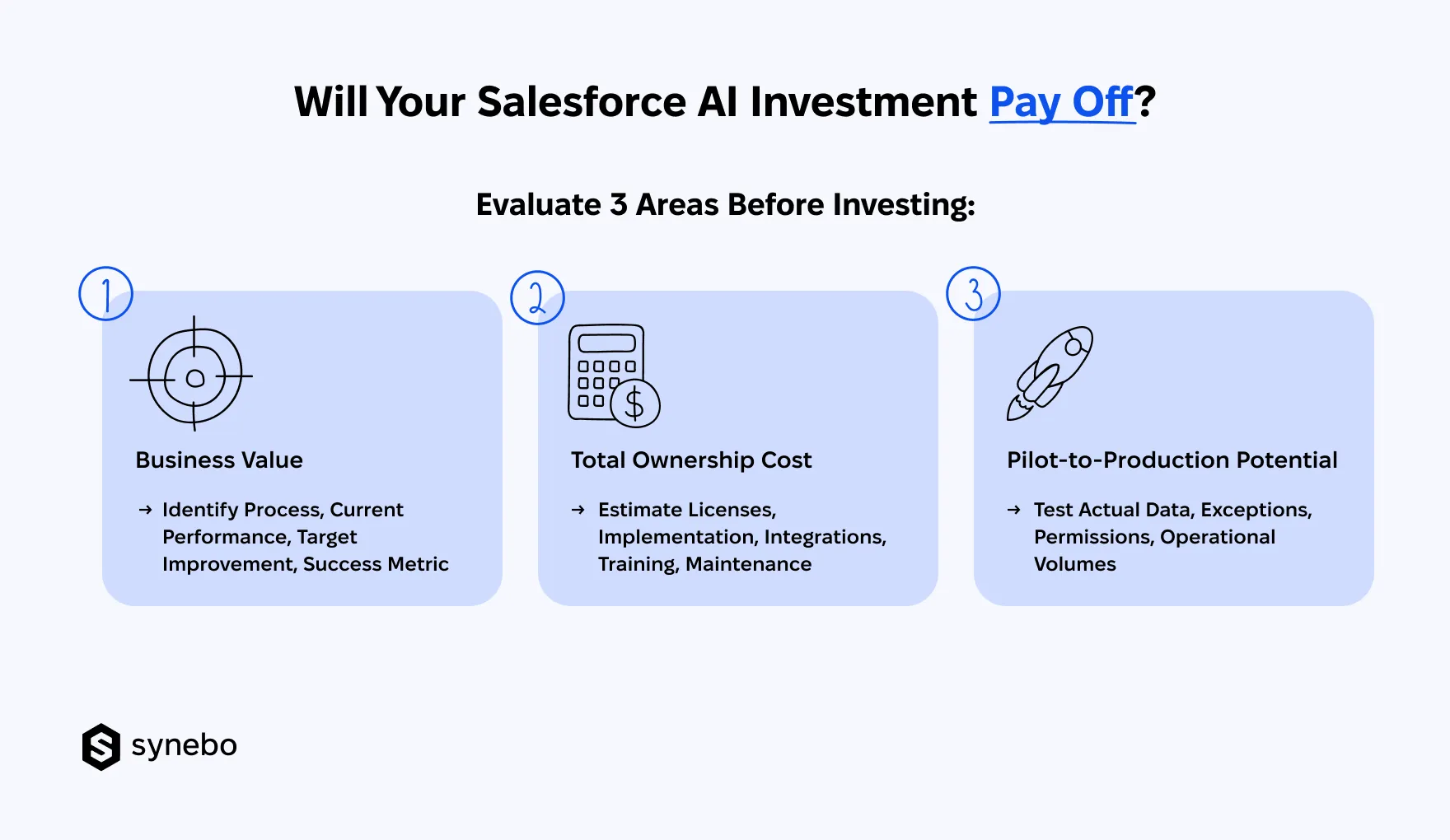
Start with a process that costs your company time and/or money. Set a baseline. Then define the expected improvement. Сhoose a metric to verify the result.
What to pay attention to:
- Pick Proper (Costly) Task. Examples are: lead follow-up, customer case resolution, sales admin, manual reporting. Choose a recurring process with a clear owner.
- Set Target. Record current handling time, conversion rates, case resolution time. Or hours spent on reports. Then define a worthwhile improvement.
For American businesses, this keeps their AI strategy around Salesforce tied to an operating priority, not a product feature that looks impressive on stage. “Save time” is too vague. “Reduce average case handling time by 15%” gives you something to verify.
Read Also: Salesforce AI Strategy: What US Businesses Should Plan for Next
Full Price Tag
The license fee rarely tells the whole financial story. A credible AI strategy for US businesses – surely – has to account for expenses before launch. And throughout the solution’s lifetime.
What to pay attention to:
- Count Setup. Include SF licenses, implementation, custom development, integrations, data preparation. Then also – testing and employee training.
- Plan for Long Term. Add maintenance, usage-based fees, monitoring, human review. Don’t forget future updates. These expenses can change the economics of your Salesforce AI roadmap.
At the Salesforce New York World Tour, ask SF representatives for a full cost estimate, not a license price with the fine print left for later. You should compare the total with the value the use case can generate.
Pilot-to-Production Potential
This is probably a cliche, but still: Salesforce AI transformation requires more than an interesting demo. The pilot must handle your company’s actual data, permissions, exceptions, transaction volumes.
To judge its production potential, do 2 things:
- Test Your Own Conditions. Check how the agent responds to problematic (incomplete) records, unusual requests, conflicting info, restricted data.
- Map Route To Production. Pinpoint required integrations, security reviews, governance rules. Plus performance tests and employee approval processes.
An AI agent may save your employees hour(s) a day. On paper. The financial return on implementing AI in Salesforce depends on adoption, review time, operating costs, and how much of those saved hour(s) become productive work.
Another Bunch of Questions to SF Representatives & Implementation Partner
At the New York World Tour by Salesforce, ask SF product experts:
- What result should we expect? Which metric will prove the value? And over what period?
- What will it cost? What are the full implementation and ongoing operating costs?
Then ask your AI implementation partner, such as Synebo:
- What must happen for this pilot to become a production-ready solution in our SF environment?
These questions are absolutely practical. A Dun & Bradstreet survey of 10k businesses found that 56% plan to increase AI spending. Yet only 24% report broad or strong returns. These figures show why investment decisions require more than enthusiasm for new tools.
Going to Salesforce World Tour NYC 2026? Let’s Talk About Your SF Plans
The Salesforce New York World Tour 2026 takes place on December 3, from 9 a.m. to 5 p.m. ET at the Javits Center, NYC.
Synebo is attending the event. We’ll be represented by CEO Kateryna Mishei and Oleksandr Molchanov, SF Architect and Team Lead.
We welcome you to meet us and discuss:
- Your SF Priorities. Which AI capabilities address your business goals? And/or current challenges?
- Your Investment Plans. What would it take to turn an AI opportunity into a sound investment? What business value could it bring? And what should your company consider before committing a budget?
- Your SF environment. How well can your current setup handle the reqs? Аnd where may development or adjustments be necessary?
- Your Next Move. What can be your next steps? And where could Synebo’s Salesforce expertise help?
You don’t have to leave Salesforce World Tour NYC with a complete Salesforce AI roadmap. Knowing which opportunities deserve further investigation – and which don’t – can be a much more valuable result for you.
And if AI isn’t your only priority, we’re also happy to discuss your broader SF plans, upcoming projects, or ideas for your existing CRM environment.
Have an SF project worth discussing? Meet Synebo in New York.
Before You Invest in Salesforce AI for Business, Know What’s Worth It
Every big AI announcement may catch your attention. But it doesn’t automatically deserve your budget.
For US companies, a sound enterprise AI strategy starts with a business priority. It implies a clear use case and an honest look at implementation costs.
The SF World Tour New York 2026 is a chance to explore what Salesforce can offer and decide what deserves your closer look. Not every new capability requires an immediate investment.
Start with the opportunity that makes business sense for your company – build your competitive advantage on AI that delivers. Contact Synebo specialists.
AIforce (SIforce) is Salesforce’s interface layer. It brings SF data, workflows, business logic, permissions, and governance into AI tools such as Claude and Slack. For US companies, it lets employees and agents use SF context beyond CRM screens. Claudeforce and Slackforce are among its first offerings.
Salesforce’s future direction points toward an agentic enterprise. I.e., AI agents use your data, apps, workflows – and complete tasks. Independentlу. And for US companies, the future of Salesforce therefore means closer ties between Agentforce, Data 360, Claude, Slack – with governance and security at the core.
Yes, the Salesforce World Tour NYC 2026 is definitely worth checking out if your company evaluates Salesforce AI or is thinking about investing in it. At the Dec 3, 2026 event in NYC, you’ll find expert sessions, many demos, plus training and customer examples. There, you’ll be able to compare capabilities, ask strategic and implementation questions, assess practical fit.