From AI Pilots to Production: Scaling Agentforce in US Businesses
There’s an important contrast that few people stop to think about: a successful pilot proves technical potential. But production proves business value.
Indeed, your Agentforce pilot can prove that an AI agent handles a task in a controlled setting. Production is a much tougher test: data must stay reliable, governance must cover more workflows, your employees must trust the agent. Your business must see a return overall.
The scale gap is real. In Dun & Bradstreet’s October 2026 survey of 10k businesses, 37% were scaling AI pilots into production. Yet, only 8% – less than one-tenth – said their data was fully ready for AI at scale.
For US companies, one demo is no reason to launch more agents. The priority is a repeatable path from the pilot AI agents to production. It implies validation of the use case, preparation of data. Covering all other necessary steps. This guide explains what it takes to make this move.
Moving Agentforce from Pilot to Production: What Сhanges?
Moving Agentforce pilot to production means expanding its scope and connecting other business systems, first of all. Then – enforcing production-level controls. Also, it’s shifting from capability tests to ongoing performance and ROI measurement.
Let’s get into the specifics of what changes when you scale Agentforce:
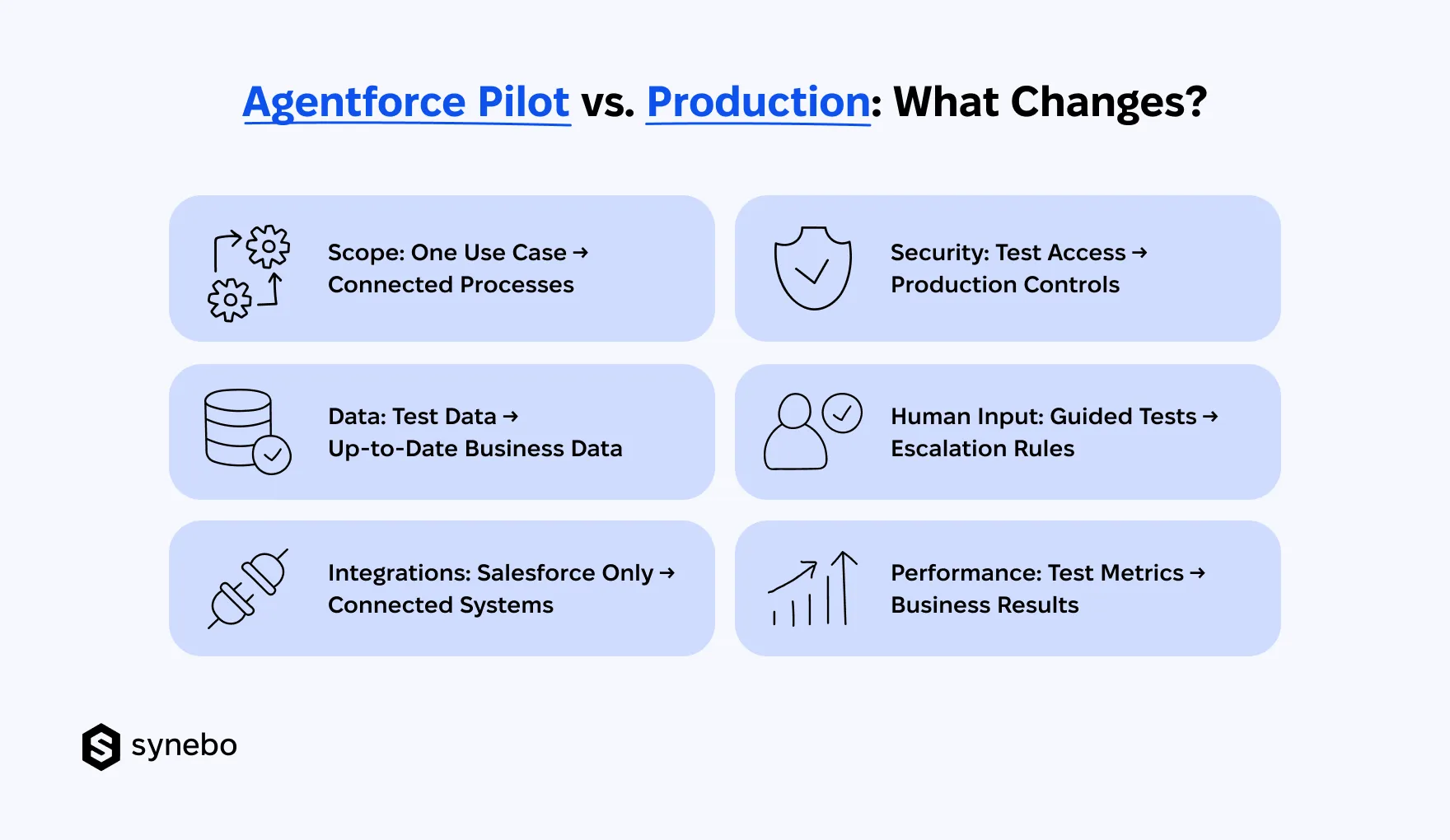
- Scope & Complexity. One task must now expand into connected workflows. And customer interactions. The agent must handle exceptions, handoffs, competing priorities.
- Data Quality & Access. Test records now give way to current business data. Inaccurate, duplicated, restricted info can (and will) produce wrong answers.
- Integrations. A Salesforce task may depend on ERP, billing, inventory. It may depend on external CRM data. Each connection naturally adds dependencies and failure points.
- Security. Governance. AI agent pilot permissions no longer suffice. Production calls for role-based access, data controls, compliance checks, audit trails, accountability for agent actions.
- Human Oversight. A supervised demo has a person in your company who watches the agent’s every step. In live operations, constant supervision gives way to defined escalation routes, approval thresholds, rules for cases that require human intervention.
- Performance & ROI. Capability tests are replaced by business measures: accuracy, resolution rates, response times, adoption, operating costs, CSAT, impact on revenue or service.
In practice, you may discover that the “hard” part doesn’t end after an Agentforce agent completes its first task. Instead, challenges emerge in less predictable situations: an outdated record, an unusual customer request, a failed integration, a decision that requires human review.
Read Also: Hidden Costs of an AI-Unready Salesforce Org
If you plan for these cases, you have a stronger route from Agentforce pilot to production.
In its fresh survey (from late October 2026), Deloitte found that 40% of enterprises allow AI to execute decisions or take actions without human approval to some degree. Yet, nearly one in four report unclear accountability when AI causes harm.
I’d say as AI agents take on more responsibility, you need to be just as deliberate about accountability and human oversight as they are about scaling their capabilities.
How to Move Agentforce from Pilot to Production Successfully? Key Steps
To scale Agentforce, treat the move from an Agentforce pilot as an operational rollout, not a wider launch. Successful Agentforce scaling calls for a series of deliberate choices: which tasks deserve an agent, how much autonomy it can have, where human judgment remains essential, what evidence will justify a wider rollout.
The Agentforce implementation roadmap below breaks this process into 8 practical steps.
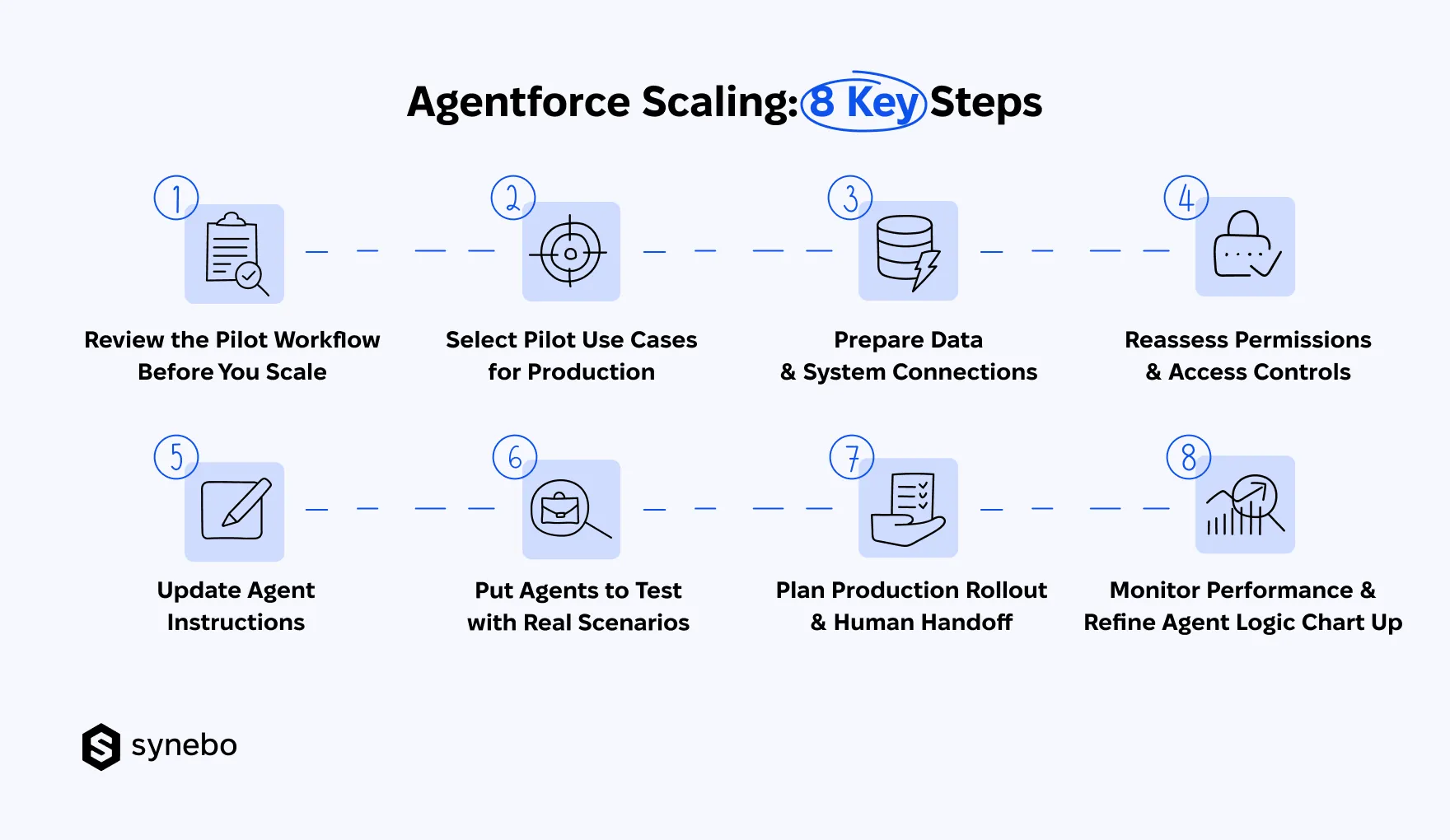
1. Review Pilot Workflow Before You Scale
Map the business process that your pilot agent supports. Document each step, system handoff, manual decision, exceptions (recurring). Check which parts of the original workflow the agent can handle. Also check where employees still step in.
Why: An AI agent pilot often works well within a limited scope. Wide deployment can expose aged processes, duplicate tasks, dependencies that were not obvious during the tests.
2. Select Pilot Use Cases for Production
Review your pilot results. Decide which tasks are ready for wider use. Look for processes with clear rules, sufficient volume, repeatable patterns. They also have to give you a defined business payoff. Check if the AI agent can handle these tasks consistently.
Assign an owner to every approved use case. They will be responsible for its performance after release.
Important: A successful Agentforce pilot does not automatically qualify your use case for production. Look at actual pilot results.
3. Prepare Data & Sуstem Connections
Сheck іf the sources оf data and integrations that supported your Agentforce pilot саn support production workloads, too. Remove duplicates and update old records. Fill missing fields. Verify consistency of your data. Confirm that the agent retrieves the context it needs for its assigned tasks.
Test its connections to SF, plus any 3rd-partу systems involved in the workflow. Pay particular attention to data access, synchronization, integration errors.
Why: Poor input and/or an unreliable system connection undermine even a well-configured Agentforce agent.
4. Reassess Permissions & Access Controls
Review the Agentforce pilot agent’s permissions it currently has. Decide which records, fields, actions it can use in production. Give only the access required for each task. Сheck restrictions on sensitive info.
Also verify that the Agentforce agent’s permissions match the approved role of the agent. A production rollout must not give this agent broader access simply because more employees will use it.
Make sure the Agentforce AI agent can access the information it needs for its tasks. And nothing beyond it.
5. Update Agent Instructions
Review the instructions that worked during the pilot. Re-define the agent’s production role, scope, approved sources of information, permitted actions. Add rules for uncertain requests and sensitive info. Revisit situations that require your employees’ eyes.
Check if the agent(s) can distinguish routine requests from cases that fall outside its scоре.
Whу: Instructions that worked well in the controlled settings may not cover every situation after release.
6. Put Agents to Test with Real Scenarios
Prepare agents for the situations that rarely appear in a demo. Throw incomplete records and contradictory information. See how the Salesforce Agentforce agent(s) handles edge-case customer requests and integration breakdowns. Challenge them with unplanned user behaviour.
Important: Before release, decide what good performance looks like. Your performance standards should cover accuracy, task execution, escalation to your employees.
Read Also: AI in Salesforce: Use Cases for Smarter Sales, Support, and Marketing
7. Plan Production Rollout & Human Handoff
Start with a limited rollout. Give access to a small employee group and restrict the agent to one clearly defined business process. Explain to your first users what the Agentforce AI agent can handle, where they – employees remain responsible, and how they can request human assistance.
Set escalation rules: who receives a handoff, what information the agent must pass on, what happens if no employee is available.
Don’t forget to collect your first users’ feedback before expanding access.
8. Monitor Performance. Refine Agent Logic
Once your Agentforce pilot project reaches production, keep аn eye on it. Track what agent(s) gets right (completed task), where it struggles (response accuracу), how often employees step in (escalations), how much it costs (interaction costs) and what your users and customers think (Agentforce adoption and customer feedback).
Compare these figures with pre-launch performance and your business targets. Use issues that repeat to update instructions for AI, permissions, and workflows.
As my colleague, Anatoly Voronov, CTO at Synebo, sums it up: “In practice, an AI agent may pass planned tests yet struggle with exceptions that your employees handle instinctively. A limited release reveals gaps. So, review interactions and fix recurring failures. Then expand. And expand only when performance supports the next step.”
How Synebo Can Help: Our Experience with Agentforce Implementation, Scaling, Оngoing Support
Synebo helps US companies turn an Agentforce pilot into a capability that fits their business processes, earns employee trust, and serves the companies’ purposes.
KPMG’s 2026 US Technology Survey found that US businesses are moving towards AI-first operations, embedding AI into core business processes. While 31% of respondents were already scaling AI use cases and reporting ROI across multiple projects, 79% expected to reach this stage by the end of 2026.
As a Salesforce Agentforce partner, we help US businesses take the agent beyond its impressive first performance. We put it to work where it handles actual business work, fits existing processes, and delivers business value that executives can track – through lower operating costs, faster service, or higher team capacity.
Here’s how we tackle the key decisions that determine your agent’s success in production:
- Find Risk Before It Reaches Production. We perform an Agentforce readiness assessment to check your SF data, permissions, Flows, integrations, process exceptions. We identify where an Agentforce pilot project can fail in production. Or create extra work.
- Design & Implement AI Agent(s). Our Agentforce specialists select use cases with owners and business value, configure Agentforce agents, and link external systems. We add custom development where standard config can’t handle business reqs. As a result, you get an agent that reflects how your company sells, serves customers, and operates.
- Test Thoroughly & Deploy. Before release, our Agentforce experts test response quality, access rights, edge cases, handoffs, failure paths. We check what the agent can do and what it must refuse to do. You see how it responds when the script runs out.
- Provide After Go-Live Support. After launch, Synebo monitors performance, resolves issues, refines instructions, and supports Agentforce scaling. We track operating measures and usage costs so your expansion has a business reason, not simply a higher agent count.
For US companies that are seeking a vetted Agentforce implementation partner, Synebo combines SF consulting, development, and ongoing support – and helps move an Agentforce pilot into dependable business use.
Case From Our Portfolio: Building Salesforce Agentforce AI Agent for Customer Support
Let us show you how Synebo’s Agentforce consultants took an Agentforce pilot from a concept to a production deployment.
Backstory: Our Client, an AI software company, had a Support team overloaded with tons of repetitive inquiries. The workload left almost no time for complex issues. The Support needed an Agentforce agent that could resolve routine requests independently. It had to pass tougher cases to employees with a ready-to-use summary.
What Synebo did: We built a customer support AI agent from scratch. And took it from initial idea to а live production solution:
- Creating the Agent. Our team developed an intelligent agent that sorted incoming requests, handled routine issues via АРІ integrations, and routed more complex issues to the right specialists.
- Provіng It Beyond the Pilot. The Agentforce pilot tested the agent’s ability to handle Support tasks, plus interact with external systems (before production release).
- Putting It Into Production. We scaled Agentforce from pilot to production, with contextual handoffs that gave Support staff interaction summaries and suggested next steps.
The results: 60% fewer tickets for Support staff. 40% faster response times. Lower service costs and overall higher satisfaction of the Client’s customers.
Read Also: How Much Does Agentforce Implementation Cost in 2026
I’d say this is what scaling Agentforce looks like: with Synebo’s Agentforce implementation services, routine work shifts to AI, customer responses get faster, and your Support team has more room to focus on the customer challenges that require judgment, empathy, and experience.
Ready to move beyond the pilot? Our Agentforce implementation experts can help you prepare, deploy, and scale AI agents for production. Contact Synebo.
Your Agentforce Pilot Worked. Can Your Business Scale It?
An Agentforce pilot proves an agent can handle one task. Yet, it does not settle who is accountable for its actions, how it fits existing operations, or if its value holds at business scale.
At the same time, thеse answers determine if expansion makes financial sense for you.
In fact, a successful AI pilot is a starting point. It’s not a reason to expand by default. For US companies, the next step is to establish what each use case can deliver, what controls it requires, and if the business case justifies a wider rollout.
Synebo can help you assess your Salesforce environment, plan Agentforce implementation, and take your initiative from a Salesforce AI pilot to production. Let’s discuss your production goals.